


2026 Realistic Free4Dump Databricks-Generative-AI-Engineer-Associate Dumps PDF - 100% Passing Guarantee
Free Databricks Databricks-Generative-AI-Engineer-Associate Exam Questions and Answer
NEW QUESTION # 37
A Generative AI Engineer is creating an agent-based LLM system for their favorite monster truck team. The system can answer text based questions about the monster truck team, lookup event dates via an API call, or query tables on the team's latest standings.
How could the Generative AI Engineer best design these capabilities into their system?
- A. Ingest PDF documents about the monster truck team into a vector store and query it in a RAG architecture.
- B. Write a system prompt for the agent listing available tools and bundle it into an agent system that runs a number of calls to solve a query.
- C. Build a system prompt with all possible event dates and table information in the system prompt. Use a RAG architecture to lookup generic text questions and otherwise leverage the information in the system prompt.
- D. Instruct the LLM to respond with "RAG", "API", or "TABLE" depending on the query, then use text parsing and conditional statements to resolve the query.
Answer: B
Explanation:
In this scenario, the Generative AI Engineer needs to design a system that can handle different types of queries about the monster truck team. The queries may involve text-based information, API lookups for event dates, or table queries for standings. The best solution is to implement atool-based agent system.
Here's how option B works, and why it's the most appropriate answer:
* System Design Using Agent-Based Model:In modern agent-based LLM systems, you can design a system where the LLM (Large Language Model) acts as a central orchestrator. The model can "decide" which tools to use based on the query. These tools can include API calls, table lookups, or natural language searches. The system should contain asystem promptthat informs the LLM about the available tools.
* System Prompt Listing Tools:By creating a well-craftedsystem prompt, the LLM knows which tools are at its disposal. For instance, one tool may query an external API for event dates, another might look up standings in a database, and a third may involve searching a vector database for general text-based information. Theagentwill be responsible for calling the appropriate tool depending on the query.
* Agent Orchestration of Calls:The agent system is designed to execute a series of steps based on the incoming query. If a user asks for the next event date, the system will recognize this as a task that requires an API call. If the user asks about standings, the agent might query the appropriate table in the database. For text-based questions, it may call a search function over ingested data. The agent orchestrates this entire process, ensuring the LLM makes calls to the right resources dynamically.
* Generative AI Tools and Context:This is a standard architecture for integrating multiple functionalities into a system where each query requires different actions. The core design in option B is efficient because it keeps the system modular and dynamic by leveraging tools rather than overloading the LLM with static information in a system prompt (like option D).
* Why Other Options Are Less Suitable:
* A (RAG Architecture): While relevant, simply ingesting PDFs into a vector store only helps with text-based retrieval. It wouldn't help with API lookups or table queries.
* C (Conditional Logic with RAG/API/TABLE): Although this approach works, it relies heavily on manual text parsing and might introduce complexity when scaling the system.
* D (System Prompt with Event Dates and Standings): Hardcoding dates and table information into a system prompt isn't scalable. As the standings or events change, the system would need constant updating, making it inefficient.
By bundling multiple tools into a single agent-based system (as in option B), the Generative AI Engineer can best handle the diverse requirements of this system.
NEW QUESTION # 38
A Generative Al Engineer is creating an LLM system that will retrieve news articles from the year 1918 and related to a user's query and summarize them. The engineer has noticed that the summaries are generated well but often also include an explanation of how the summary was generated, which is undesirable.
Which change could the Generative Al Engineer perform to mitigate this issue?
- A. Split the LLM output by newline characters to truncate away the summarization explanation.
- B. Provide few shot examples of desired output format to the system and/or user prompt.
- C. Tune the chunk size of news articles or experiment with different embedding models.
- D. Revisit their document ingestion logic, ensuring that the news articles are being ingested properly.
Answer: B
Explanation:
To mitigate the issue of the LLM including explanations of how summaries are generated in its output, the best approach is to adjust the training or prompt structure. Here's why Option D is effective:
* Few-shot Learning: By providing specific examples of how the desired output should look (i.e., just the summary without explanation), the model learns the preferred format. This few-shot learning approach helps the model understand not only what content to generate but also how to format its responses.
* Prompt Engineering: Adjusting the user prompt to specify the desired output format clearly can guide the LLM to produce summaries without additional explanatory text. Effective prompt design is crucial in controlling the behavior of generative models.
Why Other Options Are Less Suitable:
* A: While technically feasible, splitting the output by newline and truncating could lead to loss of important content or create awkward breaks in the summary.
* B: Tuning chunk sizes or changing embedding models does not directly address the issue of the model's tendency to generate explanations along with summaries.
* C: Revisiting document ingestion logic ensures accurate source data but does not influence how the model formats its output.
By using few-shot examples and refining the prompt, the engineer directly influences the output format, making this approach the most targeted and effective solution.
NEW QUESTION # 39
A Generative AI Engineer is tasked with deploying an application that takes advantage of a custom MLflow Pyfunc model to return some interim results.
How should they configure the endpoint to pass the secrets and credentials?
- A. Use spark.conf.set ()
- B. Pass variables using the Databricks Feature Store API
- C. Add credentials using environment variables
- D. Pass the secrets in plain text
Answer: C
Explanation:
Context: Deploying an application that uses an MLflow Pyfunc model involves managing sensitive information such as secrets and credentials securely.
Explanation of Options:
* Option A: Use spark.conf.set(): While this method can pass configurations within Spark jobs, using it for secrets is not recommended because it may expose them in logs or Spark UI.
* Option B: Pass variables using the Databricks Feature Store API: The Feature Store API is designed for managing features for machine learning, not for handling secrets or credentials.
* Option C: Add credentials using environment variables: This is a common practice for managing credentials in a secure manner, as environment variables can be accessed securely by applications without exposing them in the codebase.
* Option D: Pass the secrets in plain text: This is highly insecure and not recommended, as it exposes sensitive information directly in the code.
Therefore,Option Cis the best method for securely passing secrets and credentials to an application, protecting them from exposure.
NEW QUESTION # 40
A Generative Al Engineer is tasked with improving the RAG quality by addressing its inflammatory outputs.
Which action would be most effective in mitigating the problem of offensive text outputs?
- A. Increase the frequency of upstream data updates
- B. Curate upstream data properly that includes manual review before it is fed into the RAG system
- C. Inform the user of the expected RAG behavior
- D. Restrict access to the data sources to a limited number of users
Answer: B
Explanation:
Addressing offensive or inflammatory outputs in a Retrieval-Augmented Generation (RAG) system is critical for improving user experience and ensuring ethical AI deployment. Here's whyDis the most effective approach:
* Manual data curation: The root cause of offensive outputs often comes from the underlying data used to train the model or populate the retrieval system. By manually curating the upstream data and conducting thorough reviews before the data is fed into the RAG system, the engineer can filter out harmful, offensive, or inappropriate content.
* Improving data quality: Curating data ensures the system retrieves and generates responses from a high-quality, well-vetted dataset. This directly impacts the relevance and appropriateness of the outputs from the RAG system, preventing inflammatory content from being included in responses.
* Effectiveness: This strategy directly tackles the problem at its source (the data) rather than just mitigating the consequences (such as informing users or restricting access). It ensures that the system consistently provides non-offensive, relevant information.
Other options, such as increasing the frequency of data updates or informing users about behavior expectations, may not directly mitigate the generation of inflammatory outputs.
NEW QUESTION # 41
What is the most suitable library for building a multi-step LLM-based workflow?
- A. Pandas
- B. LangChain
- C. PySpark
- D. TensorFlow
Answer: B
Explanation:
* Problem Context: The Generative AI Engineer needs a tool to build amulti-step LLM-based workflow. This type of workflow often involves chaining multiple steps together, such as query generation, retrieval of information, response generation, and post-processing, with LLMs integrated at several points.
* Explanation of Options:
* Option A: Pandas: Pandas is a powerful data manipulation library for structured data analysis, but it is not designed for managing or orchestrating multi-step workflows, especially those involving LLMs.
* Option B: TensorFlow: TensorFlow is primarily used for training and deploying machine learning models, especially deep learning models. It is not designed for orchestrating multi-step tasks in LLM-based workflows.
* Option C: PySpark: PySpark is a distributed computing framework used for large-scale data processing. While useful for handling big data, it is not specialized for chaining LLM-based operations.
* Option D: LangChain: LangChain is a purpose-built framework designed specifically for orchestrating multi-step workflowswith large language models (LLMs). It enables developers to easily chain different tasks, such as retrieving documents, summarizing information, and generating responses, all in a structured flow. This makes it the best tool for building complex LLM-based workflows.
Thus,LangChainis the most suitable library for creating multi-step LLM-based workflows.
NEW QUESTION # 42
A Generative Al Engineer is building a system that will answer questions on currently unfolding news topics.
As such, it pulls information from a variety of sources including articles and social media posts. They are concerned about toxic posts on social media causing toxic outputs from their system.
Which guardrail will limit toxic outputs?
- A. Implement rate limiting
- B. Reduce the amount of context Items the system will Include in consideration for its response.
- C. Use only approved social media and news accounts to prevent unexpected toxic data from getting to the LLM.
- D. Log all LLM system responses and perform a batch toxicity analysis monthly.
Answer: C
Explanation:
The system answers questions on unfolding news topics using articles and social media, with a concern about toxic outputs from toxic inputs. A guardrail must limit toxicity in the LLM's responses. Let's evaluate the options.
* Option A: Use only approved social media and news accounts to prevent unexpected toxic data from getting to the LLM
* Curating input sources (e.g., verified accounts) reduces exposure to toxic content at the data ingestion stage, directly limiting toxic outputs. This is a proactive guardrail aligned with data quality control.
* Databricks Reference:"Control input data quality to mitigate unwanted LLM behavior, such as toxicity"("Building LLM Applications with Databricks," 2023).
* Option B: Implement rate limiting
* Rate limiting controls request frequency, not content quality. It prevents overload but doesn't address toxicity in social media inputs or outputs.
* Databricks Reference: Rate limiting is for performance, not safety:"Use rate limits to manage compute load"("Generative AI Cookbook").
* Option C: Reduce the amount of context items the system will include in consideration for its response
* Reducing context might limit exposure to some toxic items but risks losing relevant information, and it doesn't specifically target toxicity. It's an indirect, imprecise fix.
* Databricks Reference: Context reduction is for efficiency, not safety:"Adjust context size based on performance needs"("Databricks Generative AI Engineer Guide").
* Option D: Log all LLM system responses and perform a batch toxicity analysis monthly
* Logging and analyzing responses is reactive, identifying toxicity after it occurs rather than preventing it. Monthly analysis doesn't limit real-time toxic outputs.
* Databricks Reference: Monitoring is for auditing, not prevention:"Log outputs for post-hoc analysis, but use input filters for safety"("Building LLM-Powered Applications").
Conclusion: Option A is the most effective guardrail, proactively filtering toxic inputs from unverified sources, which aligns with Databricks' emphasis on data quality as a primary safety mechanism for LLM systems.
NEW QUESTION # 43
A Generative Al Engineer has already trained an LLM on Databricks and it is now ready to be deployed.
Which of the following steps correctly outlines the easiest process for deploying a model on Databricks?
- A. Wrap the LLM's prediction function into a Flask application and serve using Gunicorn
- B. Log the model using MLflow during training, directly register the model to Unity Catalog using the MLflow API, and start a serving endpoint
- C. Save the model along with its dependencies in a local directory, build the Docker image, and run the Docker container
- D. Log the model as a pickle object, upload the object to Unity Catalog Volume, register it to Unity Catalog using MLflow, and start a serving endpoint
Answer: B
NEW QUESTION # 44
A Generative AI Engineer I using the code below to test setting up a vector store: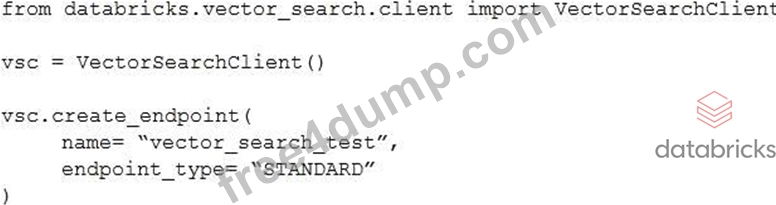
Assuming they intend to use Databricks managed embeddings with the default embedding model, what should be the next logical function call?
- A. vsc.similarity_search()
- B. vsc.get_index()
- C. vsc.create_delta_sync_index()
- D. vsc.create_direct_access_index()
Answer: C
Explanation:
Context: The Generative AI Engineer is setting up a vector store using Databricks' VectorSearchClient. This is typically done to enable fast and efficient retrieval of vectorized data for tasks like similarity searches.
Explanation of Options:
* Option A: vsc.get_index(): This function would be used to retrieve an existing index, not create one, so it would not be the logical next step immediately after creating an endpoint.
* Option B: vsc.create_delta_sync_index(): After setting up a vector store endpoint, creating an index is necessary to start populating and organizing the data. The create_delta_sync_index() function specifically creates an index that synchronizes with a Delta table, allowing automatic updates as the data changes. This is likely the most appropriate choice if the engineer plans to use dynamic data that is updated over time.
* Option C: vsc.create_direct_access_index(): This function would create an index that directly accesses the data without synchronization. While also a valid approach, it's less likely to be the next logical step if the default setup (typically accommodating changes) is intended.
* Option D: vsc.similarity_search(): This function would be used to perform searches on an existing index; however, an index needs to be created and populated with data before any search can be conducted.
Given the typical workflow in setting up a vector store, the next step after creating an endpoint is to establish an index, particularly one that synchronizes with ongoing data updates, henceOption B.
NEW QUESTION # 45
A Generative AI Engineer I using the code below to test setting up a vector store: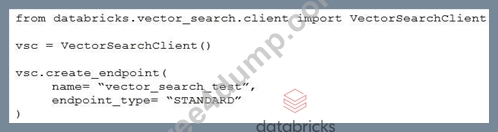
Assuming they intend to use Databricks managed embeddings with the default embedding model, what should be the next logical function call?
- A. vsc.similarity_search()
- B. vsc.get_index()
- C. vsc.create_delta_sync_index()
- D. vsc.create_direct_access_index()
Answer: C
Explanation:
Context: The Generative AI Engineer is setting up a vector store using Databricks' VectorSearchClient. This is typically done to enable fast and efficient retrieval of vectorized data for tasks like similarity searches.
Explanation of Options:
* Option A: vsc.get_index(): This function would be used to retrieve an existing index, not create one, so it would not be the logical next step immediately after creating an endpoint.
* Option B: vsc.create_delta_sync_index(): After setting up a vector store endpoint, creating an index is necessary to start populating and organizing the data. The create_delta_sync_index() function specifically creates an index that synchronizes with a Delta table, allowing automatic updates as the data changes. This is likely the most appropriate choice if the engineer plans to use dynamic data that is updated over time.
* Option C: vsc.create_direct_access_index(): This function would create an index that directly accesses the data without synchronization. While also a valid approach, it's less likely to be the next logical step if the default setup (typically accommodating changes) is intended.
* Option D: vsc.similarity_search(): This function would be used to perform searches on an existing index; however, an index needs to be created and populated with data before any search can be conducted.
Given the typical workflow in setting up a vector store, the next step after creating an endpoint is to establish an index, particularly one that synchronizes with ongoing data updates, henceOption B.
NEW QUESTION # 46
A Generative AI Engineer is designing a RAG application for answering user questions on technical regulations as they learn a new sport.
What are the steps needed to build this RAG application and deploy it?
- A. Ingest documents from a source -> Index the documents and save to Vector Search -> Evaluate model -
> Deploy it using Model Serving - B. Ingest documents from a source -> Index the documents and save to Vector Search -> User submits queries against an LLM -> LLM retrieves relevant documents -> LLM generates a response -> Evaluate model -> Deploy it using Model Serving
- C. User submits queries against an LLM -> Ingest documents from a source -> Index the documents and save to Vector Search -> LLM retrieves relevant documents -> LLM generates a response -> Evaluate model -> Deploy it using Model Serving
- D. Ingest documents from a source -> Index the documents and saves to Vector Search -> User submits queries against an LLM -> LLM retrieves relevant documents -> Evaluate model -> LLM generates a response -> Deploy it using Model Serving
Answer: B
Explanation:
The Generative AI Engineer needs to follow a methodical pipeline to build and deploy a Retrieval- Augmented Generation (RAG) application. The steps outlined in optionBaccurately reflect this process:
* Ingest documents from a source: This is the first step, where the engineer collects documents (e.g., technical regulations) that will be used for retrieval when the application answers user questions.
* Index the documents and save to Vector Search: Once the documents are ingested, they need to be embedded using a technique like embeddings (e.g., with a pre-trained model like BERT) and stored in a vector database (such as Pinecone or FAISS). This enables fast retrieval based on user queries.
* User submits queries against an LLM: Users interact with the application by submitting their queries.
These queries will be passed to the LLM.
* LLM retrieves relevant documents: The LLM works with the vector store to retrieve the most relevant documents based on their vector representations.
* LLM generates a response: Using the retrieved documents, the LLM generates a response that is tailored to the user's question.
* Evaluate model: After generating responses, the system must be evaluated to ensure the retrieved documents are relevant and the generated response is accurate. Metrics such as accuracy, relevance, and user satisfaction can be used for evaluation.
* Deploy it using Model Serving: Once the RAG pipeline is ready and evaluated, it is deployed using a model-serving platform such as Databricks Model Serving. This enables real-time inference and response generation for users.
By following these steps, the Generative AI Engineer ensures that the RAG application is both efficient and effective for the task of answering technical regulation questions.
NEW QUESTION # 47
A company has a typical RAG-enabled, customer-facing chatbot on its website.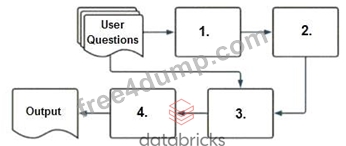
Select the correct sequence of components a user's questions will go through before the final output is returned. Use the diagram above for reference.
- A. 1.embedding model, 2.vector search, 3.context-augmented prompt, 4.response-generating LLM
- B. 1.context-augmented prompt, 2.vector search, 3.embedding model, 4.response-generating LLM
- C. 1.response-generating LLM, 2.context-augmented prompt, 3.vector search, 4.embedding model
- D. 1.response-generating LLM, 2.vector search, 3.context-augmented prompt, 4.embedding model
Answer: A
Explanation:
To understand how a typical RAG-enabled customer-facing chatbot processes a user's question, let's go through the correct sequence as depicted in the diagram and explained in option A:
* Embedding Model (1):The first step involves the user's question being processed through an embedding model. This model converts the text into a vector format that numerically represents the text. This step is essential for allowing the subsequent vector search to operate effectively.
* Vector Search (2):The vectors generated by the embedding model are then used in a vector search mechanism. This search identifies the most relevant documents or previously answered questions that are stored in a vector format in a database.
* Context-Augmented Prompt (3):The information retrieved from the vector search is used to create a context-augmented prompt. This step involves enhancing the basic user query with additional relevant information gathered to ensure the generated response is as accurate and informative as possible.
* Response-Generating LLM (4):Finally, the context-augmented prompt is fed into a response- generating large language model (LLM). This LLM uses the prompt to generate a coherent and contextually appropriate answer, which is then delivered as the final output to the user.
Why Other Options Are Less Suitable:
* B, C, D: These options suggest incorrect sequences that do not align with how a RAG system typically processes queries. They misplace the role of embedding models, vector search, and response generation in an order that would not facilitate effective information retrieval and response generation.
Thus, the correct sequence isembedding model, vector search, context-augmented prompt, response- generating LLM, which is option A.
NEW QUESTION # 48
What is an effective method to preprocess prompts using custom code before sending them to an LLM?
- A. It is better not to introduce custom code to preprocess prompts as the LLM has not been trained with examples of the preprocessed prompts
- B. Write a MLflow PyFunc model that has a separate function to process the prompts
- C. Directly modify the LLM's internal architecture to include preprocessing steps
- D. Rather than preprocessing prompts, it's more effective to postprocess the LLM outputs to align the outputs to desired outcomes
Answer: B
Explanation:
The most effective way to preprocess prompts using custom code is to write a custom model, such as an MLflow PyFunc model. Here's a breakdown of why this is the correct approach:
* MLflow PyFunc Models:MLflow is a widely used platform for managing the machine learning lifecycle, including experimentation, reproducibility, and deployment. APyFuncmodel is a generic Python function model that can implement custom logic, which includes preprocessing prompts.
* Preprocessing Prompts:Preprocessing could include various tasks like cleaning up the user input, formatting it according to specific rules, or augmenting it with additional context before passing it to the LLM. Writing this preprocessing as part of a PyFunc model allows the custom code to be managed, tested, and deployed easily.
* Modular and Reusable:By separating the preprocessing logic into a PyFunc model, the system becomes modular, making it easier to maintain and update without needing to modify the core LLM or retrain it.
* Why Other Options Are Less Suitable:
* A (Modify LLM's Internal Architecture): Directly modifying the LLM's architecture is highly impractical and can disrupt the model's performance. LLMs are typically treated as black-box models for tasks like prompt processing.
* B (Avoid Custom Code): While it's true that LLMs haven't been explicitly trained with preprocessed prompts, preprocessing can still improve clarity and alignment with desired input formats without confusing the model.
* C (Postprocessing Outputs): While postprocessing the output can be useful, it doesn't address the need for clean and well-formatted inputs, which directly affect the quality of the model's responses.
Thus, using an MLflow PyFunc model allows for flexible and controlled preprocessing of prompts in a scalable way, making it the most effective method.
NEW QUESTION # 49
A small and cost-conscious startup in the cancer research field wants to build a RAG application using Foundation Model APIs.
Which strategy would allow the startup to build a good-quality RAG application while being cost-conscious and able to cater to customer needs?
- A. Limit the number of queries a customer can send per day
- B. Use the largest LLM possible because that gives the best performance for any general queries
- C. Limit the number of relevant documents available for the RAG application to retrieve from
- D. Pick a smaller LLM that is domain-specific
Answer: D
Explanation:
For a small, cost-conscious startup in the cancer research field, choosing a domain-specific and smaller LLM is the most effective strategy. Here's whyBis the best choice:
* Domain-specific performance: A smaller LLM that has been fine-tuned for the domain of cancer research will outperform a general-purpose LLM for specialized queries. This ensures high-quality responses without needing to rely on a large, expensive LLM.
* Cost-efficiency: Smaller models are cheaper to run, both in terms of compute resources and API usage costs. A domain-specific smaller LLM can deliver good quality responses without the need for the extensive computational power required by larger models.
* Focused knowledge: In a specialized field like cancer research, having an LLM tailored to the subject matter provides better relevance and accuracy for queries, while keeping costs low.Large, general- purpose LLMs may provide irrelevant information, leading to inefficiency and higher costs.
This approach allows the startup to balance quality, cost, and customer satisfaction effectively, making it the most suitable strategy.
NEW QUESTION # 50
A Generative Al Engineer is helping a cinema extend its website's chat bot to be able to respond to questions about specific showtimes for movies currently playing at their local theater. They already have the location of the user provided by location services to their agent, and a Delta table which is continually updated with the latest showtime information by location. They want to implement this new capability In their RAG application.
Which option will do this with the least effort and in the most performant way?
- A. implementation. Write the Delta table contents to a text column.then embed those texts using an embedding model and store these in the vector index Look up the information based on the embedding as part of the agent logic / tool implementation.
- B. Create a Feature Serving Endpoint from a FeatureSpec that references an online store synced from the Delta table. Query the Feature Serving Endpoint as part of the agent logic / tool implementation.
- C. Set up a task in Databricks Workflows to write the information in the Delta table periodically to an external database such as MySQL and query the information from there as part of the agent logic / tool implementation.
- D. Query the Delta table directly via a SQL query constructed from the user's input using a text-to-SQL LLM in the agent logic / tool
Answer: B
Explanation:
The task is to extend a cinema chatbot to provide movie showtime information using a RAG application, leveraging user location and a continuously updated Delta table, with minimal effort and high performance.
Let's evaluate the options.
* Option A: Create a Feature Serving Endpoint from a FeatureSpec that references an online store synced from the Delta table. Query the Feature Serving Endpoint as part of the agent logic / tool implementation
* Databricks Feature Serving provides low-latency access to real-time data from Delta tables via an online store. Syncing the Delta table to a Feature Serving Endpoint allows the chatbot to query showtimes efficiently, integrating seamlessly into the RAG agent'stool logic. This leverages Databricks' native infrastructure, minimizing effort and ensuring performance.
* Databricks Reference:"Feature Serving Endpoints provide real-time access to Delta table data with low latency, ideal for production systems"("Databricks Feature Engineering Guide," 2023).
* Option B: Query the Delta table directly via a SQL query constructed from the user's input using a text-to-SQL LLM in the agent logic / tool
* Using a text-to-SQL LLM to generate queries adds complexity (e.g., ensuring accurate SQL generation) and latency (LLM inference + SQL execution). While feasible, it's less performant and requires more effort than a pre-built serving solution.
* Databricks Reference:"Direct SQL queries are flexible but may introduce overhead in real-time applications"("Building LLM Applications with Databricks").
* Option C: Write the Delta table contents to a text column, then embed those texts using an embedding model and store these in the vector index. Look up the information based on the embedding as part of the agent logic / tool implementation
* Converting structured Delta table data (e.g., showtimes) into text, embedding it, and using vector search is inefficient for structured lookups. It's effort-intensive (preprocessing, embedding) and less precise than direct queries, undermining performance.
* Databricks Reference:"Vector search excels for unstructured data, not structured tabular lookups"("Databricks Vector Search Documentation").
* Option D: Set up a task in Databricks Workflows to write the information in the Delta table periodically to an external database such as MySQL and query the information from there as part of the agent logic / tool implementation
* Exporting to an external database (e.g., MySQL) adds setup effort (workflow, external DB management) and latency (periodic updates vs. real-time). It's less performant and more complex than using Databricks' native tools.
* Databricks Reference:"Avoid external systems when Delta tables provide real-time data natively"("Databricks Workflows Guide").
Conclusion: Option A minimizes effort by using Databricks Feature Serving for real-time, low-latency access to the Delta table, ensuring high performance in a production-ready RAG chatbot.
NEW QUESTION # 51
A Generative Al Engineer would like an LLM to generate formatted JSON from emails. This will require parsing and extracting the following information: order ID, date, and sender email. Here's a sample email: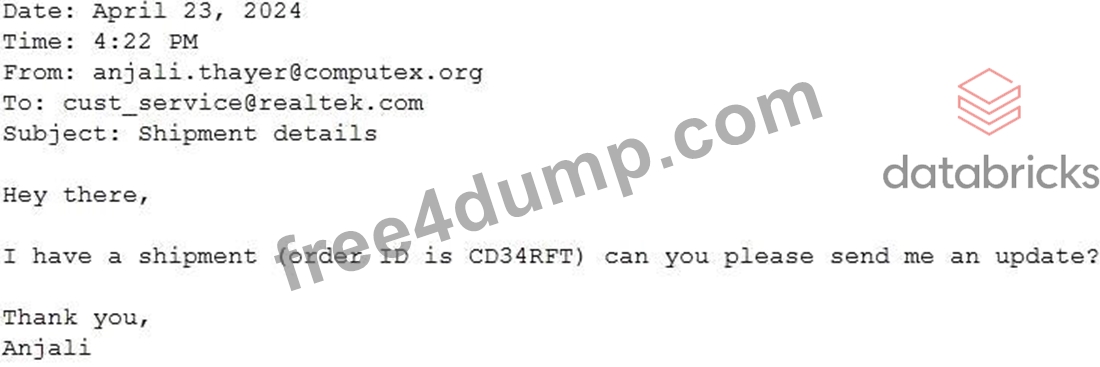
They will need to write a prompt that will extract the relevant information in JSON format with the highest level of output accuracy.
Which prompt will do that?
- A. You will receive customer emails and need to extract date, sender email, and order ID. Return the extracted information in a human-readable format.
- B. You will receive customer emails and need to extract date, sender email, and order ID. You should return the date, sender email, and order ID information in JSON format.
- C. You will receive customer emails and need to extract date, sender email, and order ID. Return the extracted information in JSON format.
- D. You will receive customer emails and need to extract date, sender email, and order ID. Return the extracted information in JSON format.
Here's an example: {"date": "April 16, 2024", "sender_email": "[email protected]", "order_id":
"RE987D"}
Answer: D
Explanation:
Problem Context: The goal is to parse emails to extract certain pieces of information and output this in a structured JSON format. Clarity and specificity in the prompt design will ensure higher accuracy in the LLM' s responses.
Explanation of Options:
* Option A: Provides a general guideline but lacks an example, which helps an LLM understand the exact format expected.
* Option B: Includes a clear instruction and a specific example of the output format. Providing an example is crucial as it helps set the pattern and format in which the information should be structured, leading to more accurate results.
* Option C: Does not specify that the output should be in JSON format, thus not meeting the requirement.
* Option D: While it correctly asks for JSON format, it lacks an example that would guide the LLM on how to structure the JSON correctly.
Therefore,Option Bis optimal as it not only specifies the required format but also illustrates it with an example, enhancing the likelihood of accurate extraction and formatting by the LLM.
NEW QUESTION # 52
......
Verified Databricks-Generative-AI-Engineer-Associate dumps Q&As Latest Databricks-Generative-AI-Engineer-Associate Download: https://www.free4dump.com/Databricks-Generative-AI-Engineer-Associate-braindumps-torrent.html
Updated 100% Cover Real Databricks-Generative-AI-Engineer-Associate Exam Questions - 100% Pass Guarantee: https://drive.google.com/open?id=1kToIPd4EeGmZZlEGVc3kOCqWc3rHJjBY