


[Dec 13, 2025] AZ-500 certification guide Q&A from Training Expert Free4Dump
AZ-500 Certification Overview Latest AZ-500 PDF Dumps
NEW QUESTION # 80
You have an Azure subscription that contains the Azure Log Analytics workspaces shown in the following table.
You create the virtual machines shown in the following table.
You plan to use Azure Sentinel to monitor Windows Defender Firewall on the virtual machines.
Which virtual machines you can connect to Azure Sentinel?
- A. VM1 and VM2 only
- B. VM1 and VM3 only
- C. VM1 Only
- D. VM1, VM2, VM3 and VM4
Answer: D
Explanation:
Reference:
https://docs.microsoft.com/en-us/azure/sentinel/connect-windows-firewall
NEW QUESTION # 81
You have an Azure subscription named Sub1 that contains the Azure key vaults shown in the following table.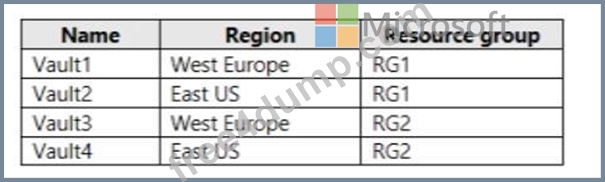
In Sub1, you create a virtual machine that has the following configurations:
* Name:VM1
* Size: DS2v2
* Resource group: RG1
* Region: West Europe
* Operating system: Windows Server 2016
You plan to enable Azure Disk Encryption on VM1.
In which key vaults can you store the encryption key for VM1?
- A. Vault1, Vault2, Vault3, or Vault4
- B. Vault1 or Vault2 only
- C. Vault1 only
- D. Vault1 or Vault3 only
Answer: B
Explanation:
Topic 1, ContosoPlease wait while the virtual machine loads. Once
loaded, you may proceed to the lab section. This may take a few
minutes, and the wait time will not be deducted from your overall
test time.
When the Next button is available, click it to access the lab section. In this section, you will perform a set of tasks in a live environment. While most functionality will be available to you as it would be in a live environment some functionality (e.g., copy and paste, ability to navigate to external websites) will not be possible by design.
Scoring is based on the outcome of performing the tasks stated in the lab. In other words, it doesn't matter how you accomplish the task, if you successfully perform it, you will earn credit for that task.
Labs are not timed separately, and this exam may have more than one lab that you must complete. You can use as much time as you would like to complete each lab. But, you should manage your time appropriately to ensure that you are able to complete the lab{s) and all Please note that once you submit your work by clicking the Next button within a lab.
Task 1:
You need to configure Azure to allow RDP connections from the Internet to a virtual machine named VM1.
The solution must minimize the attack surface of VM1.
To complete this task, sign in to the Azure portal.
Task 2:
You need to add the network interface of a virtual machine named VM1 to an application security group named ASG1.
To complete this task, sign in to the Azure portal.
Task 3:
You need to perform a full malware scan every Sunday at 02:00 on a virtual machine named VM1 by using Microsoft Antimalware for Virtual Machines.
Task 4:
The developers at your company plan to create a web app named App103178O6 and to publish the app to htlps://www.contoso.com.
You need to perform the following tasks:
* Ensure that App10317806 is registered lo Azure Active Directory (Azure AD).
* Generate a password for App10317806.
Task 5:
You need to prevent administrative users from accidentally deleting a virtual network named VNET1. The administrative users must be allowed to modify the settings of VNET1.
Task 6:
You need to ensure that a user named user2103l7806 can manage the properties of the virtual machines in the RG1lod10317806 resource group. The solution must use the principle of least privilege.
Task 7:
You need to ensure that only devices connected to a 131.107.0.0/16 subnet can access data in the railod10317806 Azure Storage account, Task 8:
You need to email an alert to a user named [email protected] if the average CPU usage of a virtual machine named VM1 is greater than 70 percent for a period of 15 minutes.
Task 9:
You need to collect all the audit failure data from the security log of a virtual machine named VM1 to an Azure Storage account.
To complete this task, sign in to the Azure portal.
This task might take several minutes to complete. You can perform other tasks while the task completes.
Task 10:
You need to prevent HTTP connections to the rg1lodl03l7806n1 Azure Storage account.
Task 11:
You need to ensure that the rg1lod10317806n1 Azure Storage account is encrypted by using a key stored in the KeyVault10317806 Azure key vault.
Task 12:
You need to create a new Azure Active Directory (Azure AD) directory named 10317806.onmicrosoft.com.
The new directory must contain a user named userl103l7806.onmicrosoft.com who is configured to sign in by using Azure Multi-Factor Authentication (MFA).
This is a case study. Case studies are not timed separately. You can use as much exam time as you would like to complete each case. However, there may be additional case studies and sections on this exam. You must manage your time to ensure that you are able to complete all questions included on this exam in the time provided.
To answer the questions included in a case study, you will need to reference information that is provided in the case study. Case studies might contain exhibits and other resources that provide more information about the scenario that is described in the case study. Each question is independent of the other question on this case study.
At the end of this case study, a review screen will appear. This screen allows you to review your answers and to make changes before you move to the next sections of the exam. After you begin a new section, you cannot return to this section.
To start the case study
To display the first question on this case study, click the Next button. Use the buttons in the left pane to explore the content of the case study before you answer the questions. Clicking these buttons displays information such as business requirements, existing environment, and problem statements. If the case study has an All Information tab, note that the information displayed is identical to the information displayed on the subsequent tabs. When you are ready to answer a question, click the Question button to return to the question.
Overview
Contoso, Ltd. is a consulting company that has a main office in Montreal and two branch offices in Seattle and New York.
The company hosts its entire server infrastructure in Azure.
Contoso has two Azure subscriptions named Sub1 and Sub2. Both subscriptions are associated to an Azure Active Directory (Azure AD) tenant named contoso.com.
Technical requirements
Contoso identifies the following technical requirements:
* Deploy Azure Firewall to VNetWork1 in Sub2.
* Register an application named App2 in contoso.com.
* Whenever possible, use the principle of least privilege.
* Enable Azure AD Privileged Identity Management (PIM) for contoso.com
Existing Environment
Azure AD
Contoso.com contains the users shown in the following table.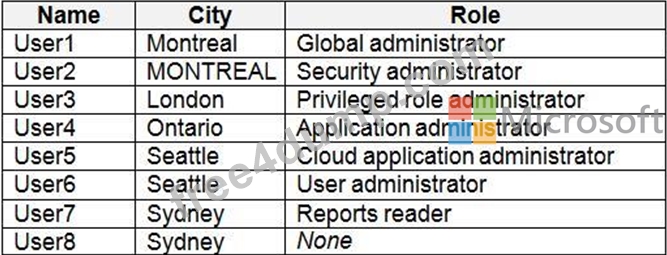
Contoso.com contains the security groups shown in the following table.
Sub1
Sub1 contains six resource groups named RG1, RG2, RG3, RG4, RG5, and RG6.
User2 creates the virtual networks shown in the following table.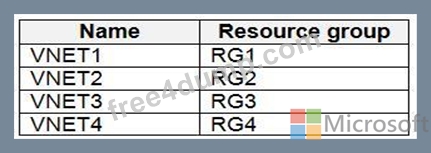
Sub1 contains the locks shown in the following table.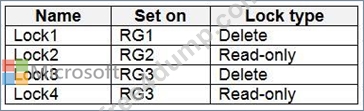
Sub1 contains the Azure policies shown in the following table.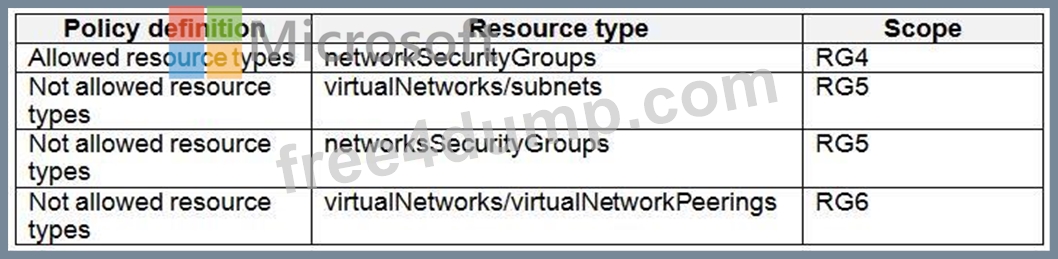
Sub2
Sub2 contains the virtual machines shown in the following table.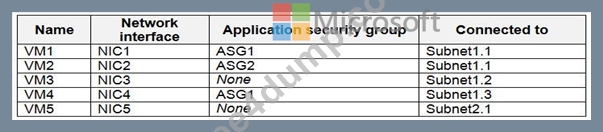
All virtual machines have the public IP addresses and the Web Server (IIS) role installed. The firewalls for each virtual machine allow ping requests and web requests.
Sub2 contains the network security groups (NSGs) shown in the following table.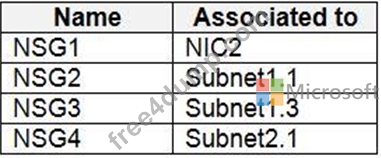
NSG1 has the inbound security rules shown in the following table.
NSG2 has the inbound security rules shown in the following table.
NSG3 has the inbound security rules shown in the following table.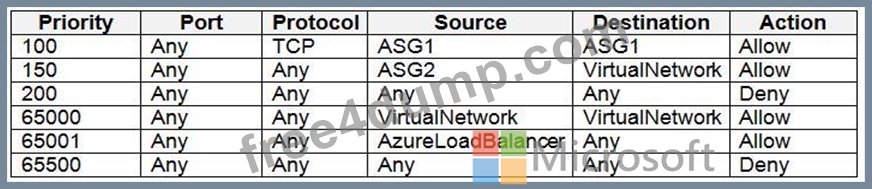
NSG4 has the inbound security rules shown in the following table.
NSG1, NSG2, NSG3, and NSG4 have the outbound security rules shown in the following table.
Contoso identifies the following technical requirements:
* Deploy Azure Firewall to VNetwork1 in Sub2.
* Register an application named App2 in contoso.com.
* Whenever possible, use the principle of least privilege.
* Enable Azure AD Privileged Identity Management (PIM) for contoso.com.
NEW QUESTION # 82
You are configuring network connectivity for two Azure virtual networks named VNET1 and VNET2.
You need to implement VPN gateways for the virtual networks to meet the following requirements:
* VNET1 must have six site-to-site connections that use BGP.
* VNET2 must have 12 site-to-site connections that use BGP.
* Costs must be minimized.
Which VPN gateway SKI) should you use for each virtual network? To answer, drag the appropriate SKUs to the correct networks. Each SKU may be used once, more than once, or not at all. You may need to drag the split bar between panes or scroll to view content.
NOTE: Each correct selection is worth one point
Answer:
Explanation:
Explanation:
References:
https://docs.microsoft.com/en-us/azure/vpn-gateway/vpn-gateway-about-vpngateways#gwsku
NEW QUESTION # 83
You have an Azure Active Directory (Azure AD) tenant that contains the users shown in the following table.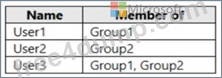
From Azure AD Privileged Identity Management (PIM), you configure the settings for the Security Administrator role as shown in the following exhibit.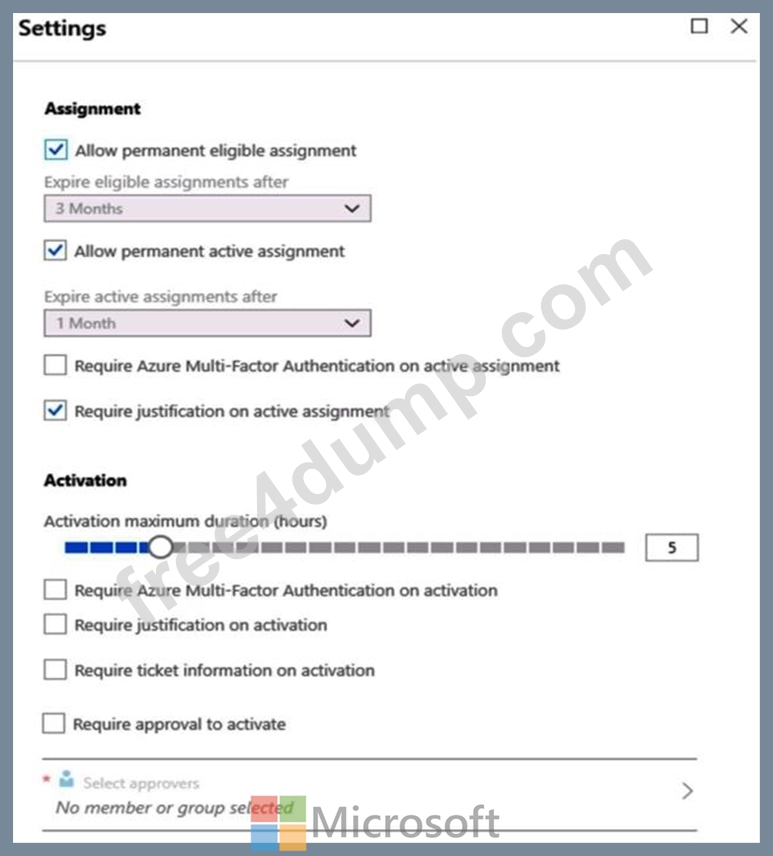
From PIM, you assign the Security Administrator role to the following groups:
Group1: Active assignment type, permanently assigned
Group2: Eligible assignment type, permanently eligible
For each of the following statements, select Yes if the statement is true. Otherwise, select No.
NOTE: Each correct selection is worth one point.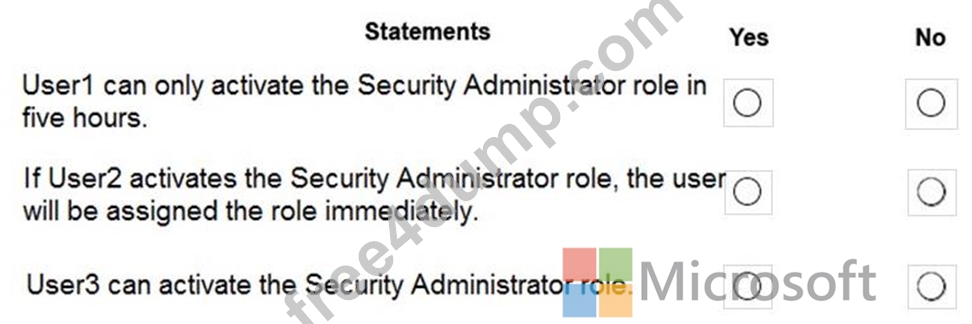
Answer:
Explanation: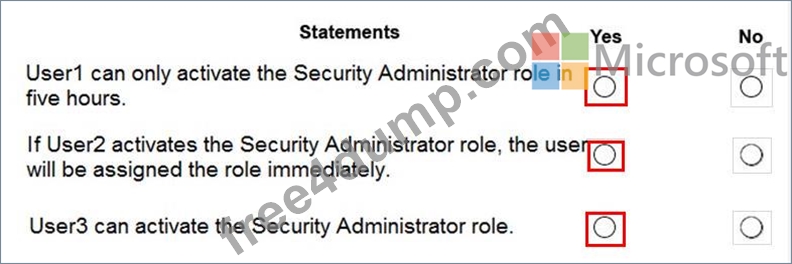
Reference:
https://docs.microsoft.com/en-us/azure/active-directory/privileged-identity-management/pim-configure
https://docs.microsoft.com/bs-cyrl-ba/azure/active-directory/privileged-identity-management/pim-resource-roles-configure-role-settings
NEW QUESTION # 84
You plan to use Azure Sentinel to create an analytic rule that will detect suspicious threats and automate responses.
Which components are required for the rule? To answer, select the appropriate options in the answer area.
NOTE: Each correct selection is worth one point.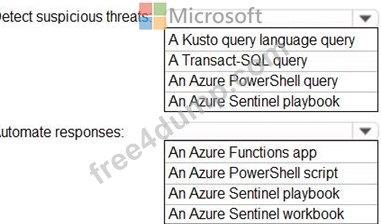
Answer:
Explanation: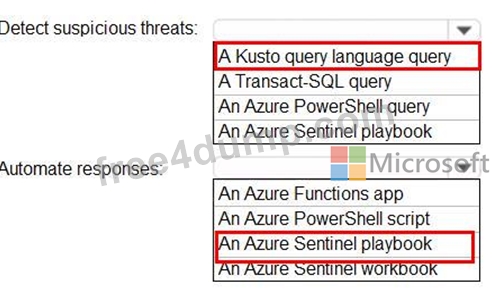
Reference:
https://docs.microsoft.com/en-us/azure/sentinel/tutorial-detect-threats-custom
https://docs.microsoft.com/en-us/azure/sentinel/tutorial-respond-threats-playbook
NEW QUESTION # 85
You have an Azure Active Directory (Azure AD) tenant named contoso.com. The tenant contains the users shown in the following table.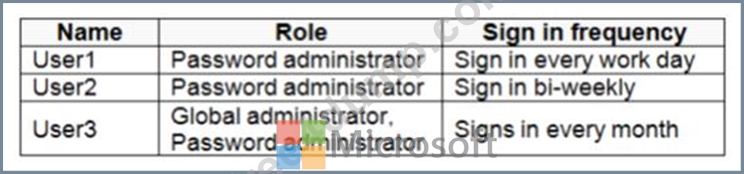
You configure an access review named Review1 as shown in the following exhibit.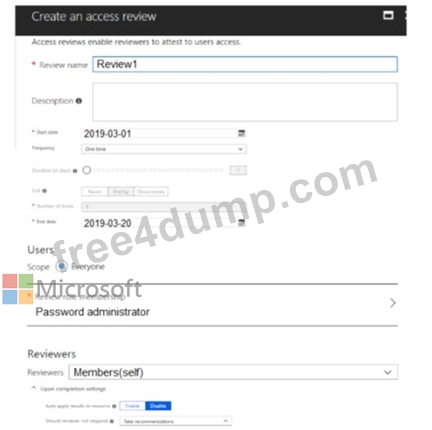
Use the drop-down menus to select the answer choice that completes each statement based on the information presented in the graphic.
NOTE: Each correct selection is worth one point.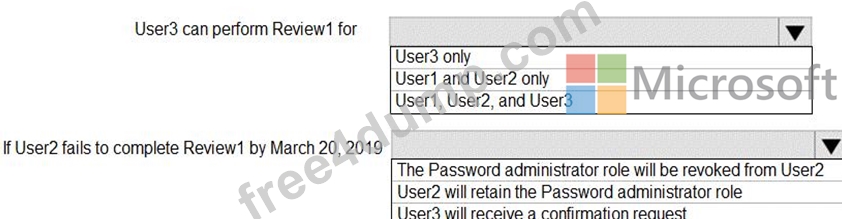
Answer:
Explanation: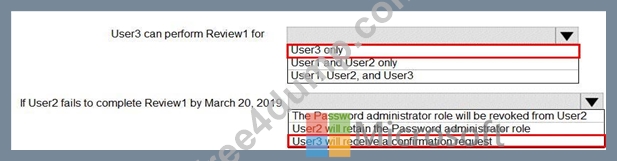
Explanation:
Box 1: User3 only
Use the Members (self) option to have the users review their own role assignments.
Box 2: User3 will receive a confirmation request
Use the Should reviewer not respond list to specify what happens for users that are not reviewed by the reviewer within the review period. This setting does not impact users who have been reviewed by the reviewers manually. If the final reviewer's decision is Deny, then the user's access will be removed.
No change - Leave user's access unchanged
Remove access - Remove user's access
Approve access - Approve user's access
Take recommendations - Take the system's recommendation on denying or approving the user's continued access References:
https://docs.microsoft.com/bs-latn-ba/azure/active-directory/privileged-identity-management/pim-how-to-start-security-review
NEW QUESTION # 86
You have an Azure Sentinel workspace that contains an Azure Active Directory (Azure AD) connector, an Azure Log Analytics query named Query1 and a playbook named Playbook1.
Query1 returns a subset of security events generated by Azure AD.
You plan to create an Azure Sentinel analytic rule based on Query1 that will trigger Playbook1.
You need to ensure that you can add Playbook1 to the new rule.
What should you do? To answer, select the appropriate options in the answer area.
NOTE: Each correct selection is worth one point.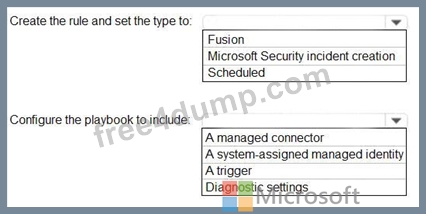
Answer:
Explanation: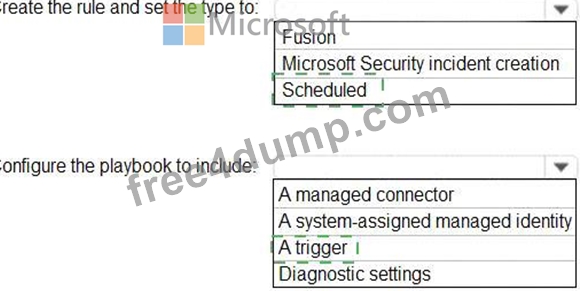
Explanation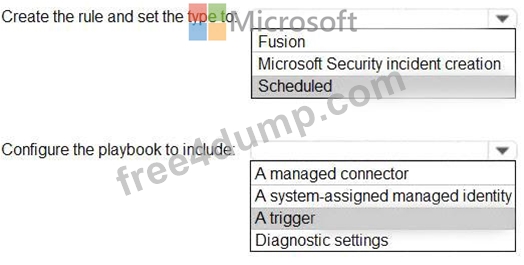
Reference:
https://docs.microsoft.com/en-us/azure/sentinel/tutorial-detect-threats-custom
https://docs.microsoft.com/en-us/azure/sentinel/tutorial-respond-threats-playbook
NEW QUESTION # 87
You have an Azure subscription that contains the Azure Active Directory (Azure AD) resources shown in the following table.
You create the groups shown in the following table.
Which resources can you add to Group5 and Group6? To answer, select the appropriate options in the answer area.
NOTE: Each correct selection is worth one point.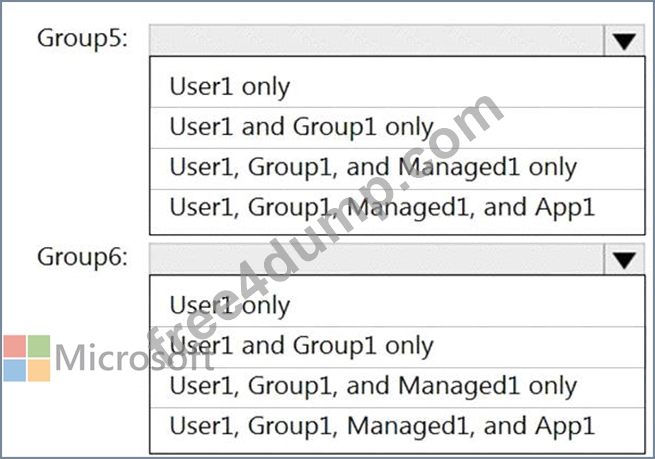
Answer:
Explanation: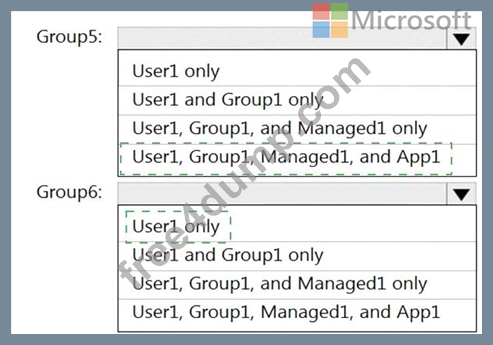
Explanation
Graphical user interface, text, application Description automatically generated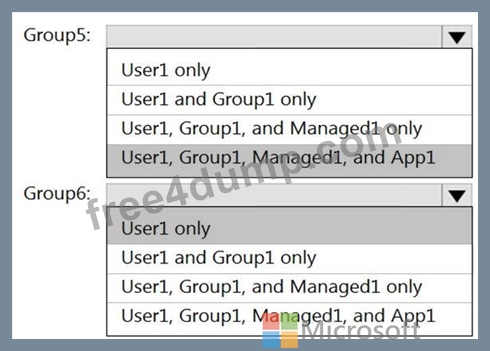
NEW QUESTION # 88
You need to configure WebApp1 to meet the data and application requirements.
Which two actions should you perform? Each correct answer presents part of the solution.
NOTE: Each correct selection is worth one point.
- A. Change the pricing tier of the App Service plan.
- B. Turn on the HTTPS Only protocol setting.
- C. Turn on the Incoming client certificates protocol setting.
- D. Upload a public certificate.
- E. Set the Minimum TLS Version protocol setting to 1.2.
Answer: B,C
Explanation:
Explanation
Refer https://docs.microsoft.com/en-us/azure/app-service/app-service-web-configure-tls-mutual-auth
Topic 1, Litware, inc
This is a case study. Case studies are not timed separately. You can use as much exam time as you would like to complete each case. However, there may be additional case studies and sections on this exam. You must manage your time to ensure that you are able to complete all questions included on this exam in the time provided.
To answer the questions included in a case study, you will need to reference information that is provided in the case study. Case studies might contain exhibits and other resources that provide more information about the scenario that is described in the case study. Each question is independent of the other question on this case study.
At the end of this case study, a review screen will appear. This screen allows you to review your answers and to make changes before you move to the next sections of the exam. After you begin a new section, you cannot return to this section.
To start the case study
To display the first question on this case study, click the Next button. Use the buttons in the left pane to explore the content of the case study before you answer the questions. Clicking these buttons displays information such as business requirements, existing environment, and problem statements. If the case study has an All Information tab, note that the information displayed is identical to the information displayed on the subsequent tabs. When you are ready to answer a question, click the Question button to return to the question.
Overview
Litware, Inc. is a digital media company that has 500 employees in the Chicago area and 20 employees in the San Francisco area.
Existing Environment
Litware has an Azure subscription named Sub1 that has a subscription ID of
43894a43-17c2-4a39-8cfc-3540c2653ef4.
Sub1 is associated to an Azure Active Directory (Azure AD) tenant named litwareinc.com. The tenant contains the user objects and the device objects of all the Litware employees and their devices. Each user is assigned an Azure AD Premium P2 license. Azure AD Privileged Identity Management (PIM) is activated.
The tenant contains the groups shown in the following table.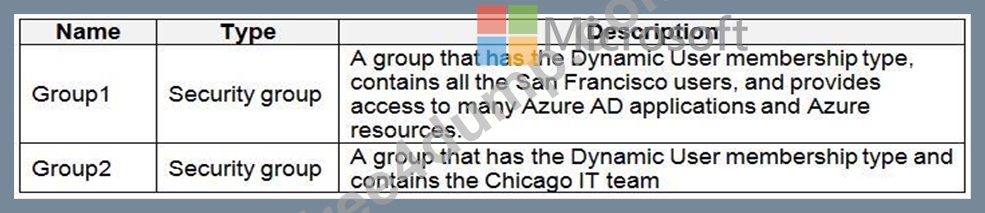
The Azure subscription contains the objects shown in the following table.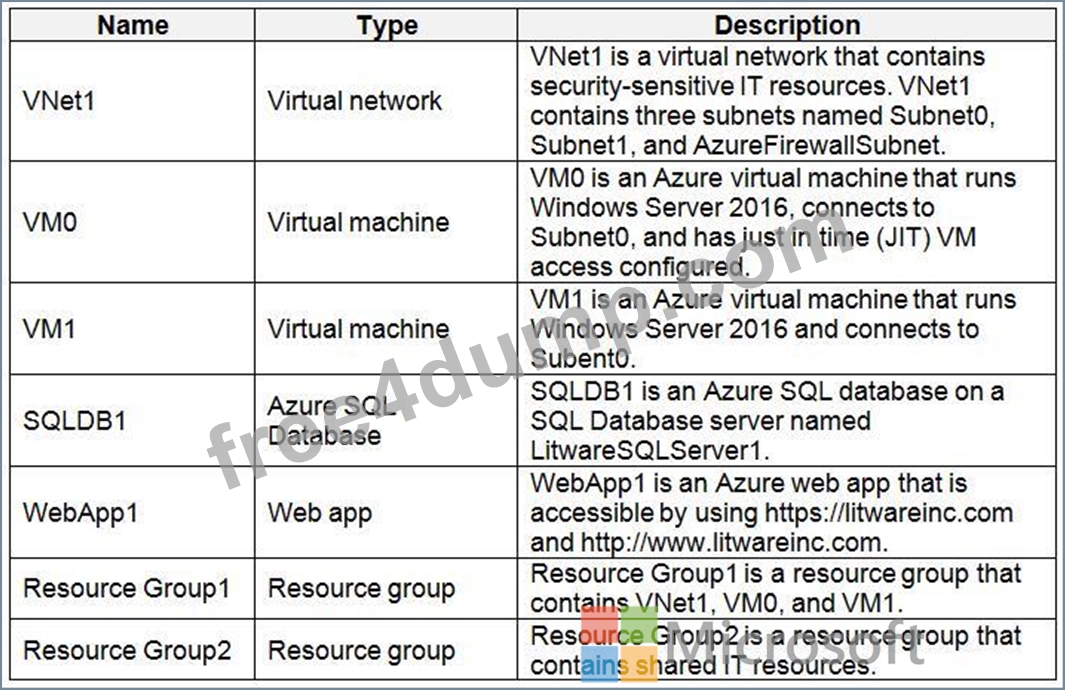
Azure Security Center is set to the Free tier.
Planned changes
Litware plans to deploy the Azure resources shown in the following table.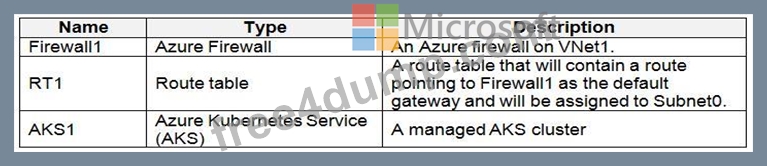
Litware identifies the following identity and access requirements:
All San Francisco users and their devices must be members of Group1.
The members of Group2 must be assigned the Contributor role to Resource Group2 by using a permanent eligible assignment.
Users must be prevented from registering applications in Azure AD and from consenting to applications that access company information on the users' behalf.
Platform Protection Requirements
Litware identifies the following platform protection requirements:
Microsoft Antimalware must be installed on the virtual machines in Resource Group1.
The members of Group2 must be assigned the Azure Kubernetes Service Cluster Admin Role.
Azure AD users must be to authenticate to AKS1 by using their Azure AD credentials.
Following the implementation of the planned changes, the IT team must be able to connect to VM0 by using JIT VM access.
A new custom RBAC role named Role1 must be used to delegate the administration of the managed disks in Resource Group1. Role1 must be available only for Resource Group1.
Security Operations Requirements
Litware must be able to customize the operating system security configurations in Azure Security Center.
NEW QUESTION # 89
You have an Azure subscription named Subscription1.
You deploy a Linux virtual machine named VM1 to Subscription1.
You need to monitor the metrics and the logs of VM1.
What should you use?
- A. the AzurePerformanceDiagnostics extension
- B. Azure Analysis Services
- C. Azure HDInsight
- D. Linux Diagnostic Extension (LAD) 3.0
Answer: D
Explanation:
Explanation/Reference:
https://docs.microsoft.com/en-us/azure/virtual-machines/extensions/diagnostics-linux
NEW QUESTION # 90
Note: This question is part of a series of questions that present the same scenario. Each question in the series contains a unique solution that might meet the stated goals. Some question sets might have more than one correct solution, while others might not h After you answer a question in this section, you will NOT be able to return to it. As a result, these questions will not appear in the review screen.
You have an Azure subscription named Sub1.
You have an Azure Storage account named Sa1 in a resource group named RG1.
Users and applications access the blob service and the file service in Sa1 by using several shared access signatures (SASs) and stored access policies.
You discover that unauthorized users accessed both the file service and the blob service.
You need to revoke all access to Sa1.
Solution: You create a lock on Sa1.
Does this meet the goal?
- A. No
- B. Yes
Answer: A
Explanation:
Explanation
To revoke a stored access policy, you can either delete it, or rename it by changing the signed identifier.
Changing the signed identifier breaks the associations between any existing signatures and the stored access policy. Deleting or renaming the stored access policy immediately affects all of the shared access signatures associated with it.
References:
https://docs.microsoft.com/en-us/rest/api/storageservices/Establishing-a-Stored-Access-Policy
NEW QUESTION # 91
Your company has an Azure subscription named Subscription1 that contains the users shown in the following table.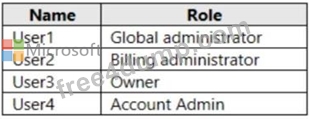
The company is sold to a new owner.
The company needs to transfer ownership of Subscription1.
Which user can transfer the ownership and which tool should the user use? To answer, select the appropriate options in the answer area.
NOTE: Each correct selection is worth one point.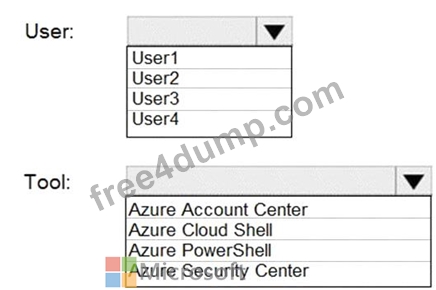
Answer:
Explanation: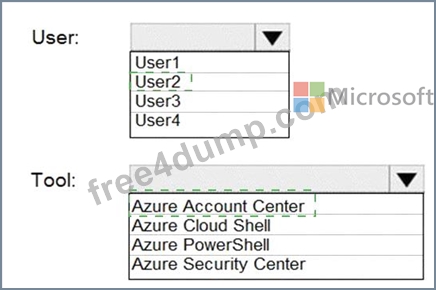
Explanation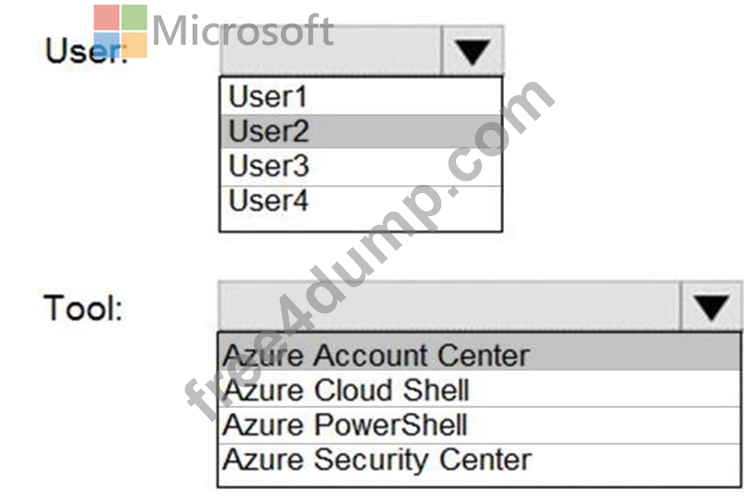
Box 1; User2
Billing Administrator
Select Transfer billing ownership for the subscription that you want to transfer.
Enter the email address of a user who's a billing administrator of the account that will be the new owner for the subscription.
Box 2: Azure Account Center
Azure Account Center can be used.
Reference:
https://docs.microsoft.com/en-us/azure/billing/billing-subscription-transfer#transfer-billing-ownership-of-an-azu
NEW QUESTION # 92
You have an Azure subscription. The subscription contains a virtual network named VNet1 that contains the subnets shown in the following table.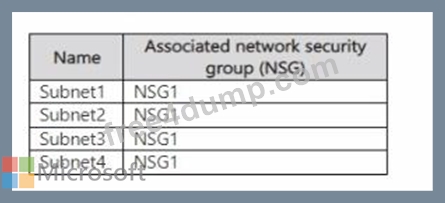
The subscription contains the function apps shown in the following table.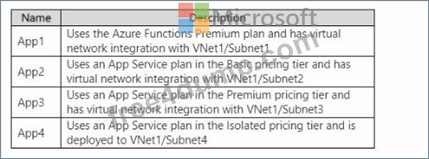
The outbound traffic of which app is controlled by using NSG1?
- A. App2, App3, and App4 only
- B. App4 only
- C. App3 and App4 only
- D. App1, App2, App3, andApp4
Answer: D
NEW QUESTION # 93
You have an Azure subscription that contains virtual machines.
You enable just in time (JIT) VM access to all the virtual machines.
You need to connect to a virtual machine by using Remote Desktop.
What should you do first?
- A. From the Azure portal, select the virtual machine and add the Network Watcher Agent virtual machine extension.
- B. From Azure Directory (Azure AD) Privileged Identity Management (PIM), activate the Security administrator user role.
- C. From the Azure portal, select the virtual machine, select Connect, and then select Request access.
- D. From Azure Active Directory (Azure AD) Privileged Identity Management (PIM), activate the Owner role for the virtual machine.
Answer: C
Explanation:
Explanation/Reference:
https://docs.microsoft.com/en-us/azure/virtual-machines/windows/connect-logon
NEW QUESTION # 94
You have an Azure virtual machines shown in the following table.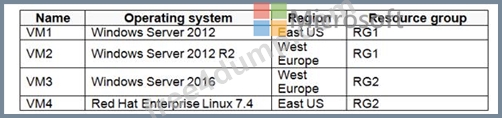
You create an Azure Log Analytics workspace named Analytics1 in RG1 in the East US region.
Which virtual machines can be enrolled in Analytics1?
- A. VM1 and VM4 only
- B. VM1 only
- C. VM1, VM2, VM3, and VM4
- D. VM1, VM2, and VM3 only
Answer: C
Explanation:
Note: Create a workspace
In the Azure portal, click All services. In the list of resources, type Log Analytics. As you begin typing, the list filters based on your input. Select Log Analytics.
Click Create, and then select choices for the following items:
Provide a name for the new Log Analytics workspace, such as DefaultLAWorkspace. OMS workspaces are now referred to as Log Analytics workspaces.
Select a Subscription to link to by selecting from the drop-down list if the default selected is not appropriate.
For Resource Group, select an existing resource group that contains one or more Azure virtual machines.
Select the Location your VMs are deployed to. For additional information, see which regions Log Analytics is available in.
Incorrect Answers:
B, C: A Log Analytics workspace provides a geographic location for data storage. VM2 and VM3 are at a different location.
D: VM4 is a different resource group.
Reference:
https://docs.microsoft.com/en-us/azure/azure-monitor/platform/manage-access
NEW QUESTION # 95
You have an Azure subscription and the computers shown in the following table.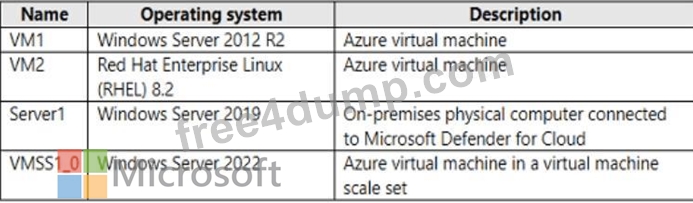
You need to perform a vulnerability scan of the computers by using Microsoft Defender for Cloud. Which computers can you scan?
- A. Server1 and VMSS1.0 only
- B. VM1 and VM2 only
- C. VM1, VM2, Server1, and VMSS1.0
- D. VM1, VM2, and Server1 only
- E. VM1 only
Answer: D
NEW QUESTION # 96
You need to meet the technical requirements for VNetwork1.
What should you do first?
- A. Remove the NSGs from Subnet11 and Subnet13.
- B. Associate an NSG to Subnet12.
- C. Create a new subnet on VNetwork1.
- D. Configure DDoS protection for VNetwork1.
Answer: C
Explanation:
From scenario: Deploy Azure Firewall to VNetwork1 in Sub2.
Azure firewall needs a dedicated subnet named AzureFirewallSubnet.
Reference:
https://docs.microsoft.com/en-us/azure/firewall/tutorial-firewall-deploy-portal
Topic 1, Contoso
Technical Requirements
Contoso identifies the following technical requirements:
Deploy Azure Firewall to VNetWork1 in Sub2.
Register an application named App2 in contoso.com.
Whenever possible, use the principle of least privilege.
Enable Azure AD Privileged Identity Management (PIM) for contoso.com
Existing Environment
Azure AD
Contoso.com contains the users shown in the following table.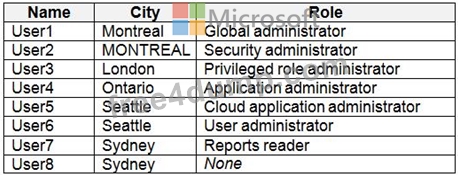
Contoso.com contains the security groups shown in the following table.
Sub1
Sub1 contains six resource groups named RG1, RG2, RG3, RG4, RG5, and RG6.
User2 creates the virtual networks shown in the following table.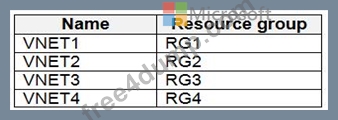
Sub1 contains the locks shown in the following table.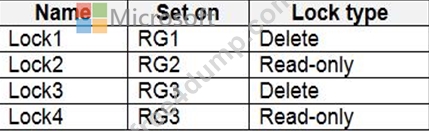
Sub1 contains the Azure policies shown in the following table.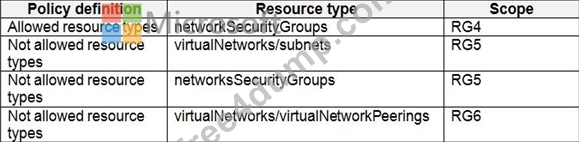
Sub2
Sub2 contains the virtual machines shown in the following table.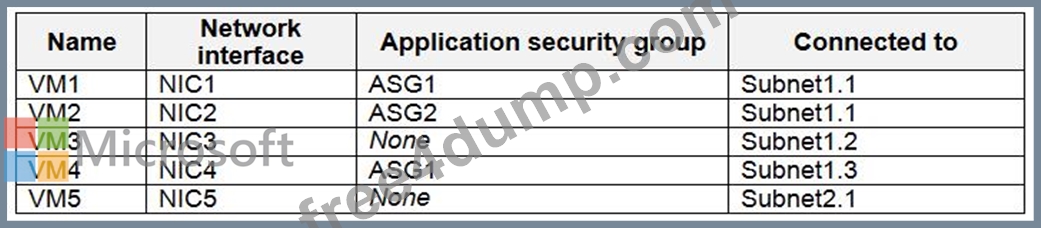
All virtual machines have the public IP addresses and the Web Server (IIS) role installed. The firewalls for each virtual machine allow ping requests and web requests.
Sub2 contains the network security groups (NSGs) shown in the following table.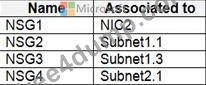
NSG1 has the inbound security rules shown in the following table.
NSG2 has the inbound security rules shown in the following table.
NSG3 has the inbound security rules shown in the following table.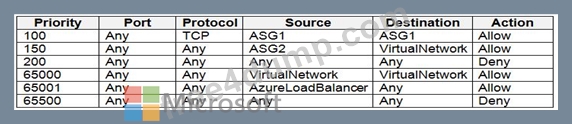
NSG4 has the inbound security rules shown in the following table.
NSG1, NSG2, NSG3, and NSG4 have the outbound security rules shown in the following table.
Contoso identifies the following technical requirements:
Deploy Azure Firewall to VNetwork1 in Sub2.
Register an application named App2 in contoso.com.
Whenever possible, use the principle of least privilege.
Enable Azure AD Privileged Identity Management (PIM) for contoso.com.
NEW QUESTION # 97
You have an Azure subscription named Subscription1 that contains the resources shown in the following table.
You have an Azure subscription named Subscription2 that contains the following resources:
An Azure Sentinel workspace
An Azure Event Grid instance
You need to ingest the CEF messages from the NVAs to Azure Sentinel.
What should you configure for each subscription? To answer, select the appropriate options in the answer area.
NOTE: Each correct selection is worth one point.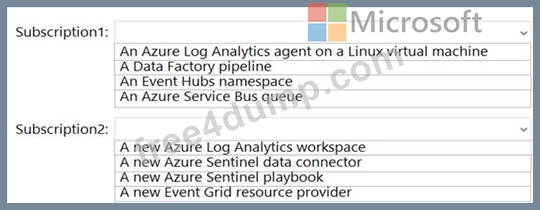
Answer:
Explanation: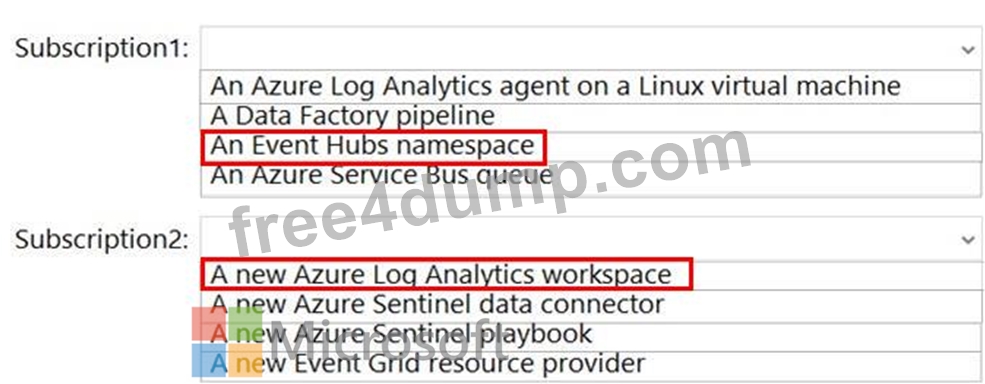
NEW QUESTION # 98
You have 20 Azure subscriptions and a security group named Group1. The subscriptions are children of the root management group.
Each subscription contains a resource group named RG1.
You need to ensure that for each subscription RG1 meets the following requirements:
The members of Group1 are assigned the Owner role.
The modification of permissions to RG1 is prevented.
What should you do? To answer, select the appropriate options in the answer area.
NOTE: Each correct selection is worth one point.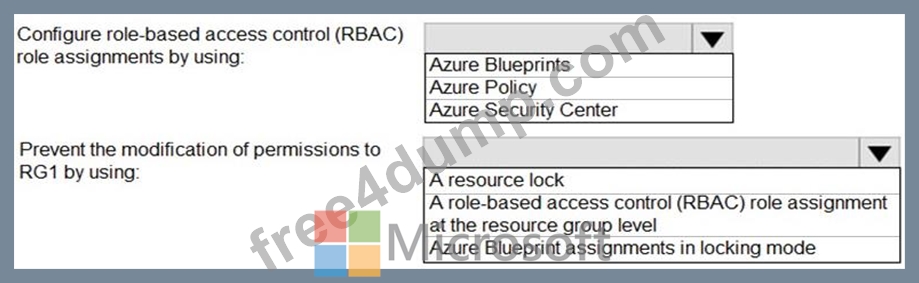
Answer:
Explanation: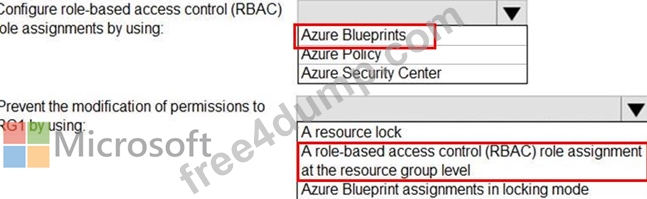
NEW QUESTION # 99
You have an Azure subscription named Subcription1 that contains the resources shown in the following table.
You have an Azure subscription named Subcription2 that contains the following resources:
An Azure Sentinel workspace
An Azure Event Grid instance
You need to ingest the CEF messages from the NVAs to Azure Sentinel.
NOTE: Each correct selection is worth one point.
Answer:
Explanation:
NEW QUESTION # 100
......
The Best Microsoft AZ-500 Study Guides and Dumps of 2025: https://www.free4dump.com/AZ-500-braindumps-torrent.html
Top Microsoft AZ-500 Exam Audio Study Guide! Practice Questions Edition: https://drive.google.com/open?id=1qlHY4qh5lfBlIRbVjEp2F_0IOwPJfgFU