


Huawei H12-811_V2.0 Premium Exam Engine pdf - Download Free Updated 87 Questions
Verified H12-811_V2.0 Bundle Real Exam Dumps PDF
Huawei H12-811_V2.0 Exam Syllabus Topics:
| Topic | Details |
|---|---|
| Topic 1 |
|
| Topic 2 |
|
| Topic 3 |
|
| Topic 4 |
|
| Topic 5 |
|
NEW QUESTION # 33
Which of the following statements are true about the Python code shown below? (Select all that apply) import paramiko import time ssh = paramiko.SSHClient() ssh.set_missing_host_key_policy(paramiko.AutoAddPolicy()) ssh.connect('192.168.1.254', username='python', password='Huawei@123') channel = ssh.invoke_shell() channel.send('screen-length 0 temporary\n') time.sleep(1) output = channel.recv(65535).decode('utf-8') print(output) ssh.close()
- A. import paramiko and import time are used to import the modules required by the code.
- B. ssh.connect('192.168.1.254', username='python', password='Huawei@123') is used to set up a connection with the device whose IP address is 192.168.1.254.
- C. channel = ssh.invoke_shell() is used to create an interactive shell session.
- D. ssh.close() is used to terminate the SSH connection.
Answer: A,B,C,D
NEW QUESTION # 34
If the neighbor relationship between R1 and R2 has reached the Full state in OSPF, which of the following statements are true? (Select all that apply)
- A. R1 and R2 have different router IDs.
- B. R1 and R2 have the same LSDB in the same area.
- C. R1 and R2 belong to the same area.
- D. R1 and R2 use the same process ID.
Answer: A,B,C
Explanation:
When two OSPF routers reach the Full state, it means that adjacency establishment has been successfully completed and the routers have synchronized the necessary link-state information for that area. For this to happen, the two routers must have different router IDs, so option A is correct. They must also belong to the same OSPF area on the interfaces used to form the adjacency, making option B correct. Once adjacency reaches Full state, the routers have synchronized their link-state databases for that area, so option D is also correct.
NEW QUESTION # 35
On the network shown in the figure, the administrator creates Eth-Trunk 1 in manual mode on SW1 and SW2, and adds GE1/0/1 and GE1/0/2 on both switches to the Eth-Trunk. After the administrator runs the display interface brief command on SW1, the administrator finds that GE1/0/1 is Up and GE1/0/2 is Down. Which of the following statements is true about this scenario?
- A. Eth-Trunk 1 is Down because it has only two member interfaces and the minimum number of active links is not reached after one member interface is Down.
- B. Eth-Trunk 1 is Up because it is Up as long as one member interface is Up.
- C. Eth-Trunk 1 is Down because all member interfaces of the Eth-Trunk must be Up.
- D. Eth-Trunk 1 is Down because the states of member interfaces must be the same in manual mode.
Answer: B
Explanation:
For an Eth-Trunk operating in manual load-balancing mode , the logical Eth-Trunk interface can remain Up as long as at least one member link is operational and properly added to the trunk. Therefore, if GE1/0/1 is Up and GE1/0/2 is Down, Eth-Trunk 1 can still stay Up, making option A correct.
Option B is incorrect because member interfaces in a manual Eth-Trunk do not need to be in identical physical states for the trunk itself to remain operational. Option C is also incorrect because there is no inherent rule here that two-member trunks must have both links active unless a separate minimum-links mechanism has been explicitly configured. No such condition is stated in the question. Option D is false because one of the key purposes of Eth-Trunk is redundancy; requiring all member interfaces to be Up would defeat that design advantage. HCIA-Datacom teaches that Eth-Trunk enhances link reliability by allowing continued forwarding when part of the bundle fails, provided the trunk still has an active forwarding member.
NEW QUESTION # 36
Four links between two switches establish an Eth-Trunk in manual mode, and the bandwidth of each link is 1 Gbit/s. One of the links fails. Which of the following statements are true about this scenario? (Select all that apply)
- A. All TCP sessions established over the Eth-Trunk are immediately interrupted and re-established.
- B. The service traffic originally carried by the faulty link stops being forwarded by the switches until the faulty link recovers.
- C. The Eth-Trunk interfaces on the switches are still in the Up state.
- D. The available link bandwidth between the switches is 3 Gbit/s.
Answer: C,D
Explanation:
In an Eth-Trunk working in manual mode , multiple physical member links are bundled into one logical interface to provide higher bandwidth and link redundancy. If one of four 1 Gbit/s member links fails, the Eth- Trunk does not go down as long as at least one valid member link remains active. Therefore, statement A is correct. Since one link has failed and three member links remain available, the total available bandwidth becomes 3 Gbit/s , so statement B is also correct.
Statement C is incorrect because the traffic originally hashed to the failed link is not permanently stopped.
Instead, after the link failure is detected, traffic is redistributed across the remaining active member links according to the trunk load-balancing mechanism. Statement D is also incorrect because Eth-Trunk provides link-level redundancy. Existing upper-layer sessions such as TCP are not necessarily interrupted and re- established simply because one member link fails. HCIA-Datacom emphasizes that Eth-Trunk improves reliability and bandwidth utilization by allowing traffic to continue across surviving links when a single member fails. This is one of the main advantages of link aggregation in campus and data center switching networks.
NEW QUESTION # 37
In the WAC + Fit AP networking, an AP fails to go online. The output of the display ap all command run on the WAC is shown below. According to the command output, which of the following is the possible cause of the AP's failure to go online?
- A. The AP is in the blacklist.
- B. The AP fails the authentication.
- C. The AP's software version does not match the WAC's software version.
- D. The AP fails to initialize the configuration.
Answer: C
Explanation:
The correct answer is C. In the command output, the AP state is shown as ver-mismatch. This state directly indicates a version mismatch between the AP and the WAC. In Huawei WLAN deployment, a Fit AP must use a software version that is compatible with the WAC version. If the versions do not match, the AP may be discovered by the WAC and appear in the AP list, but it cannot successfully complete the online process.
NEW QUESTION # 38
If a device running STP receives an RSTP configuration BPDU, it discards the BPDU.
- A. FALSE
- B. TRUE
Answer: B
Explanation:
A device running Standard Spanning Tree Protocol (STP) is not compatible with Rapid Spanning Tree Protocol (RSTP) BPDUs and will discard them upon receipt. STP devices cannot interpret the additional RSTP fields, leading to discarded BPDUs.
NEW QUESTION # 39
Which of the following configurations can enable connectivity between interfaces on R1 and R3? (Select all that apply)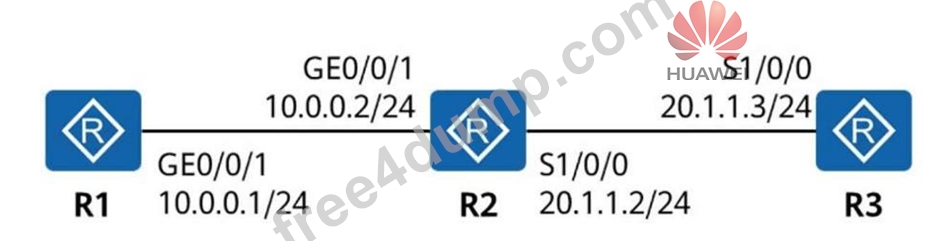
- A. [R3] ip route-static 10.0.0.0 24 20.1.1.1
- B. [R3] ip route-static 10.0.0.0 24 20.1.1.2
- C. [R1] ip route-static 20.1.1.0 24 20.1.1.2
- D. [R1] ip route-static 20.1.1.0 24 10.0.0.2
Answer: A,D
Explanation:
For two directly connected edge networks to communicate through intermediate routing, each end router must have a route to the remote destination network pointing to the correct next hop on the transit link. Since
10.0.0.0/24 is directly connected to R1 and 20.1.1.0/24 is directly connected to R3, R1 needs a route to
20.1.1.0/24, and R3 needs a route to 10.0.0.0/24.
Option A is correct because it configures on R1 a static route to the remote network 20.1.1.0/24 using next hop 10.0.0.2, which is the neighbor toward the transit path. Option D is correct because it configures on R3 a static route to the remote network 10.0.0.0/24 using next hop 20.1.1.1, which is the proper adjacent forwarding address in that direction. Option B is incorrect because a router cannot use a next hop that belongs to the remote destination network but is not directly reachable as a valid immediate forwarding address in this topology. Option C is also incorrect because the specified next hop is not the correct adjacent next-hop address for R3. HCIA-Datacom stresses that static routes must always point to a reachable next hop or outbound interface.
NEW QUESTION # 40
The domain to which a user belongs is determined by the user name used by the user to log in to the NAS device. If the domain name carried in the user name is not configured on the NAS device, the authentication fails.
- A. FALSE
- B. TRUE
Answer: A
Explanation:
This statement is false. On Huawei devices, the domain to which a user belongs is usually determined by the domain part carried in the user name, for example [email protected].
However, if the specified domain is not configured on the NAS device, authentication does not necessarily fail immediately. In many cases, the device can use a default domain for authentication processing, depending on the AAA configuration.
Huawei AAA supports both an administrator user default domain and a normal user default domain. If a user name does not match a configured domain, or the domain carried in the user name is unavailable, the device may fall back to the default domain and continue authentication according to the configured policy. Therefore, the statement is incorrect because it treats authentication failure as unavoidable in every such case. HCIA-Datacom emphasizes domain- based AAA processing because it allows different groups of users to use different authentication, authorization, and accounting methods. At the same time, learners must understand the function of default domains, which provide flexibility in real deployments and prevent unnecessary authentication failures in some login scenarios.
NEW QUESTION # 41
On the OSPF network shown in the figure, all IP addresses can communicate with each other.
Then the following configurations are added on R1: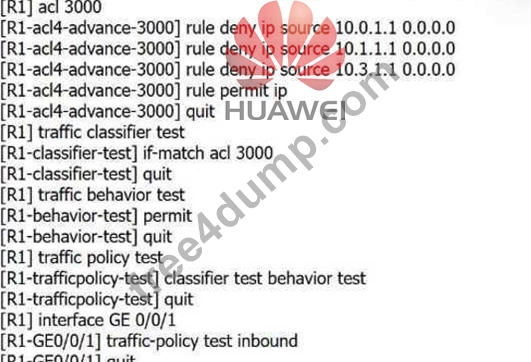
Which IP address of S1 can successfully ping 10.2.23.3?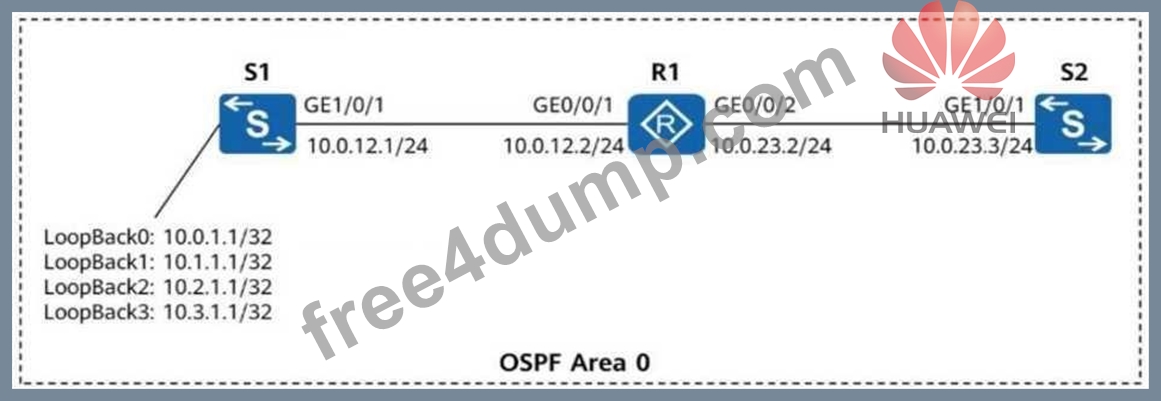
- A. 10.2.1.1
- B. 10.1.1.1
- C. 10.3.1.1
- D. 10.0.1.1
Answer: A
Explanation:
According to the topology and the original question scenario, the correct answer is 10.2.1.1, so option B is selected. In HCIA-Datacom troubleshooting questions of this type, the goal is usually to identify the correct management address, next-hop interface address, or testing destination based on the addressing design shown in the figure.
The answer depends on the role of the device and the direction of the connectivity verification. In such topologies, each interface belongs to a specific network segment, and the selected address must match the intended test target on that segment. If the test is being performed toward the neighboring device or a specific reachable interface, using the correct IP on the proper subnet is essential. An incorrect address may still look familiar from the topology but would not represent the right test endpoint. HCIA-Datacom places strong emphasis on reading topology labels carefully, matching interface addresses to subnet assignments, and choosing the correct destination when using tools such as ping, tracert, or service-specific connectivity tests. This question mainly checks address recognition accuracy in a troubleshooting context.
NEW QUESTION # 42
On the OSPF network shown in the figure, all IP addresses can communicate with each other. Then the following configurations are added on R1:
[R1] acl 3000
[R1-acl4-advance-3000] rule deny ip source 10.0.1.1 0.0.0.0
[R1-acl4-advance-3000] rule deny ip source 10.1.1.1 0.0.0.0
[R1-acl4-advance-3000] rule permit ip source 10.3.1.1 0.0.0.0
[R1-acl4-advance-3000] rule permit ip
[R1-acl4-advance-3000] quit
[R1] traffic classifier test
[R1-classifier-test] if-match acl 3000
[R1-classifier-test] quit
[R1] traffic behavior test
[R1-behavior-test] permit
[R1-behavior-test] quit
[R1] traffic policy test
[R1-trafficpolicy-test] classifier test behavior test
[R1-trafficpolicy-test] quit
[R1] interface GE 0/0/1
[R1-GE0/0/1] traffic-policy test outbound
[R1-GE0/0/1] quit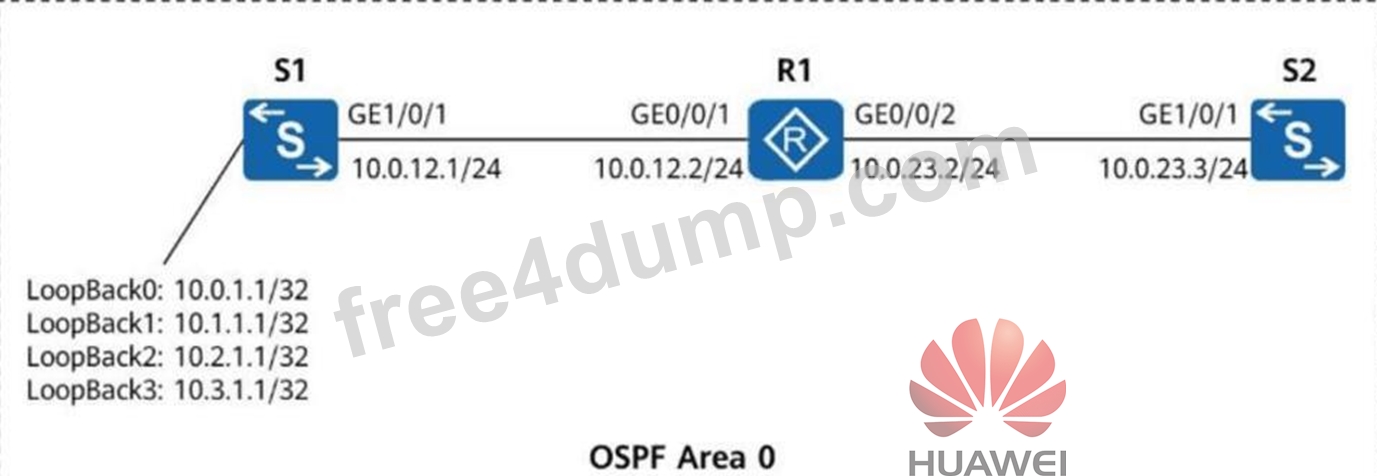
Which IP addresses of S1 can successfully ping 10.0.23.3? (Select all that apply)
- A. 10.2.1.1
- B. 10.1.1.1
- C. 10.3.1.1
- D. 10.0.1.1
Answer: A,B,C,D
Explanation:
All four addresses can successfully ping 10.0.23.3, so the correct answer is A, B, C, D .
The key point is that the traffic policy is applied outbound on GE0/0/1 of R1, which is the interface facing S1
. When S1 pings 10.0.23.3, the echo request travels from S1 to R1 and then to S2. The return echo reply from
10.0.23.3 comes back to R1 and is then sent outbound on GE0/0/1 toward S1. Therefore, the traffic policy examines the reply packets , not the original ping request packets.
In those reply packets, the source IP address is 10.0.23.3 , and the destination is one of S1's loopback addresses. The ACL rules denying 10.0.1.1 and 10.1.1.1 as source addresses do not match these reply packets, because those addresses appear as destination addresses , not source addresses. In addition, the ACL contains rule permit ip, which permits all remaining IP traffic. As a result, replies to all four S1 addresses are forwarded successfully, so every listed address can ping 10.0.23.3.
NEW QUESTION # 43
Which of the following commands can be used to check OSPF routes in the global routing table?
- A. display ospf interface
- B. display ospf routing
- C. display ip routing-table protocol ospf
- D. display ospf peer
Answer: C
Explanation:
To check OSPF-learned routes in the global IP routing table , the correct command is display ip routing- table protocol ospf , so option A is correct. This command filters the routing table and shows only the routes whose source protocol is OSPF. It is especially useful when verifying whether OSPF-learned routes have been successfully installed into the forwarding table after neighbor establishment and LSDB calculation.
Option B , display ospf peer, is used to check OSPF neighbor information and adjacency states, not the routing table. Option C , display ospf interface, shows OSPF-related parameters on interfaces such as timers, network type, and cost. Option D , display ospf routing, displays OSPF route information maintained by the OSPF process itself, but the question specifically asks about routes in the global routing table , which is the RIB used for actual forwarding decisions. HCIA-Datacom distinguishes between protocol-specific route information and the final routing table seen by the device. Understanding this distinction helps engineers verify whether a protocol has only learned topology information or has actually produced usable forwarding entries.
NEW QUESTION # 44
In the WAC + Fit AP networking, an AP fails to go online. The output of the display ap all command run on the WAC is shown below. According to the command output, which of the following is the possible cause of the AP's failure to go online?
- A. The AP is in the blacklist.
- B. The AP fails the authentication.
- C. The AP's software version does not match the WAC's software version.
- D. The AP fails to initialize the configuration.
Answer: C
Explanation:
The correct answer is C. In the command output, the AP state is shown as ver-mismatch. This state directly indicates a version mismatch between the AP and the WAC. In Huawei WLAN deployment, a Fit AP must use a software version that is compatible with the WAC version. If the versions do not match, the AP may be discovered by the WAC and appear in the AP list, but it cannot successfully complete the online process.
Option A is incorrect because blacklist-related failures are displayed with blacklist-related status information, not ver-mismatch. Option B is also incorrect because authentication failures normally generate authentication- related fault indications. Option D is incorrect because configuration initialization failure would not be identified by the specific ver-mismatch state.
HCIA-Datacom troubleshooting knowledge emphasizes reading AP online states carefully. Common causes of AP online failure include IP address acquisition failure, CAPWAP tunnel establishment failure, insufficient licenses, authentication problems, and version mismatch. When the state explicitly shows ver-mismatch, the troubleshooting direction is clear: check AP and WAC software compatibility and upgrade or align the software version as needed.
NEW QUESTION # 45
The figure shows the simplified topology of an enterprise campus network. On this network, the aging time of dynamic MAC address entries on switches is 300 seconds. The administrator connects PC1 to GE1/0/1 of SW1 and successfully pings the IP address of PC2 from PC1. Then, the administrator disconnects the Ethernet cable of PC1 from GE1/0/1 of SW1, immediately connects the cable to GE1/0/2 of SW1, and pings the IP address of PC2 from PC1. Which of the following operations does SW1 perform after receiving a data frame from PC1 when PC1 is connected to GE1/0/2 of SW1?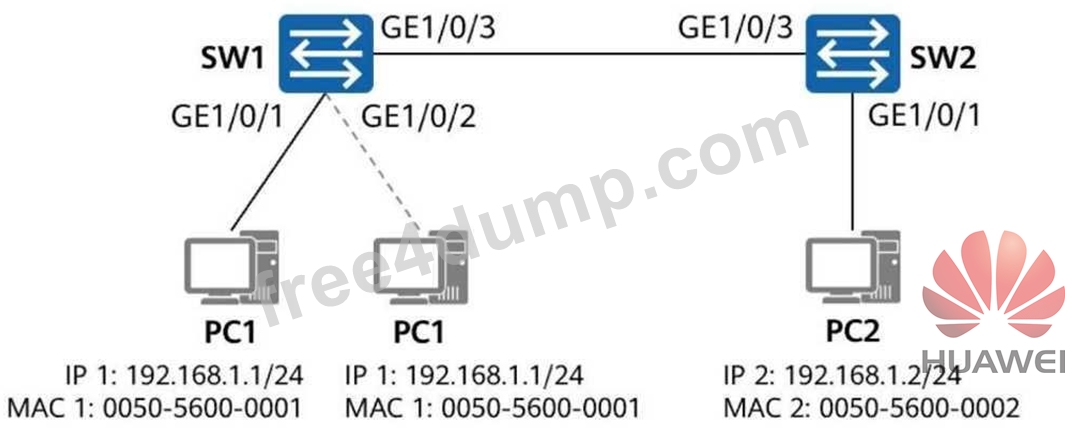
- A. SW1 does not update the MAC address table until the original entry ages out.
- B. SW1 saves the mapping between the MAC address of PC1 and GE1/0/1, and also keeps the mapping between the MAC address of PC1 and GE1/0/2.
- C. SW1 deletes all MAC address entries and relearns them from all ports.
- D. SW1 saves the mapping between the MAC address of PC1 and GE1/0/2 and deletes the mapping between the MAC address of PC1 and GE1/0/1.
Answer: D
Explanation:
An Ethernet switch learns MAC address entries dynamically by examining the source MAC address of incoming frames. When SW1 first receives frames from PC1 on GE1/0/1, it creates a MAC address table entry mapping PC1's MAC address to that port. If PC1 later sends frames that arrive on GE1/0/2, SW1 updates the learned entry to reflect the new incoming interface.
Therefore, option B is correct: SW1 saves the mapping between PC1's MAC address and GE1/0/2 and removes or overwrites the old mapping associated with GE1/0/1.
NEW QUESTION # 46
Which of the following are valid static route configurations?
- A. ip route-static 129.1.0.0 16 10.0.0.2
- B. ip route-static 129.1.0.0 255.255.0.0 10.0.0.2
- C. ip route-static 10.0.0.2 16 129.1.0.0
- D. ip route-static 129.1.0.0 16 serial 0/0/0
Answer: A,B,D
Explanation:
Option A is valid; the destination is defined in CIDR format (129.1.0.0/16) with a specified outgoing interface.
Option B is valid; it uses a subnet mask format and specifies a next-hop IP.
Option D is also valid with the destination and mask defined and a next-hop IP.
NEW QUESTION # 47
Which of the following are features of the OSPF protocol?
- A. Triggered update is supported.
- B. Routing loops are likely to occur.
- C. The shortest path is calculated based on the number of hops.
- D. Area division is supported.
Answer: A,D
Explanation:
Option B: OSPF supports triggered updates, allowing routing tables to be updated only when changes occur, conserving bandwidth.
Option D: OSPF supports area division, which is essential for optimizing large networks and limiting the scope of link-state advertisements.
NEW QUESTION # 48
Assume that you cannot configure an IP address for GE1/0/1 on a Huawei switch. Which of the following commands can you run in the interface view to resolve this problem?
- A. port link-type hybrid
- B. port link-type trunk
- C. undo portswitch
- D. port link-type access
Answer: C
Explanation:
On Huawei switches, a physical Ethernet interface usually works as a Layer 2 switch port by default. A Layer 2 interface cannot be assigned an IP address directly. If an administrator wants to configure an IP address on such an interface, the interface must first be converted into a Layer 3 interface . The command used for this is undo portswitch , so option B is correct.
After this command is executed, the interface no longer behaves as a Layer 2 switching port and can then support Layer 3 features such as direct IP address configuration. Options A , C , and D are all Layer 2 port- type commands used to configure the interface as a trunk, access, or hybrid port. These commands do not solve the problem because they keep the interface operating at Layer 2. HCIA-Datacom emphasizes the difference between Layer 2 switching interfaces and Layer 3 routed interfaces on switches. Understanding when to use undo portswitch is important in campus network deployment, especially when configuring routed uplinks, management interfaces, or inter-device Layer 3 links on switches.
NEW QUESTION # 49
......
Pass Your Huawei Exam with H12-811_V2.0 Exam Dumps: https://www.free4dump.com/H12-811_V2.0-braindumps-torrent.html
H12-811_V2.0 Dumps PDF New [2026] Ultimate Study Guide: https://drive.google.com/open?id=1HLDtNeohjZz8iOB45cNQDR6EZoHkdn8A