


[Dec 21, 2021] Powerful 1z0-809 PDF Dumps for 1z0-809 Questions
Authentic 1z0-809 Dumps - Free PDF Questions to Pass
Who should take the 1Z0-809 exam
The Oracle Java SE 8 Programmer II 1Z0-809 Exam certification is an internationally-recognized validation that identifies persons who earn it as possessing skilled as an Oracle Certified Java Programmer. If a candidate wants significant improvement in career growth needs enhanced knowledge, skills, and talents. The Oracle Java SE 8 Programmer II 1Z0-809 Exam certification provides proof of this advanced knowledge and skill. If a candidate has knowledge of associated technologies and skills that are required to pass Oracle Java SE 8 Programmer II 1Z0-809 Exam then he should take this exam.
Conclusion
Certified specialists in the field of Java development are highly valued by employers of large IT companies, so only those candidates who have proven their practical skills in using Java language by passing specialized Oracle exams can avoid serious competition and show their expertise. However, having the OCP Java SE 8 Programmer certificate will not only set you apart from other applicants but allow you to qualify for a higher salary.
So now that you see the benefits and are ready to continue on the path to Oracle certification, enroll for the Oracle 1Z0-809 exam and start preparing diligently. You have all the possibilities in your hands, it is enough to cast aside doubts and start studying hard to get ahead of the challenging job market.
NEW QUESTION 34
Given: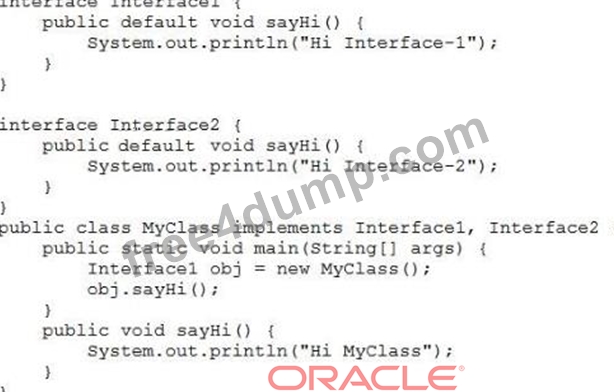
What is the result?
- A. Hi MyClass
- B. A compilation error occurs.
- C. Hi Interface-1
- D. Hi Interface-2
Answer: A
NEW QUESTION 35
Given the code fragment:
Which two code fragments can be independently inserted at line n1 to enable the code to print the elements of the array in reverse order?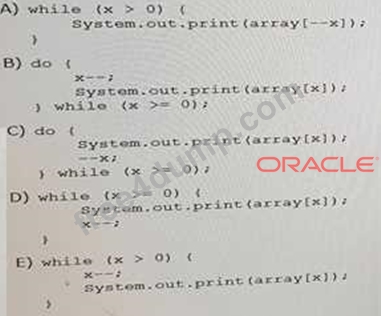
- A. Option A
- B. Option B
- C. Option D
- D. Option C
- E. Option E
Answer: A,E
NEW QUESTION 36
Given the code fragment: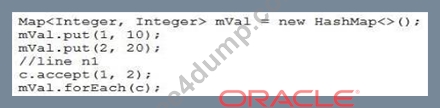
Which statement can be inserted into line n1 to print 1,2; 1,10; 2,20;?
- A. BiConsumer<Integer, Integer, Integer> c = (i, j) ?gt; {System.out.print (i + "," + j+ "; ");};
- B. BiConsumer<Integer,Integer> c = (i, j) ->
{System.out.print (i + "," + j+
"; ");}; - C. BiConsumer<Integer, Integer, String> c = (i, j) ?gt; {System.out.print (i + "," + j+ "; ")};
- D. BiFunction<Integer, Integer, String> c = (i, j) ?gt; {System.out.print (i + "," + j+ "; ")};
Answer: B
NEW QUESTION 37
Which class definition compiles?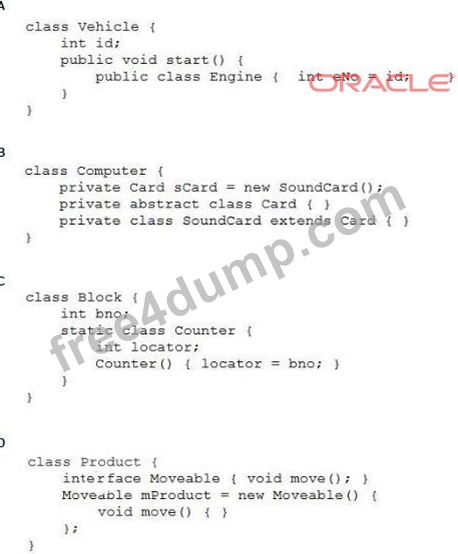
- A. Option B
- B. Option D
- C. Option C
- D. Option A
Answer: A
NEW QUESTION 38
Given:
final class Folder { //line n1
/ /line n2
public void open () {
System.out.print("Open");
}
}
public class Test {
public static void main (String [] args) throws Exception {
try (Folder f = new Folder()) {
f.open();
}
}
}
Which two modifications enable the code to print Open Close?
- A. Replace line n1 with:
class Folder extends Exception { - B. Replace line n1 with:
class Folder implements AutoCloseable { - C. Replace line n1 with:
class Folder extends Closeable { - D. At line n2, insert:
final void close () {
System.out.print("Close");
} - E. At line n2, insert:
public void close () throws IOException {
System.out.print("Close");
}
Answer: A,B
NEW QUESTION 39
Given:
class FuelNotAvailException extends Exception { }
class Vehicle {
void ride() throws FuelNotAvailException {//line n1
System.out.println("Happy Journey!");
}
}
class SolarVehicle extends Vehicle {
public void ride () throws Exception {//line n2
super ride ();
}
}
and the code fragment:
public static void main (String[] args) throws FuelNotAvailException, Exception {
Vehicle v = new SolarVehicle ();
v.ride();
}
Which modification enables the code fragment to print Happy Journey!?
- A. Replace line n2 with void ride() throws Exception {
- B. Replace line n1 with protected void ride() throws Exception {
- C. Replace line n1 with public void ride() throws FuelNotAvailException {
- D. Replace line n2 with private void ride() throws FuelNotAvailException {
Answer: B
NEW QUESTION 40
Given: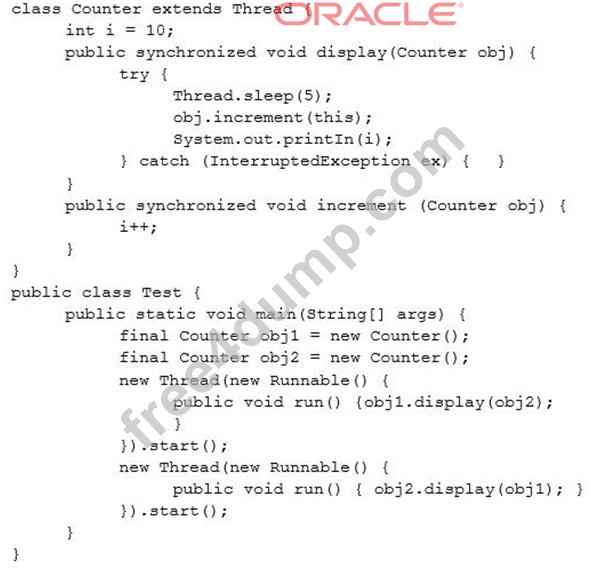
From what threading problem does the program suffer?
- A. starvation
- B. livelock
- C. race condition
- D. deadlock
Answer: D
NEW QUESTION 41
Given the code fragment:
List<String> listVal = Arrays.asList("Joe", "Paul", "Alice", "Tom");
System.out.println (
// line n1
);
Which code fragment, when inserted at line n1, enables the code to print the count of string elements whose length is greater than three?
- A. listVal.stream().map(x -> x.length()>3).count()
- B. listVal.stream().peek(x -> x.length()>3).count().get()
- C. listVal.stream().filter(x -> x.length()>3).count()
- D. listVal.stream().filter(x -> x.length()>3).mapToInt(x -> x).count()
Answer: B
NEW QUESTION 42
Given:
Item table
* ID, INTEGER: PK
* DESCRIP, VARCHAR(100)
* PRICE, REAL
* QUANTITY< INTEGER
And given the code fragment:
9. try {
10.Connection conn = DriveManager.getConnection(dbURL, username, password);
11. String query = "Select * FROM Item WHERE ID = 110";
12. Statement stmt = conn.createStatement();
13. ResultSet rs = stmt.executeQuery(query);
14.while(rs.next()) {
15.System.out.println("ID:" + rs.getString(1));
16.System.out.println("Description:" + rs.getString(2));
17.System.out.println("Price:" + rs.getString(3));
18. System.out.println(Quantity:" + rs.getString(4));
19.}
20. } catch (SQLException se) {
21. System.out.println("Error");
22. }
Assume that:
The required database driver is configured in the classpath.
The appropriate database is accessible with the dbURL, userName, and passWord exists.
The SQL query is valid.
What is the result?
- A. The code prints information about Item 110.
- B. Compilation fails.
- C. An exception is thrown at runtime.
- D. The code prints Error.
Answer: B
NEW QUESTION 43
Given: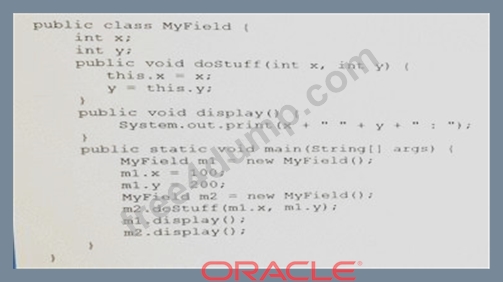
What is the result?
- A. 100 0 : 100 0 ;
- B. 100 200 : 100 200 ;
- C. 100 200 : 100 0 ;
- D. 100 0 : 100 200 ;
Answer: C
NEW QUESTION 44
Given the code fragment:
Stream<Path> files = Files.walk(Paths.get(System.getProperty("user.home"))); files.forEach (fName -> {//line n1 try { Path aPath = fName.toAbsolutePath();//line n2 System.out.println(fName + ":"
+ Files.readAttributes(aPath, Basic.File.Attributes.class).creationTime ());
} catch (IOException ex) {
ex.printStackTrace();
});
What is the result?
- A. A compilation error occurs at line n1.
- B. A compilation error occurs at line n2.
- C. The files in the home directory are listed along with their attributes.
- D. All files and directories under the home directory are listed along with their attributes.
Answer: D
NEW QUESTION 45
Given the code fragment:
List<Integer> nums = Arrays.asList (10, 20, 8):
System.out.println (
//line n1
);
Which code fragment must be inserted at line n1 to enable the code to print the maximum number in the nums list?
- A. nums.stream().max(Integer : : max).get()
- B. nums.stream().max()
- C. nums.stream().map(a -> a).max()
- D. nums.stream().max(Comparator.comparing(a -> a)).get()
Answer: B
NEW QUESTION 46
Given: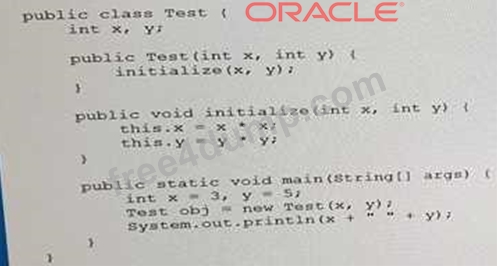
What is the result?
- A. 9 25
- B. 3 5
- C. Compilation fails.
- D. 0 0
Answer: B
NEW QUESTION 47
Given the code fragment: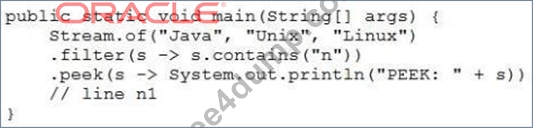
Which two code fragments, when inserted at line n1 independently, result in the output PEEK:
Unix?
- A. .noneMatch ();
- B. .allMatch ();
- C. .anyMatch ();
- D. .findAny ();
- E. .findFirst ();
Answer: E
NEW QUESTION 48
Given:
Item table
ID, INTEGER: PK
DESCRIP, VARCHAR(100)
PRICE, REAL
QUANTITY< INTEGER
And given the code fragment:
9. try {
10.Connection conn = DriveManager.getConnection(dbURL, username,
password);
11. String query = "Select * FROM Item WHERE ID = 110";
12. Statement stmt = conn.createStatement();
13. ResultSet rs = stmt.executeQuery(query);
14.while(rs.next()) {
15.System.out.println("ID:" + rs.getInt("Id"));
16.System.out.println("Description:" + rs.getString("Descrip"));
17.System.out.println("Price:" + rs.getDouble("Price"));
18. System.out.println(Quantity:" + rs.getInt("Quantity"));
19.}
20. } catch (SQLException se) {
21. System.out.println("Error");
22. }
Assume that:
- The required database driver is configured in the classpath.
- The appropriate database is accessible with the dbURL, userName, and
passWord exists.
- The SQL query is valid.
What is the result?
- A. Compilation fails.
- B. An exception is thrown at runtime.
- C. The code prints Error.
- D. The code prints information about Item 110.
Answer: D
NEW QUESTION 49
Given the code fragment:
public class Foo {
public static void main (String [ ] args) {
Map<Integer, String> unsortMap = new HashMap< > ( );
unsortMap.put (10, "z");
unsortMap.put (5, "b");
unsortMap.put (1, "d");
unsortMap.put (7, "e");
unsortMap.put (50, "j");
Map<Integer, String> treeMap = new TreeMap <Integer, String> (new
Comparator<Integer> ( ) {
@Override public int compare (Integer o1, Integer o2) {return
o2.compareTo
(o1); } } );
treeMap.putAll (unsortMap);
for (Map.Entry<Integer, String> entry : treeMap.entrySet () ) {
System.out.print (entry.getValue () + " ");
}
}
}
What is the result?
- A. d b e z j
- B. A compilation error occurs.
- C. z b d e j
- D. j z e b d
Answer: D
NEW QUESTION 50
Given that data.txt and alldata.txt are accessible, and the code fragment: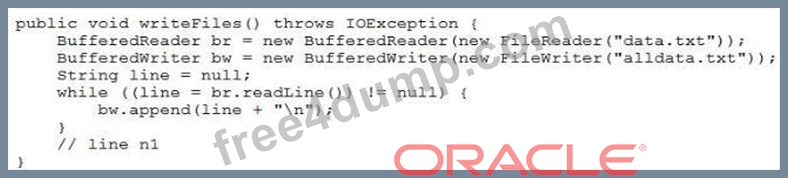
What is required at line n1 to enable the code to overwrite alldata.txt with data.txt?
- A. bw.flush();
- B. br.flush();
- C. bw.writeln();
- D. br.close();
Answer: A
NEW QUESTION 51
Given: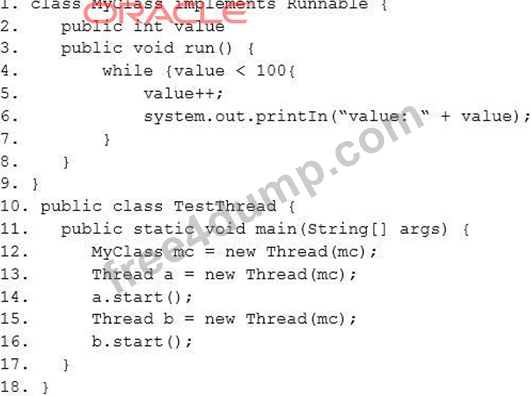
What change should you make to guarantee a single order of execution (printed values 1 -100 in order)?
- A. Line 2: public synchronized int value;
- B. Line 1: class MyClass extends Thread {
- C. Line 3: public synchronized void run() {
- D. Line 2: public volatile int value;
Answer: B
NEW QUESTION 52
Given: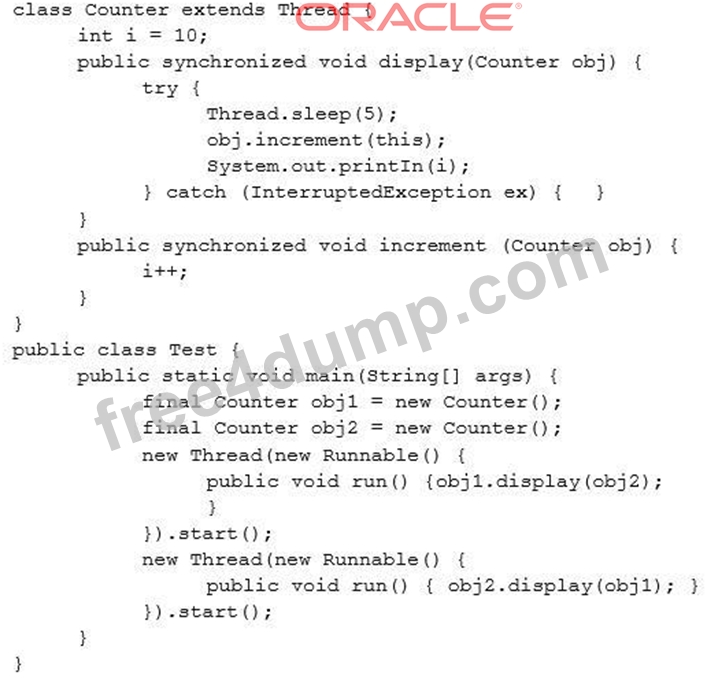
From what threading problem does the program suffer?
- A. starvation
- B. livelock
- C. race condition
- D. deadlock
Answer: D
NEW QUESTION 53
Which two statements are true for a two-dimensional array?
- A. It is implemented as an array of the specified element type.
- B. Using a row by column convention, each row of a two-dimensional array must be of the same size.
- C. All methods of the class Object may be invoked on the two-dimensional array.
- D. At declaration time, the number of elements of the array in each dimension must be specified.
Answer: A,C
NEW QUESTION 54
Given the definition of the Country class:
public class country {
public enum Continent {ASIA, EUROPE}
String name;
Continent region;
public Country (String na, Continent reg) {
name = na, region = reg;
}
public String getName () {return name;}
public Continent getRegion () {return region;}
}
and the code fragment:
List<Country> couList = Arrays.asList (
new Country ("Japan", Country.Continent.ASIA),
new Country ("Italy", Country.Continent.EUROPE),
new Country ("Germany", Country.Continent.EUROPE));
Map<Country.Continent, List<String>> regionNames = couList.stream ()
.collect(Collectors.groupingBy (Country ::getRegion,
Collectors.mapping(Country::getName, Collectors.toList()))));
System.out.println(regionNames);
What is the output?
- A. {ASIA = [Japan], EUROPE = [Italy, Germany]}
- B. {EUROPE = [Italy, Germany], ASIA = [Japan]}
- C. {EUROPE = [Germany, Italy], ASIA = [Japan]}
- D. {EUROPE = [Germany], EUROPE = [Italy], ASIA = [Japan]}
Answer: A
NEW QUESTION 55
Given that data.txt and alldata.txt are accessible, and the code fragment: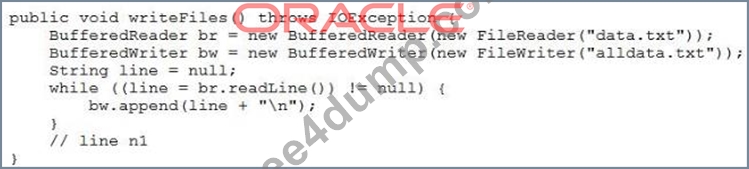
What is required at line n1to enable the code to overwrite alldata.txtwith data.txt?
- A. bw.flush();
- B. br.flush();
- C. bw.writeln();
- D. br.close();
Answer: A
NEW QUESTION 56
......
Guaranteed Accomplishment with Newest Dec-2021 FREE : https://www.free4dump.com/1z0-809-braindumps-torrent.html
Use Valid New Free 1z0-809 Exam Dumps & Answers: https://drive.google.com/open?id=1AW3ZZwFHQU892oUWhRs93wLXDaPC-9BY