


Free 2022 Professional-Machine-Learning-Engineer Dumps 100 Pass Guarantee With Latest Demo
Prepare Professional-Machine-Learning-Engineer Question Answers Free Update With 100% Exam Passing Guarantee [2022]
Understanding functional and technical aspects of Professional Machine Learning Engineer - Google Data Preparation and Processing
The following will be discussed in Google Professional-Machine-Learning-Engineer dumps:
- Encoding structured data types
- Feature crosses
- Visualization
- Build data pipelines
- Monitoring/changing deployed pipelines
- Batching and streaming data pipelines at scale
- Data leakage and augmentation
- Statistical fundamentals at scale
- Feature selection
- Streaming data (e.g. from IoT devices)
- Transformations (TensorFlow Transform)
- Database migration
- Design data pipelines
- Feature engineering
- Managing large samples (TFRecords)
- Handling missing data
- Handling outliers
- Data validation
- Evaluation of data quality and feasibility
- Ingestion of various file types (e.g. Csv, json, img, parquet or databases, Hadoop/Spark)
- Data ingestion
- Class imbalance
- Data exploration (EDA)
- Data privacy and compliance
NEW QUESTION 43
You are an ML engineer at a global shoe store. You manage the ML models for the company's website. You are asked to build a model that will recommend new products to the user based on their purchase behavior and similarity with other users. What should you do?
- A. Build a collaborative-based filtering model
- B. Build a regression model using the features as predictors
- C. Build a knowledge-based filtering model
- D. Build a classification model
Answer: A
NEW QUESTION 44
A Machine Learning Specialist wants to bring a custom algorithm to Amazon SageMaker. The Specialist implements the algorithm in a Docker container supported by Amazon SageMaker.
How should the Specialist package the Docker container so that Amazon SageMaker can launch the training correctly?
- A. Copy the training program to directory /opt/ml/train
- B. Configure the training program as an ENTRYPOINTnamed train
- C. Use CMD configin the Dockerfile to add the training program as a CMD of the image
- D. Modify the bash_profile file in the container and add a bashcommand to start the training program
Answer: C
NEW QUESTION 45
You are training a Resnet model on Al Platform using TPUs to visually categorize types of defects in automobile engines. You capture the training profile using the Cloud TPU profiler plugin and observe that it is highly input-bound. You want to reduce the bottleneck and speed up your model training process. Which modifications should you make to the tf .data dataset?
Choose 2 answers
- A. Increase the buffer size for the shuffle option.
- B. Set the prefetch option equal to the training batch size
- C. Use the interleave option for reading data
- D. Reduce the value of the repeat parameter
- E. Decrease the batch size argument in your transformation
Answer: B,C
NEW QUESTION 46
You work on a growing team of more than 50 data scientists who all use Al Platform. You are designing a strategy to organize your jobs, models, and versions in a clean and scalable way. Which strategy should you choose?
- A. Use labels to organize resources into descriptive categories. Apply a label to each created resource so that users can filter the results by label when viewing or monitoring the resources
- B. Separate each data scientist's work into a different project to ensure that the jobs, models, and versions created by each data scientist are accessible only to that user.
- C. Set up restrictive I AM permissions on the Al Platform notebooks so that only a single user or group can access a given instance.
- D. Set up a BigQuery sink for Cloud Logging logs that is appropriately filtered to capture information about Al Platform resource usage In BigQuery create a SQL view that maps users to the resources they are using.
Answer: B
NEW QUESTION 47
This graph shows the training and validation loss against the epochs for a neural network.
The network being trained is as follows:
* Two dense layers, one output neuron
* 100 neurons in each layer
* 100 epochs
* Random initialization of weights
Which technique can be used to improve model performance in terms of accuracy in the validation set?
- A. Early stopping
- B. Adding another layer with the 100 neurons
- C. Increasing the number of epochs
- D. Random initialization of weights with appropriate seed
Answer: C
NEW QUESTION 48
A Machine Learning Specialist is configuring Amazon SageMaker so multiple Data Scientists can access notebooks, train models, and deploy endpoints. To ensure the best operational performance, the Specialist needs to be able to track how often the Scientists are deploying models, GPU and CPU utilization on the deployed SageMaker endpoints, and all errors that are generated when an endpoint is invoked.
Which services are integrated with Amazon SageMaker to track this information? (Choose two.)
- A. AWS CloudTrail
- B. Amazon CloudWatch
- C. AWS Health
- D. AWS Config
- E. AWS Trusted Advisor
Answer: A,B
Explanation:
Explanation/Reference: https://aws.amazon.com/sagemaker/faqs/
NEW QUESTION 49
A company is using Amazon Textract to extract textual data from thousands of scanned text-heavy legal documents daily. The company uses this information to process loan applications automatically. Some of the documents fail business validation and are returned to human reviewers, who investigate the errors. This activity increases the time to process the loan applications.
What should the company do to reduce the processing time of loan applications?
- A. Configure Amazon Textract to route low-confidence predictions to Amazon Augmented AI (Amazon A2I).
Perform a manual review on those words before performing a business validation. - B. Use Amazon Rekognition's feature to detect text in an image to extract the data from scanned images. Use this information to process the loan applications.
- C. Configure Amazon Textract to route low-confidence predictions to Amazon SageMaker Ground Truth.
Perform a manual review on those words before performing a business validation. - D. Use an Amazon Textract synchronous operation instead of an asynchronous operation.
Answer: A
NEW QUESTION 50
You work for a large hotel chain and have been asked to assist the marketing team in gathering predictions for a targeted marketing strategy. You need to make predictions about user lifetime value (LTV) over the next 30 days so that marketing can be adjusted accordingly. The customer dataset is in BigQuery, and you are preparing the tabular data for training with AutoML Tables. This data has a time signal that is spread across multiple columns. How should you ensure that AutoML fits the best model to your data?
- A. Submit the data for training without performing any manual transformations, and indicate an appropriate column as the Time column Allow AutoML to split your data based on the time signal provided, and reserve the more recent data for the validation and testing sets
- B. Submit the data for training without performing any manual transformations Use the columns that have a time signal to manually split your data Ensure that the data in your validation set is from 30 days after the data in your training set and that the data in your testing set is from 30 days after your validation set
- C. Manually combine all columns that contain a time signal into an array Allow AutoML to interpret this array appropriately Choose an automatic data split across the training, validation, and testing sets
- D. Submit the data for training without performing any manual transformations Allow AutoML to handle the appropriate transformations Choose an automatic data split across the training, validation, and testing sets
Answer: B
NEW QUESTION 51
A web-based company wants to improve its conversion rate on its landing page. Using a large historical dataset of customer visits, the company has repeatedly trained a multi-class deep learning network algorithm on Amazon SageMaker. However, there is an overfitting problem: training data shows 90% accuracy in predictions, while test data shows 70% accuracy only.
The company needs to boost the generalization of its model before deploying it into production to maximize conversions of visits to purchases.
Which action is recommended to provide the HIGHEST accuracy model for the company's test and validation data?
- A. Apply L1 or L2 regularization and dropouts to the training
- B. Reduce the number of layers and units (or neurons) from the deep learning network
- C. Increase the randomization of training data in the mini-batches used in training
- D. Allocate a higher proportion of the overall data to the training dataset
Answer: B
NEW QUESTION 52
A Data Scientist is developing a machine learning model to classify whether a financial transaction is fraudulent. The labeled data available for training consists of 100,000 non-fraudulent observations and 1,000 fraudulent observations.
The Data Scientist applies the XGBoost algorithm to the data, resulting in the following confusion matrix when the trained model is applied to a previously unseen validation dataset. The accuracy of the model is 99.1%, but the Data Scientist has been asked to reduce the number of false negatives.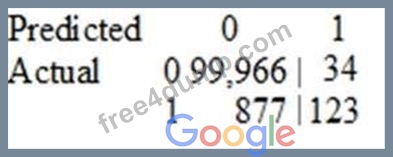
Which combination of steps should the Data Scientist take to reduce the number of false positive predictions by the model? (Choose two.)
- A. Increase the XGBoost scale_pos_weight parameter to adjust the balance of positive and negative weights.
- B. Increase the XGBoost max_depth parameter because the model is currently underfitting the data.
- C. Change the XGBoost eval_metric parameter to optimize based on AUC instead of error.
- D. Decrease the XGBoost max_depth parameter because the model is currently overfitting the data.
- E. Change the XGBoost eval_metric parameter to optimize based on rmse instead of error.
Answer: C,D
NEW QUESTION 53
Your team needs to build a model that predicts whether images contain a driver's license, passport, or credit card. The data engineering team already built the pipeline and generated a dataset composed of 10,000 images with driver's licenses, 1,000 images with passports, and 1,000 images with credit cards. You now have to train a model with the following label map: ['driversjicense', 'passport', 'credit_card']. Which loss function should you use?
- A. Sparse categorical cross-entropy
- B. Categorical cross-entropy
- C. Binary cross-entropy
- D. Categorical hinge
Answer: A
Explanation:
se sparse_categorical_crossentropy. Examples for above 3-class classification problem: [1] , [2], [3]
NEW QUESTION 54
A financial services company is building a robust serverless data lake on Amazon S3. The data lake should be flexible and meet the following requirements:
* Support querying old and new data on Amazon S3 through Amazon Athena and Amazon Redshift Spectrum.
* Support event-driven ETL pipelines
* Provide a quick and easy way to understand metadata
Which approach meets these requirements?
- A. Use an AWS Glue crawler to crawl S3 data, an Amazon CloudWatch alarm to trigger an AWS Batch job, and an AWS Glue Data Catalog to search and discover metadata.
- B. Use an AWS Glue crawler to crawl S3 data, an Amazon CloudWatch alarm to trigger an AWS Glue ETL job, and an external Apache Hive metastore to search and discover metadata.
- C. Use an AWS Glue crawler to crawl S3 data, an AWS Lambda function to trigger an AWS Batch job, and an external Apache Hive metastore to search and discover metadata.
- D. Use an AWS Glue crawler to crawl S3 data, an AWS Lambda function to trigger an AWS Glue ETL job, and an AWS Glue Data catalog to search and discover metadata.
Answer: D
NEW QUESTION 55
A company is using Amazon Polly to translate plaintext documents to speech for automated company announcements. However, company acronyms are being mispronounced in the current documents.
How should a Machine Learning Specialist address this issue for future documents?
- A. Output speech marks to guide in pronunciation.
- B. Use Amazon Lex to preprocess the text files for pronunciation
- C. Convert current documents to SSML with pronunciation tags.
- D. Create an appropriate pronunciation lexicon.
Answer: C
Explanation:
Explanation/Reference: https://docs.aws.amazon.com/polly/latest/dg/ssml.html
NEW QUESTION 56
You are building a real-time prediction engine that streams files which may contain Personally Identifiable Information (Pll) to Google Cloud. You want to use the Cloud Data Loss Prevention (DLP) API to scan the files. How should you ensure that the Pll is not accessible by unauthorized individuals?
- A. Stream all files to Google Cloud, and write batches of the data to BigQuery While the data is being written to BigQuery conduct a bulk scan of the data using the DLP API.
- B. Create three buckets of data: Quarantine, Sensitive, and Non-sensitive Write all data to the Quarantine bucket.
- C. Stream all files to Google CloudT and then write the data to BigQuery Periodically conduct a bulk scan of the table using the DLP API.
- D. Periodically conduct a bulk scan of that bucket using the DLP API, and move the data to either the Sensitive or Non-Sensitive bucket
- E. Create two buckets of data Sensitive and Non-sensitive Write all data to the Non-sensitive bucket Periodically conduct a bulk scan of that bucket using the DLP API, and move the sensitive data to the Sensitive bucket
Answer: C
NEW QUESTION 57
An agency collects census information within a country to determine healthcare and social program needs by province and city. The census form collects responses for approximately 500 questions from each citizen.
Which combination of algorithms would provide the appropriate insights? (Select TWO.)
- A. The Latent Dirichlet Allocation (LDA) algorithm
- B. The k-means algorithm
- C. The principal component analysis (PCA) algorithm
- D. The factorization machines (FM) algorithm
- E. The Random Cut Forest (RCF) algorithm
Answer: B,C
Explanation:
The PCA and K-means algorithms are useful in collection of data using census form.
NEW QUESTION 58
Your company manages a video sharing website where users can watch and upload videos. You need to create an ML model to predict which newly uploaded videos will be the most popular so that those videos can be prioritized on your company's website.
Which result should you use to determine whether the model is successful?
- A. The model predicts videos as popular if the user who uploads them has over 10,000 likes.
- B. The model predicts 95% of the most popular videos measured by watch time within 30 days of being uploaded.
- C. The model predicts 97.5% of the most popular clickbait videos measured by number of clicks.
- D. The Pearson correlation coefficient between the log-transformed number of views after 7 days and 30 days after publication is equal to 0.
Answer: B
NEW QUESTION 59
You are designing an ML recommendation model for shoppers on your company's ecommerce website. You will use Recommendations Al to build, test, and deploy your system. How should you develop recommendations that increase revenue while following best practices?
- A. Import your user events and then your product catalog to make sure you have the highest quality event stream
- B. Use the "Other Products You May Like" recommendation type to increase the click-through rate
- C. Because it will take time to collect and record product data, use placeholder values for the product catalog to test the viability of the model.
- D. Use the "Frequently Bought Together' recommendation type to increase the shopping cart size for each order.
Answer: A
NEW QUESTION 60
You are building a linear regression model on BigQuery ML to predict a customer's likelihood of purchasing your company's products. Your model uses a city name variable as a key predictive component. In order to train and serve the model, your data must be organized in columns. You want to prepare your data using the least amount of coding while maintaining the predictable variables. What should you do?
- A. Use TensorFlow to create a categorical variable with a vocabulary list Create the vocabulary file, and upload it as part of your model to BigQuery ML.
- B. Use Dataprep to transform the state column using a one-hot encoding method, and make each city a column with binary values.
- C. Use Cloud Data Fusion to assign each city to a region labeled as 1, 2, 3, 4, or 5r and then use that number to represent the city in the model.
- D. Create a new view with BigQuery that does not include a column with city information
Answer: C
NEW QUESTION 61
A data scientist has developed a machine learning translation model for English to Japanese by using Amazon SageMaker's built-in seq2seq algorithm with 500,000 aligned sentence pairs. While testing with sample sentences, the data scientist finds that the translation quality is reasonable for an example as short as five words. However, the quality becomes unacceptable if the sentence is 100 words long.
Which action will resolve the problem?
- A. Change preprocessing to use n-grams.
- B. Adjust hyperparameters related to the attention mechanism.
- C. Choose a different weight initialization type.
- D. Add more nodes to the recurrent neural network (RNN) than the largest sentence's word count.
Answer: D
NEW QUESTION 62
A Machine Learning Specialist at a company sensitive to security is preparing a dataset for model training. The dataset is stored in Amazon S3 and contains Personally Identifiable Information (PII).
The dataset:
* Must be accessible from a VPC only.
* Must not traverse the public internet.
How can these requirements be satisfied?
- A. Create a VPC endpoint and use Network Access Control Lists (NACLs) to allow traffic between only the given VPC endpoint and an Amazon EC2 instance.
- B. Create a VPC endpoint and apply a bucket access policy that restricts access to the given VPC endpoint and the VPC.
- C. Create a VPC endpoint and use security groups to restrict access to the given VPC endpoint and an Amazon EC2 instance
- D. Create a VPC endpoint and apply a bucket access policy that allows access from the given VPC endpoint and an Amazon EC2 instance.
Answer: D
Explanation:
Explanation/Reference: https://docs.aws.amazon.com/AmazonS3/latest/dev/example-bucket-policies-vpc-endpoint.html
NEW QUESTION 63
You are developing models to classify customer support emails. You created models with TensorFlow Estimators using small datasets on your on-premises system, but you now need to train the models using large datasets to ensure high performance. You will port your models to Google Cloud and want to minimize code refactoring and infrastructure overhead for easier migration from on-prem to cloud. What should you do?
- A. Create a cluster on Dataproc for training
- B. Create a Managed Instance Group with autoscaling
- C. Use Al Platform for distributed training
- D. Use Kubeflow Pipelines to train on a Google Kubernetes Engine cluster.
Answer: B
NEW QUESTION 64
You need to build classification workflows over several structured datasets currently stored in BigQuery. Because you will be performing the classification several times, you want to complete the following steps without writing code: exploratory data analysis, feature selection, model building, training, and hyperparameter tuning and serving. What should you do?
- A. Configure AutoML Tables to perform the classification task
- B. Run a BigQuery ML task to perform logistic regression for the classification
- C. Use Al Platform Notebooks to run the classification model with pandas library
- D. Use Al Platform to run the classification model job configured for hyperparameter tuning
Answer: B
Explanation:
BigQuery ML supports supervised learning with the logistic regression model type.
NEW QUESTION 65
You need to train a computer vision model that predicts the type of government ID present in a given image using a GPU-powered virtual machine on Compute Engine. You use the following parameters:
* Optimizer: SGD
* Image shape = 224x224
* Batch size = 64
* Epochs = 10
* Verbose = 2
During training you encounter the following error: ResourceExhaustedError: out of Memory (oom) when allocating tensor. What should you do?
- A. Reduce the image shape
- B. Reduce the batch size
- C. Change the learning rate
- D. Change the optimizer
Answer: B
NEW QUESTION 66
......
Dumps Real Google Professional-Machine-Learning-Engineer Exam Questions [Updated 2022]: https://www.free4dump.com/Professional-Machine-Learning-Engineer-braindumps-torrent.html
Free Professional-Machine-Learning-Engineer Exam Dumps to Pass Exam Easily: https://drive.google.com/open?id=1o_KuySkJghov2DVliJ9wi7N1EZnNEZxR