


Free OMG-OCSMP-MBA400 Exam Braindumps - New 2024 OMG Pratice Exam
Practice Test for OMG-OCSMP-MBA400 Certification Real 2024 Mock Exam
NEW QUESTION # 43
Choose the correct answer.
The frame of which diagram corresponds to a model library?
- A.

- B.

- C.

- D.

Answer: D
Explanation:
Explanation
The frame of the diagram that corresponds to a model library is the one that has the label "modelLibrary" in its upper left corner. This label indicates that the diagram is contained within a package with the stereotype
<<modelLibrary>> applied to it. Option D shows a diagram with this label. References:
https://www.omg.org/ocsmp/ocsmp-adv-exam.htmhttps://www.omg.org/spec/SysML/1.6/PDF
NEW QUESTION # 44
Choose the correct answer
Which kinds of model elements ate used to populate the typical stakeholder views of a design?
- A. both behavioral and structural diagrams
- B. primarily behavior elements, such as activity, state and sequence diagrams
- C. primarily structural elements, such as block definition and internal block diagrams
- D. primarily use case and requirements diagrams
Answer: A
Explanation:
Explanation
The typical stakeholder views of a design are composed of both behavioral and structural diagrams, depending on the purpose and perspective of the view. Behavioral diagrams show how the system or part behaves or interacts in different scenarios or states, such as activity, state and sequence diagrams. Structural diagrams show how the system or part is composed of parts, ports, connectors and properties, such as block definition and internal block diagrams. Both types of diagrams are important to convey the functionality and architecture of the system or part to different stakeholders. Use case and requirements diagrams are not sufficient to populate the stakeholder views of a design, as they only capture the functional and non-functional aspects of the system or part. References: OMG-Certified Systems Modeling Professional - Model Builder - Advanced (OCUP2-ADV) Examination Guide Version 1.0, Section 4.4
NEW QUESTION # 45
Choose the correct answer
An engineer wants to place formal pre-conditions and post-conditions on an activity diagram.
Which language is suitable and most compatible with SysML?
- A. OWL
- B. BPMN
- C. English
- D. VSL
- E. XML
- F. OCL
- G. XMI
Answer: F
Explanation:
Explanation
OCL is the most suitable and compatible language for placing formal pre-conditions and post-conditions on an activity diagram. OCL is part of the UML standard and can be integrated withSysML without any conflicts or inconsistencies. OCL can express complex logical expressions that can check the state of the system before and after an activity is executed. BPMN is a business process modeling language that is not compatible with SysML. English is a natural language that may not be precise or unambiguous enough for formal specifications. OWL is a web ontology language that is not designed for modeling activities or constraints.
VSL is a value specification language that can only express simple values and expressions. XMI and XML are markup languages that are used for exchanging models between tools, not for specifying constraints on models. References: OMG-Certified Systems Modeling Professional - Model Builder - Advanced (OCUP2-ADV) Examination Guide Version 1.0, Section 4.3
NEW QUESTION # 46
Choose the coned answer
What is the best way to ensure that a shared model has consistently-represented elements and diagrams?
- A. domain stereotypes maintained in a configuration control system
- B. packages that map one-for-one to components
- C. Implementation of standard libraries
- D. modeling conventions and standards
Answer: D
Explanation:
Explanation
The best way to ensure that a shared model has consistently-represented elements and diagrams is to use modeling conventions and standards. Modeling conventions and standards are rules and guidelines that define how the model elements and diagrams should be named, defined, structured, formatted and documented.
Modeling conventions and standards can help improve the clarity, consistency and quality of the model and facilitate the communication and collaboration among the modelers and stakeholders. Implementation of standard libraries is a good way to ensure that a shared model has reusable and interoperable elements and diagrams, but it may not ensure their consistent representation. Packages that map one-for-one to components is a good way to ensure that a shared model has modular and traceableelements and diagrams, but it may not ensure their consistent representation. Domain stereotypes maintained in a configuration control system is a good way to ensure that a shared model has customized and controlled elements and diagrams, but it may not ensure their consistent representation. References: OMG-Certified Systems Modeling Professional - Model Builder - Advanced (OCUP2-ADV) Examination Guide Version 1.0, Section 4.1
NEW QUESTION # 47
Choose the correct answer
How does SysML support systems engineering methodologies?
- A. SysML can only support a systems engineering methodology if it is used at the starting point of the project
- B. The generalization mechanism enables fitting of SysML to a methodology
- C. SysML does not support system engineering methodologies, as it is a language
- D. The stereotype and profile mechanisms enable lilting of SysML to a methodology.
Answer: D
Explanation:
Explanation
SysML is a general-purpose modeling language for systems engineering that can support various systems engineering methodologies. The stereotype and profile mechanisms are features of SysML that enable customizing and extending the language for a specific domain or purpose. By using stereotypes and profiles, SysML can be adapted to fit different methodologies and conventions without changing the core language semantics
NEW QUESTION # 48
Choose the correct answer
Which aspect of a MBSE-based engineering project falls outside of the scope of AP233?
- A. lifecycle stages
- B. slate machines
- C. diagrams
- D. issue management
Answer: C
Explanation:
Explanation
This aspect of a MBSE-based engineering project falls outside of the scope of AP233 because AP233 does not cover diagrams. AP233 (Application Protocol 233) is a standard that defines an information model for systems engineering. It specifies the concepts and relationships for representing systems engineering data, such as requirements, functions, properties, etc. AP233 does not define any notation or presentation for diagrams, such as SysML diagrams. AP233 only defines the serialization and deserialization of systems engineering data using XMI (XML Metadata Interchange) format. Therefore, AP233 does not address how to exchange diagrams between tools or how to visualize diagrams in different tools. References:
https://www.omg.org/ocsmp/ocsmp-adv-exam.htmhttps://www.omg.org/spec/AP233/About-AP233/
NEW QUESTION # 49
Choose the correct answer
If a systems modeling tool conforms to the XMI specification and includes the XMI representation of the UML Profile for SysML and the XMI representations of Model Libraries defined by SysML. what does the tool provide?
- A. the ability to perform model checking to verify model conformance
- B. the import and export of only SysML model data from one tool to another
- C. the import and export of both SysML diagrams and model data from one tool to another
- D. the import and export of only SysML diagrams from one tool to another
Answer: C
Explanation:
Explanation
If a systems modeling tool conforms to the XMI specification and includes the XMI representation of the UML Profile for SysML and the XMI representations of Model Libraries defined by SysML, the tool provides the import and export of both SysML diagrams and model data from one tool to another. XMI (XML Metadata Interchange) is a format specification that enables the interchange of objects and models through an XML formatted file. It is based on a metamodel that defines the abstract syntax and semantics of the model elements. By conforming to the XMI specification, a tool can serialize and deserialize SysML models in terms of XML elements and attributes. The tool can also include the XMI representation of the UML Profile for SysML, which defines the mapping of SysML concepts to UML concepts, and the XMI representations of Model Libraries defined by SysML, which provide predefined types and units for SysML models. This way, the tool can import and export both SysML diagrams and model data from one tool to another, ensuring consistency and interoperability. References:
https://www.omg.org/ocsmp/ocsmp-adv-exam.htmhttps://www.omg.org/spec/XMI/2.5.1/About-XMI/
NEW QUESTION # 50
Choose the correct answer
What are two cross-cutting mechanisms within SysML that can be used to establish traceability between the systems model and a UML software model?
- A. requirement relationships and allocations
- B. profiles and stereolypes
- C. packages and parametrics
- D. allocations and stereotypes
Answer: D
Explanation:
Explanation
Two cross-cutting mechanisms within SysML that can be used to establish traceability between the systems model and a UML software model are allocations and stereotypes. Allocations are dependencies that indicate a relationship between elements in different models or domains. Stereotypes are extensions of existing metaclasses that add additional information or semantics to model elements. By using allocations and stereotypes, different aspects of the systems model and the software model can be linked and traced.
References: https://www.omg.org/ocsmp/ocsmp-adv-exam.htmhttps://www.omg.org/spec/SysML/1.6/PDF
NEW QUESTION # 51
Choose the correct answer.
A modeling team supervisor wishes to force modelers to use particular metamodeling features What must the supervisor do?
- A. "import" the profile to the model with the {required} keyword applied
- B. place the profile in the current namespace with the model
- C. "apply" the profile to the model
- D. "import" the profile to the model with the {strict} keyword applied
- E. "apply" the profile to the model with the {required} keyword applied
- F. "apply" the profile to the model with the {strict} keyword applied
Answer: F
Explanation:
Explanation
To force modelers to use particular metamodeling features, the supervisor must "apply" the profile to the model with the {strict} keyword applied. This keyword indicates that only elements with stereotypes defined in the profile can be created as instances of the extended metaclasses. For example, if a profile defines a stereotype <<quality>> as an extension of Class, then only classes with this stereotype can be created as instances of Class when the profile is applied with the {strict} keyword. References:
https://www.omg.org/ocsmp/ocsmp-adv-exam.htmhttps://www.ibm.com/docs/SSB2MU_8.2.0/com.ibm.rhp.sysm
NEW QUESTION # 52
Choose the correct answer
A design team is applying the MARTE profile to its model to add information about timing and resources What is a best practice to provide the MARTE information to the engineers who require it?
- A. Define a model library that encapsulates the MARTE data for the engineers
- B. Create a separate model for the MARTE data and import it into the system model.
- C. Define a viewpoint and conform views for the engineers
- D. Always show the MARTE stereotypes and properties in the diagrams
Answer: C
Explanation:
Explanation
A best practice to provide the MARTE information to the engineers who require it is to define a viewpoint and conform views for the engineers. A viewpoint is a specification of a perspective on a model that addresses a set of stakeholder concerns. A view is a representation of a model that conforms to a viewpoint. By defining a viewpoint and conform views for the engineers, the MARTE information can be presented in a way that is relevant and understandable for them. References:
https://www.omg.org/ocsmp/ocsmp-adv-exam.htmhttps://www.omg.org/spec/MARTE/1.2/About-MARTE/
NEW QUESTION # 53
Choose the correct answer
How does the Survey of MBSE Methodologies define a methodology
- A. A methodology is an instrument that can enhance the efficiency of a task
- B. A methodology is a collection of related processes, methods, and tools
- C. A methodology consists of techniques for performing a single task
- D. A methodology is a logical sequence of tasks to achieve particular objective
Answer: C
Explanation:
Explanation
According to the Survey of MBSE Methodologies 1, a methodology is defined as a collection of related processes, methods, and tools. A process is a sequence of steps or activities that transform inputs into outputs.
A method is a technique or procedure for performing a specific task. A tool is an instrument or device that supports or automates a process or method. A methodology integrates these elements to support a specific domain or purpose.
NEW QUESTION # 54
Choose the correct answer.
A team of designers led by a hardware systems engineer is finding it difficult to manage the design of a distributed air-conditioning system_ Each system component Is a complex assembly with multiple design models (such as MCAD. ECAD, and Spreadsheets). The system engineer wants to architect an approach that achieves the following (1) provides a unified view of the design of the system and Its components (2) provides a unified model for generating a bill-of-materials (3) provides sufficient semantics to propagate changes made in one design model to another Assume that the system engineer Is allocated resources to purchase or develop the new software required for this architecture Which approach would be most effective from a MBSE perspective?
- A. create a SysML activity structure representing the design process of each component, and then create relationships between the activity parameters and the design models
- B. import each design model into a single SysML model and then create relationships between the design models
- C. import each design model into a separate SysML model, link the SysML models together, and then create relationships between the design models
- D. create a SysML block structure representing (he system and its components, and then create relationships between the blocks and the design models
- E. create a SysML package structure representing the system and its components, and then create relationships between the packages and the design models
Answer: D
Explanation:
Explanation
This approach would be most effective from a MBSE perspective because it allows the system engineer to create a unified view of the design of the system and its components using SysML blocks and relationships. A block is an extension of the UML Class metaclass that can be used to model any system component with structure and behavior. A relationship is a connection between model elements that specifies some kind of dependency or association. By creating a SysML block structure representing the system and its components, the system engineer can capture the hierarchy, composition, classification, generalization, etc., of the system elements. By creating relationships between the blocks and the design models, such as MCAD, ECAD, or Spreadsheets, the system engineer can link the SysML model with the external models and provide traceability and consistency. The system engineer can also use the SysML model to generate a bill-of-materials for the system and its components, as well as to propagate changes made in one design model to another using allocation or synchronization mechanisms. References:
https://www.omg.org/ocsmp/ocsmp-adv-exam.htmhttps://sysml.org/tutorials/sysml-diagram-tutorial/
NEW QUESTION # 55
Choose the correct answer
in executing a model-based systems engineering methodology, what should the first step m building the model be?
- A. Define the domain model structure
- B. Define the initial set of system requirements
- C. Define the business or enterprise use cases.
- D. Define the initial model organization.
Answer: D
Explanation:
Explanation
The first step in building the model in executing a model-based systems engineering methodology should be to define the initial model organization. The initial model organization defines the structure and scope of the model, such as the packages, views, viewpoints and frameworks that will be used to organize the model elements and diagrams. The initial model organization provides the foundation and context for the subsequent steps in building the model, such as defining the domain model structure, defining the initial set of system requirements or defining the business or enterprise use cases. The initial model organization can also help establish the modeling conventions and standards that will be followed throughout the model development process. References: OMG-Certified Systems Modeling Professional - Model Builder - Advanced (OCUP2-ADV) Examination Guide Version 1.0, Section 4.1
NEW QUESTION # 56
Choose the correct answer
Which technique is typically used to support the automated generation of development artifacts from a SysML model?
- A. Apply stereotypes to model elements to add the metainformation required for the generation process.
- B. SysML already includes a concept for model-driven generation of office documents
- C. Define simple structures for artifacts and avoid complex layouts for office documents
- D. Adapt open-source model transformation tools originally developed for the software engineering discipline
Answer: A
Explanation:
Explanation
A common technique for supporting the automated generation of development artifacts from a SysML model is to apply stereotypes to model elements to add the metainformation required for the generation process.
Stereotypes can define tagged values that specify additional information about model elements, such as document templates, formatting options, traceability links, etc. These tagged values can be used by model transformation tools or scripts to generate artifacts from the model. References:
https://www.omg.org/ocsmp/ocsmp-adv-exam.htmhttps://docs.nomagic.com/display/SYSMLP190/Libraries+and
NEW QUESTION # 57
Choose the correct answer.
When defining a stereotype, a modeler may wish to put some constraints on the stereotype, its properties, or its relationships. What is the most suitable language to accomplish this?
- A. DSL
- B. VSL
- C. XML
- D. OCL
- E. XMI
Answer: D
Explanation:
Explanation
OCL stands for Object Constraint Language, which is a standard language for expressing constraints on UML and SysML models. Constraints are used to specify additional rules or conditions that are not directly captured by the modeling elements or their relationships. OCL can be used to define constraints on stereotypes, their properties, or their relationships in a profile. References:
https://www.omg.org/ocsmp/ocsmp-adv-exam.htmhttps://www.omg.org/spec/OCL/About-OCL/
NEW QUESTION # 58
Choose the correct answer.
A modeling team supervisor has defined a stereotype of block named *projectBlocke and wants to prevent any use of an unstereotyped block What must the supervisor do?.
- A. mark the extending stereotype with the {required} keyword
- B. mark the extending stereotype with the {strict} keyword
- C. attach a note to "block" in the profile forbidding its use
- D. delete * blocks from the profile
- E. give * blocks the (abstract) keyword in the profile
Answer: B
Explanation:
Explanation
To prevent any use of an unstereotyped block, the supervisor must mark the extending stereotype with the
{strict} keyword. This keyword indicates that only elements with this stereotype can be created as instances of the extended metaclass. In this case, only blocks with the stereotype <<projectBlock>> can be created as instances of Block. References:
https://www.omg.org/ocsmp/ocsmp-adv-exam.htmhttps://www.ibm.com/docs/SSB2MU_8.2.0/com.ibm.rhp.sysm
NEW QUESTION # 59
Choose the correct answer
What is the most significant deficiency impeding widespread use of SysML (without MARTE) in the real-time and embedded domain?
- A. the terminology that is shared with the RT7E domain
- B. a means to distinguish embedded from non-embedded systems
- C. a means to quantify interactions between a system and its physical environment
- D. a quantifiable notion of time and resources
Answer: D
Explanation:
Explanation
The most significant deficiency impeding widespread use of SysML (without MARTE) in the real-time and embedded domain is a quantifiable notion of time and resources. SysML does not provide a standard way to model time-related properties or constraints, such as deadlines, periods, durations, clocks, etc., nor does it provide a standard way to model resource-related properties or constraints, such as memory, CPU, power, etc.
These aspects are essential for real-time and embedded systems design and analysis. MARTE addresses this deficiency by providing concepts and annotations for modeling time and resources in a precise and quantitative way. References:
https://www.omg.org/ocsmp/ocsmp-adv-exam.htmhttps://www.omg.org/spec/MARTE/1.2/About-MARTE/
NEW QUESTION # 60
Choose the coned answer
Which kind of allocation relationship is pivotal m a Y development approach?
- A. requirement to design
- B. function to structure
- C. property to structure
- D. function To code
Answer: B
Explanation:
Explanation
A V development approach is a systems engineering methodology that follows a V-shaped process model. The left side of the V represents the decomposition of requirements into system and subsystem specifications. The bottom of the V represents the integration and testing of system components. The right side of the V represents the verification and validation of system performance against requirements. A function to structure allocation relationship is pivotal in a V development approach, because it defines how the system functions are realized by the system structure (i.e., components). This relationship enables traceability and consistency between requirements, design, implementation, and testing
NEW QUESTION # 61
Choose the correct answer
The lead systems engineer on a project has identified a set of Key Performance Parameters (KPPs) that need to be evaluated both on a periodic basis during development, and during acceptance for everydesign change.
Many of these KPPs are expressed In complex, interrelated differential equations The analysis team has identified appropriate numerical techniques for solving these equations and expressed them in a popular analysis tool.
The lead system modeler and methodologist must ensure that the architecture and design captured in the SysML system model are continuously and accurately reflected In the KPP calculations.
Which strategy is likely to be most successful in accomplishing this?
- A. Work with the analysis team to partition the KPP evaluation model into manageable, reusable subroutines Develop constraint blocks within the SysML model to represent these subroutines, exposing their parameters. Use these new constraint blocks to build a parametric model that ties the KPP evaluation directly to system model element value properties. Leverage available bridging software to link this parametric model to the evaluation subroutines executing in the external analysis tool, and re-evaluate the KPPs on an as-needed basis
- B. List the parameters used to evaluate the KPPs in a spreadsheet file. Use the SysML modeling tool's inherent capability to link appropriate value properties to cells in this spreadsheet Task the analysis team with modifying their analysis routines to accept parameters as an input vector from this spreadsheet.
Ensure that the spreadsheet is updated from the system model prior to each update of the KPP calculations - C. Task the analysis learn with recasting each of the KPP equations as constraint blocks and parametric models directly in SysML and linking the resulting parameters to value properties of current system model elements Keeping all information in the same model is the only way to guarantee the consistency the lead engineer has asked for
- D. Use activity and/or state models to accurately model the flow of data to numerically solve the KPP evaluation equations Ensure that the analysis team validates these behavior models Bind each relevant value property within the system model to an activity parameter or state variable such that the KPP evaluation model accurately reflects how the KPPs are derived. Next, use code generation capability inherent in the SysML tool to generate and compile the KPP evaluation routines Recompile and run these routines as needed to update KPP estimates
Answer: B
NEW QUESTION # 62
Choose the correct answer
The concerns of a group of stakeholders involved m a systems development project have been identified. What is the next project task to be earned out?
- A. Define a set of viewpoints and align them with concerns
- B. Group concerns to identify stakeholders that are interested in the same viewpoint.
- C. Define a set of viewpoints and align them with stakeholders
- D. Group together similar stakeholders and assign them to viewpoints
Answer: A
Explanation:
Explanation
The next project task to be carried out after identifying the concerns of a group of stakeholders involved in a systems development project is to define a set of viewpoints and align them with concerns. A viewpoint defines how a view should be constructed and used to address a set of stakeholder concerns. By defining and aligning viewpoints with concerns, the project can ensure that each concern is covered by at least one viewpoint, and that each viewpoint addresses one or more concerns. References:
https://www.omg.org/ocsmp/ocsmp-adv-exam.htmhttps://web.mst.edu/lib-circ/files/special%20collections/INCO
NEW QUESTION # 63
Choose the correct answer.
Which diagram fragment correctly a SysML Block extending a basic UM Class?
A)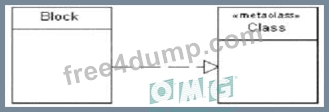
B)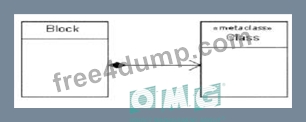
C)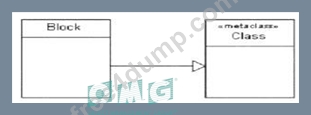
D)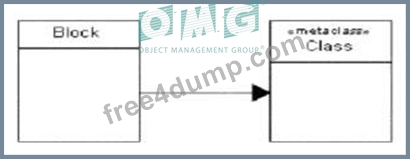
E)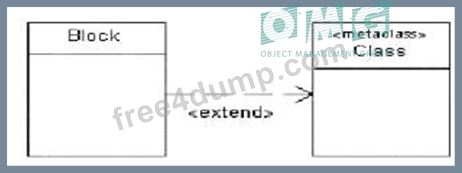
- A. Option C
- B. Option B
- C. Option D
- D. Option A
Answer: B
Explanation:
Explanation
The diagram fragment that correctly shows a SysML Block extending a basic UML Class is Option B.
This option shows a Block with the stereotype <<block>> applied to it. This stereotype indicates that the Block is an extension of the Class metaclass. The Block inherits all the features of the Class, such as attributes, operations, associations, etc., and adds additional features specific to SysML, such as ports, flows, values, constraints, etc. References:
https://www.omg.org/ocsmp/ocsmp-adv-exam.htmhttps://sysml.org/sysml-faq/what-is-block-definition-diagram.
NEW QUESTION # 64
......
Prepare For Realistic OMG-OCSMP-MBA400 Dumps PDF - 100% Passing Guarantee: https://www.free4dump.com/OMG-OCSMP-MBA400-braindumps-torrent.html
Check the Available OMG-OCSMP-MBA400 Exam Dumps with 90 QA's: https://drive.google.com/open?id=1gieM9erzotrTmNiUJUc_F-cGVTYrAIkz