


NBRC New 2022 RPFT Test Tutorial (Updated 112 Questions)
RPFT Exam Questions Dumps, Selling NBRC Products
NEW QUESTION 13
Results of two blood gas samples drawn from the same patient, 30 minutes apart, are shown below:
Which of the following is the most likely explanation for these differences?
- A. The patient has developed a pneumothorax.
- B. The patient's minute ventilation has increased.
- C. The 10:30 blood sample has been contaminated with air.
- D. The 10:30 blood sample contains an excess of heparin solution.
Answer: B
NEW QUESTION 14
Which of the following thresholds for a clinically significant change in lung function from the beginning to the end of a methacholine challenge test is significant?
- A. A decline of more than 20% in FEV1
- B. A decline of more than 30% in FEF25-75%
- C. An increase of more than 20% in airway resistance
- D. A decline of more than 20% in inspiratory capacity
Answer: A
Explanation:
Explanation/Reference:
NEW QUESTION 15
A 45-year-old female with sarcoidosis has pulmonary function tests annually. The following data have been recorded:
A pulmonary function technologist should conclude that
- A. The patient's restrictive component has worsened.
- B. Incorrect predicted values have been used.
- C. The patient has developed mild obstructive airway disease.
- D. The patient has a normal rate of loss for FEV1.
Answer: B
NEW QUESTION 16
A 54-year-old male with a normal ECG at rest develops dyspnea during an exercise (stress) test, and the following ECG pattern is noted at 25 watts:
25 mm/sec A pulmonary function technologist should
- A. Stop the test immediately; there is evidence of ischemia.
- B. Continue the test and obtain an arterial blood sample.
- C. Stop the test immediately; there is evidence of heart block.
- D. Continue the test until the subject reaches target heart rate.
Answer: C
NEW QUESTION 17
When using a variable pressure plethysmograph, a leak in the door seal that develops subsequent to calibration will cause underestimation of
- A. Raw
- B. Alveolar pressure
- C. vital capacity
- D. VTG
Answer: B
NEW QUESTION 18
The following values are obtained using a 3-liter calibration syringe during volume calibration of a dry-rolling spirometer:
2.80 L
2.79 L
2.82 L
The performance of this spirometer is best described as
- A. Neither accurate nor precise.
- B. Precise, but not accurate.
- C. Accurate, but not precise.
- D. Both accurate and precise.
Answer: C
NEW QUESTION 19
While performing a quality control test on an open circuit nitrogen system, the volume of a 3-liter syringe is measured as 3.9 L. Which of the following is the most probable explanation?
- A. The volume was not corrected from ATPS to BTPS.
- B. There was an air leak in the system.
- C. The nitrogen analyzer gain was set too low.
- D. The initial O2 concentration in the syringe was greater than 0.21.
Answer: B
Explanation:
Explanation/Reference:
NEW QUESTION 20
In setting up a CO analyzer, a pulmonary function technologist notices that the analyzer reads -0.03 while sampling air. The technologist should
- A. Reverse the sample flow.
- B. Adjust the reading to 0.00.
- C. Accept the reading because it is within ± 3%.
- D. Adjust the reading to +0.03.
Answer: B
Explanation:
Explanation
NEW QUESTION 21
A polarographic oxygen analyzer used to measure expired gas in a metabolic system should always be calibrated with
- A. Oxygen mixtures containing 4% and 8% carbon dioxide
- B. Air and fully saturated 100% oxygen.
- C. Gas concentrations higher and lower than the expected measurement
- D. 100% oxygen and 100% nitrogen, fully saturated
Answer: C
NEW QUESTION 22
A pulmonary function technologist is performing quality control on a nebulizer used in the 5breath dosimeter bronchial challenge. The target output of the device is 0.09 mL, plus or minus 10%. After 10 actuations, the nebulizer output was 75uL with a 2.0 mL initial saline dose in the nebulizer. The technologist should
- A. Accept the results and begin using the device.
- B. Clean and reevaluate this nebulizer.
- C. Open the vent before starting the bronchial challenge.
- D. Add an exhalation filter and proceed with testing patients.
Answer: A
NEW QUESTION 23
Which of the following tracings represents an airways resistance maneuver performed with a slow breathing frequency?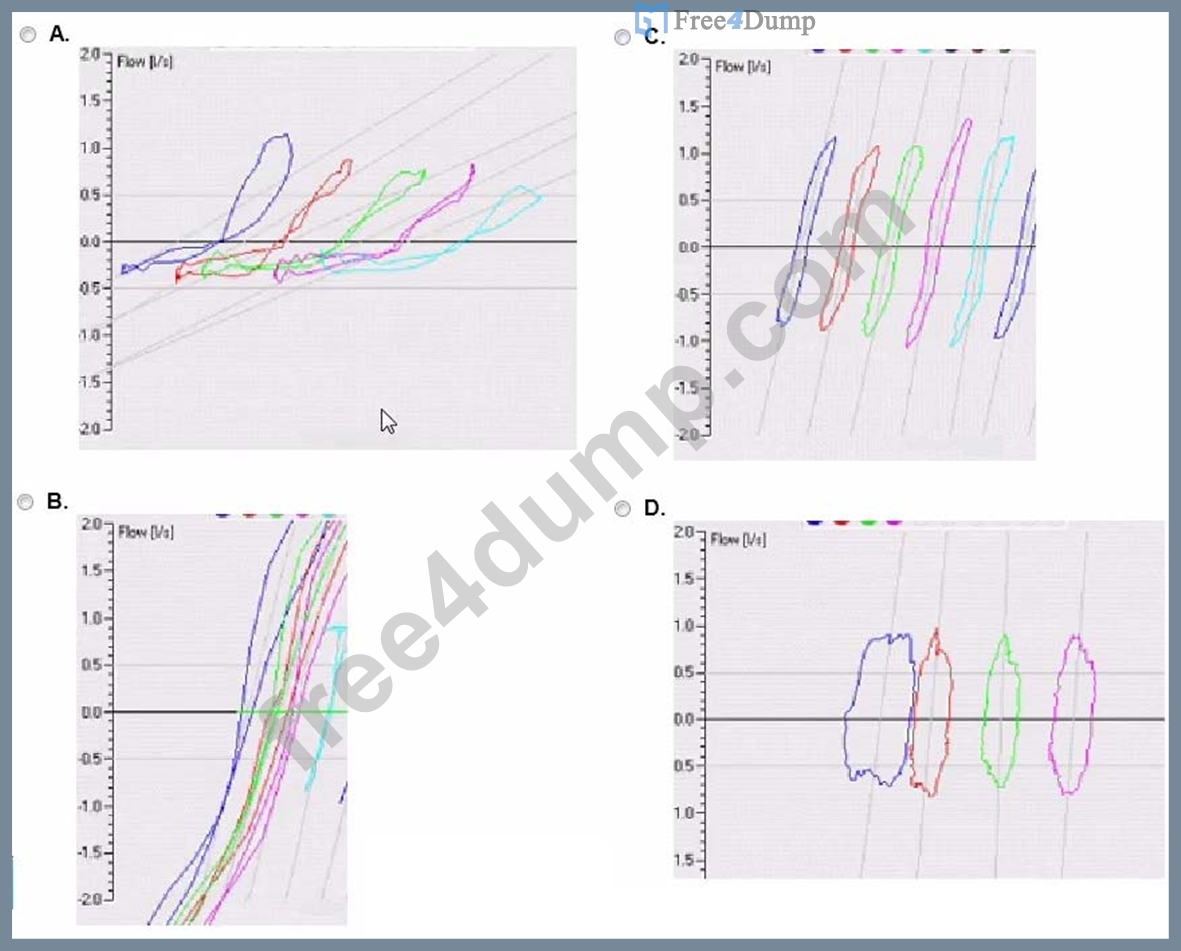
- A. Option D
- B. Option B
- C. Option A
- D. Option C
Answer: A
NEW QUESTION 24
Airways resistance and specific conductance tests are requested for a 7-year-old child with asthma.
Which of the following techniques is preferred?
- A. Oscillation
- B. Interrupter
- C. Panting with body plethysmography
- D. Quiet breathing with body plethysmography
Answer: C
Explanation:
Explanation
NEW QUESTION 25
A pulmonary function technologist is reviewing results of a recent mechanical diffusion simulation using a 3-liter syringe. The test was conducted at a room temperature of 22°
C. The following BTPS results were reported:
Which of the following should the technologist do?
- A. Recalibrate the pneumotachometer.
- B. Recalibrate the gas analyzer.
- C. Change the calibration gases.
- D. Proceed with testing.
Answer: D
NEW QUESTION 26
During the calibration and set-up of the metabolic stress testing system for a patient breathing supplemental oxygen, which of the following gas concentrations will ensure accurate calibration of the system?
- A. Option D
- B. Option B
- C. Option A
- D. Option C
Answer: A
NEW QUESTION 27
Biological control data are obtained for lung volumes by plethysmography. The following results are obtained:
A pulmonary function technologist should repeat the test instructing the individual to
- A. Pant at 90 to 100 Hz
- B. Inhale to TV
- C. Inhale to TLC
- D. Pant at 40 to 50 Hz
Answer: C
NEW QUESTION 28
Using a peak flowmeter, a pulmonary function technologist obtains the following:
The technologist should
- A. Perform at least one more peak flow trial.
- B. Report the average of the two best efforts.
- C. Conclude that bronchodilatation has occurred.
- D. Report the patient's peak flow as 750 L/min.
Answer: A
NEW QUESTION 29
The following results are obtained from an adult patient:
Which of the following is the best interpretation of these values?
- A. Airways obstruction
- B. Small airway disease
- C. Normal values
- D. Combined obstruction/restriction
Answer: B
NEW QUESTION 30
Treadmill speed can be verified by
- A. Multiplying the belt length by the cycles/min.
- B. Multiplying the cycles/min by the height.
- C. Dividing the cycles/min by the belt length.
- D. Dividing the height by the horizontal distance.
Answer: A
NEW QUESTION 31
The following values are reported at maximum effort for a 50-year-old, 70-kg (154-lb) male with significant coronary artery disease during ergometer stress testing. Which of the following is most likely an error?
- A. VE65L/min
- B. HR145/min
- C. workload 200 watts
- D. RER1.2
Answer: C
NEW QUESTION 32
A pulmonary function technologist is performing an exercise (stress) test on a patient with severe COPD. As the test progresses, the patient shows signs of increasing dyspnea. Measurements of inspiratory capacity decreased from 2.0 L to 1.5
L. Which of the following most likely occurred?
- A. drift in the flow transducer
- B. acute decrease in FRC
- C. disconnected gas sampling line
- D. dynamic hyperinflation
Answer: B
NEW QUESTION 33
The following data are obtained for a 60-year-old male undergoing an exercise (stress) test on an ergometer:
A pulmonary function technologist should
- A. Stop the test because this is an abnormal VD/VT response.
- B. Continue the test since this is a normal cardiopulmonary response.
- C. Stop the test because the blood pressure response is abnormal.
- D. Stop the test because the heart rate is too high after 10 minutes.
Answer: C
NEW QUESTION 34
In which of the following patients would an end-tidal CO2most likely produce values that are inconsistent with PaCO2?
- A. 20 year old who smokes cigarettes
- B. 42 year old with moderate COPD
- C. 12 year old with kyphoscoliosis
- D. 50 year old with mild scleroderma
Answer: B
NEW QUESTION 35
A smoking cessation program using a nicotine patch is started for all smokers in a factory. Results revealed that smokers who reported they had quit had exhaled carbon monoxide levels less than 6 ppm. A pulmonary function technologist should conclude that
- A. The program was effective in accomplishing smoking cessation.
- B. The smokers had refrained from smoking for the previous 6 hours.
- C. Adifferent method of smoking cessation should be offered to improve outcomes.
- D. The smokers were not being truthful about smoking cessation.
Answer: A
NEW QUESTION 36
During a linearity check of a flow sensor in a plethysmograph with a 3-liter calibration syringe, a pulmonary function technologist observes the following:
Which of the following should the technologist do?
- A. Perform an additional flow check at 10 L/sec.
- B. Record these results and begin testing.
- C. Recalibrate and repeat the linearity check.
- D. Look for an obstruction in the flow sensor.
Answer: D
NEW QUESTION 37
To check the reliability of a pulse oximeter reading, a pulmonary function technologist should
- A. Perform hemoximetry
- B. Measure the hematocrit
- C. Have the patient hyperventilate
- D. Calculate the SaO2from pH and PaO2
Answer: A
NEW QUESTION 38
......
RPFT Cert Guide PDF 100% Cover Real Exam Questions: https://www.free4dump.com/RPFT-braindumps-torrent.html
Pass RPFT Review Guide, Reliable RPFT Test Engine: https://drive.google.com/open?id=1w0U9hjR2nhvG6l5LrSml2mL9on4ZzUZT