


PAM-DEF Dumps PDF 2024 Program Your Preparation EXAM SUCCESS
Get Perfect Results with Premium PAM-DEF Dumps Updated 240 Questions
CyberArk PAM-DEF exam is an excellent opportunity for information security professionals to validate their skills and expertise in PAM. It is a globally recognized certification that can help professionals demonstrate their commitment to the field of cybersecurity and enhance their career prospects. With the right preparation and training, candidates can pass the exam and become certified CyberArk Defenders - PAM.
NEW QUESTION # 36
Which onboarding method would you use to integrate CyberArk with your accounts provisioning process?
- A. Accounts Discovery
- B. Onboarding RestAPI functions
- C. Auto Detection
- D. PTA Rules
Answer: C
NEW QUESTION # 37
What do you need on the Vault to support LDAP over SSL?
- A. RECPRV.key
- B. CA Certificate(s) used to sign the External Directory certificate Most Voted
- C. self-signed Certificate(s) for the Vault
- D. a private key for the external directory
Answer: B
NEW QUESTION # 38
When running a "Privileged Accounts Inventory" Report through the Reports page in PVWA on a specific safe, which permission/s are required on that safe to show complete account inventory information?
- A. List Accounts, Access Safe without confirmation
- B. Manage Safe Owners
- C. List Accounts, View Safe Members
- D. Manage Safe, View Audit
Answer: C
Explanation:
Explanation
The Privileged Accounts Inventory Report provides information about all the privileged accounts in the system, based on different filters, such as safe, platform, policy, and owner. To run this report through the Reports page in PVWA on a specific safe, the user needs to have the following permissions on that safe:
* List Accounts: This permission allows the user to view the accounts in the safe and their properties, such as name, address, platform, and policy.
* View Safe Members: This permission allows the user to view the members of the safe and their authorizations, such as owners, users, and groups.
These permissions are required to show complete account inventory information for the specific safe. Other permissions, such as Manage Safe Owners, Access Safe without confirmation, Manage Safe, and View Audit, are not relevant for this report. References: Reports and Audits - CyberArk, Safe Member Authorizations
NEW QUESTION # 39
A logon account can be specified in the platform settings.
- A. False
- B. True
Answer: B
Explanation:
Explanation
A logon account can be specified in the platform settings of CyberArk, a security software that manages privileged accounts and credentials. According to the CyberArk documentation1, "In the Account Details window, in the CPM pane, in the accounts section, you can associate either a logon account or a reconciliation account. If a default logon account has been configured for the platform that manages this account, that account is listed. You can associate another logon account or leave the default account as it is."1 A logon account is an account that is used to log on to a target system and perform password management operations on other accounts. A reconciliation account is an account that is used to restore access to a target system when the logon account fails.
NEW QUESTION # 40
What is the purpose of the Interval setting in a CPM policy?
- A. To control how often the CPM looks for User Initiated CPM work.
- B. To control how often the CPM looks for System Initiated CPM work.
- C. To control how long the CPM rests between password changes.
- D. To control the maximum amount of time the CPM will wait for a password change to complete.
Answer: B
Explanation:
Explanation
The Interval setting in a CPM policy is used to control how often the CPM looks for System Initiated CPM work, such as password changes, verifications, and reconciliations. The Interval setting defines the frequency, in minutes, that the CPM will check the accounts that are associated with the policy and perform the required actions. For example, if the Interval is set to 60, the CPM will check the accounts every hour and change, verify, or reconcile the passwords according to the policy settings. The Interval setting does not affect User Initiated CPM work, such as manual password changes or retrievals, which are performed immediately upon request. The Interval setting also does not control how long the CPM rests between password changes or the maximum amount of time the CPM will wait for a password change to complete. These parameters are configured in the CPM.ini file, which is stored in the root folder of the <CPM username> Safe. References:
* [Defender PAM eLearning Course], Module 5: Password Management, Lesson 5.1: CPM Policies, Slide
9: CPM Policy Settings
* [Defender PAM Sample Items Study Guide], Question 4: CPM Policy Settings
* [CyberArk Documentation Portal], CyberArk Privileged Access Security Implementation Guide, Chapter 5: Managing Passwords, Section: CPM Policy Settings, Subsection: Interval
NEW QUESTION # 41
Which user is automatically added to all Safes and cannot be removed?
- A. Operator
- B. Master
- C. Auditor
- D. Administrator
Answer: B
Explanation:
Explanation
The user that is automatically added to all Safes and cannot be removed is the Master user. The Master user is a predefined user that is created during the Vault installation and has full permissions on all Safes and accounts. The Master user is the only user that can perform certain tasks, such as creating other predefined users, managing the Vault configuration, and restoring the Vault from a backup. The Master user cannot be deleted or modified by any other user, and is always a member of every Safe12. References:
* Predefined users and groups - CyberArk, section "Master"
* Safes and Safe members - CyberArk, section "Safe members overview"
NEW QUESTION # 42
Which report shows the accounts that are accessible to each user?
- A. Entitlement report
- B. Activity report
- C. Applications Inventory report
- D. Privileged Accounts Compliance Status report
Answer: A
NEW QUESTION # 43
You are creating a shared safe for the help desk.
What must be considered regarding the naming convention?
- A. Ensure your naming convention is no longer than 20 characters.
- B. The use of these characters V:*<>".| is not allowed.
- C. Combine environments, owners and platforms to minimize the total number of safes created.
- D. Safe owners should determine the safe name to enable them to easily remember it.
Answer: B
NEW QUESTION # 44
Where can PTA be configured to send alerts? (Choose two.)
- A. PAReplicate
- B. Google Analytics
- C. EVD
- D. SIEM
- E. Email
Answer: D,E
Explanation:
Explanation
CyberArk's Privileged Threat Analytics (PTA) can be configured to send alerts to a Security Information and Event Management (SIEM) system and via Email. SIEM systems are used for real-time analysis of security alerts generated by applications and network hardware, while email alerts can be sent to individual or group email addresses for immediate notification1.
References:
* CyberArk Docs: Send PTA Alerts to Email1
NEW QUESTION # 45
In the screenshot displayed, you just configured the usage in CyberArk and want to update its password.
What is the least intrusive way to accomplish this?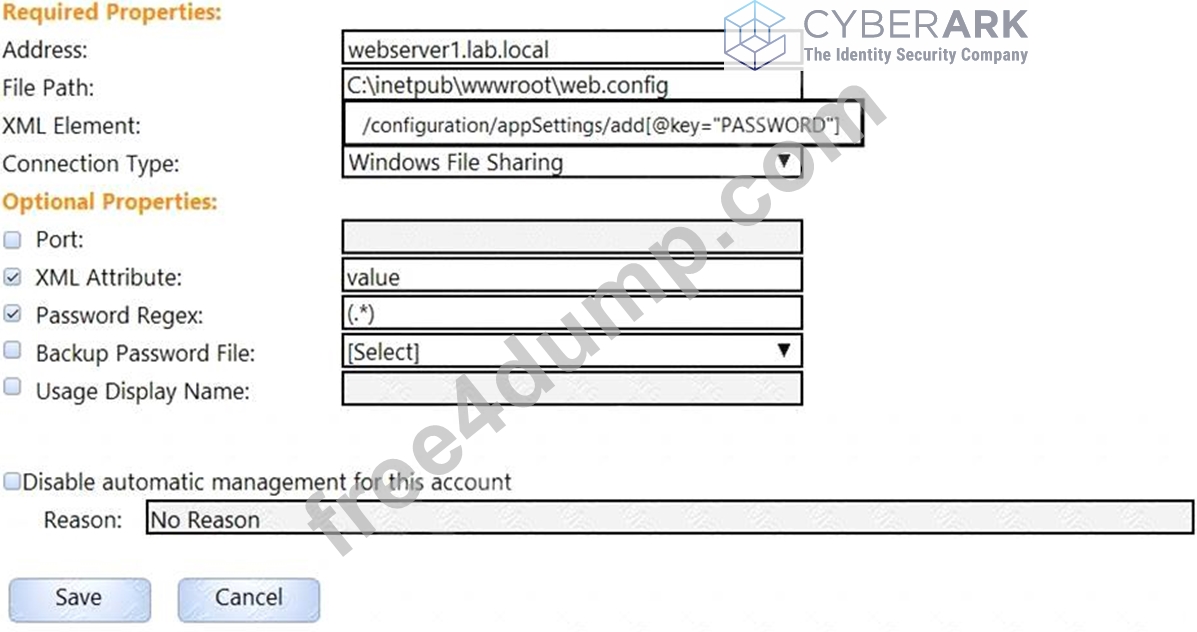
- A. Use the "reconcile" button on the parent account's details page.
- B. Use the "change" button on the parent account's details page.
- C. Use the "change" button on the usage's details page.
- D. Use the "sync" button on the usage's details page.
Answer: D
Explanation:
Explanation
A usage is a configuration that allows CyberArk to manage passwords for files, such as XML or INI files, that are stored on remote machines. A usage is associated with a parent account, which is the account that has access to the file. To update the password of a usage, the least intrusive way is to use the "sync" button on the usage's details page. This will synchronize the password value between the Vault and the file, without changing the actual password. The "change" button will initiate a password change process by the CPM, which will generate a new random password for the usage and the file. The "reconcile" button will initiate a password reconcile process by the CPM, which will use a reconcile account to reset the password of the usage and the file to the value stored in the Vault. References: Usages, Manage passwords for usages
NEW QUESTION # 46
Which item is an option for PSM recording customization?
- A. Custom audio recording for windows events
- B. Windows events text recorder and universal keystrokes recording simultaneously
- C. Universal keystrokes text recorder with windows events text recorder disabled
- D. Windows events text recorder with automatic play-back
Answer: A
NEW QUESTION # 47
You have been asked to turn off the time access restrictions for a safe.
Where is this setting found?
- A. PrivateArk Client
- B. PVWA
- C. RestAPI
- D. Vault
Answer: B
NEW QUESTION # 48
A new colleague created a directory mapping between the Active Directory groups and the Vault.
Where can the newly Configured directory mapping be tested?
- A. Connect to the PrivateArk Client with the Administrator Account to see if there is a user in the Vault Admin Group.
- B. Connect to Sailpoint (or similar tool) to ensure the organizational unit is correctly named; log in to the PVWA with "Administrator" and confirm authentication succeeds.
- C. Search for members that exist only in the mapping group to grant them safe permissions through the PVWA.
- D. Connect to the Active Directory and ensure the organizational unit exists.
Answer: C
Explanation:
Explanation
The newly configured directory mapping can be tested by searching for members that exist only in the mapping group to grant them safe permissions through the PVWA (Privileged Vault Web Access). This process allows you to verify that the directory mapping is functioning correctly by ensuring that only the intended users, who are part of the specific Active Directory group, are granted access to the safes in the CyberArk Vault12.
References:
* CyberArk Docs - Create directory mapping1
* CyberArk Docs - Edit directory mapping3
* CyberArk Docs - LDAP Integration in PVWA
NEW QUESTION # 49
You are creating a Dual Control workflow for a team's safe.
Which safe permissions must you grant to the Approvers group?
- A. List accounts, Unlock accounts
- B. List accounts, Authorize account request
- C. Retrieve accounts, Authorize account request
- D. Retrieve accounts, Access Safe without confirmation
Answer: C
NEW QUESTION # 50
In a default CyberArk installation, which group must a user be a member of to view the "reports" page in PVWA?
- A. PVWAMonitor
- B. PVWAReports
- C. ReportUsers
- D. Operators
Answer: A
Explanation:
Explanation
In a default CyberArk installation, to view the "reports" page in the PVWA (Privileged Web Access), a user must be a member of the PVWAMonitor group1. This group is specified in the ManageReportsGroup parameter in the Reports section of the Web Access Options in the System Configuration page. Being a member of this group grants the user the necessary permissions to generate and view reports within the PVWA.
References:
* CyberArk's official documentation on Reports in PVWA outlines the requirement for users to belong to the PVWAMonitor group to access the reports page and generate reports1.
NEW QUESTION # 51
A user requested access to view a password secured by dual-control and is unsure who to contact to expedite the approval process. The Vault Admin has been asked to look at the account and identify who can approve their request.
What is the correct location to identify users or groups who can approve?
- A. PrivateArk > Admin Tools > Users and Groups > Auditors (Group Membership)
- B. PVWA> Account List > Edit > Show Advanced Settings > Dual Control > Direct Managers
- C. PVWA> Policies > Access Control (Safes) > Safe Members > Workflow > Authorize Password Requests
- D. PVWA> Administration > Platform Configuration > Edit Platform > UI & Workflow > Dual Control> Approvers
Answer: C
NEW QUESTION # 52
A Vault administrator have associated a logon account to one of their Unix root accounts in the vault. When attempting to verify the root account's password the Central Policy Manager (CPM) will:
- A. none of these
- B. log in first with the logon account, then run the SU command to log in as root using the password in the Vault
- C. ignore the logon account and attempt to log in as root
- D. prompt the end user with a dialog box asking for the login account to use
Answer: B
Explanation:
Explanation
According to the web search results, when a Vault administrator has associated a logon account to one of their Unix root accounts in the vault, the CPM will log in first with the logon account, then run the SU command to log in as root using the password in the Vault1. This is a common use case for using a logon account, as the best practice for Unix systems is to disallow the root user from logging in using SSH, which is what the CPM uses to sign in to a system to manage the password2. The logon account can be defined on the target account level or on the platform level, making it available to all accounts associated with the platform2. The CPM can also use the logon account to initiate PSM sessions to the target machine3.
NEW QUESTION # 53
......
The CyberArk PAM-DEF exam is designed to test the candidate's understanding of the CyberArk PAM solution and its various components, including privileged account discovery, credential management, session management, and audit and compliance reporting. PAM-DEF exam also covers key concepts such as least privilege access, password management, and multi-factor authentication.
PAM-DEF PDF Dumps Extremely Quick Way Of Preparation: https://www.free4dump.com/PAM-DEF-braindumps-torrent.html
Free PAM-DEF Exam Study Guide for the NEW Dumps Test Engine: https://drive.google.com/open?id=1s3gHCNtlKfLu_OcT5Zpz5eUrXt0zp-15