


Valid 301 Exam Q&A PDF 301 Dump is Ready (Updated 49 Questions)
Exam Questions and Answers for 301 Study Guide
NEW QUESTION 18
A BIG-IP has the following objects configured: A SNAT pool with 2 members:
150.10.33.33 and 10.10.1.33 A load-balancing pool with 5 members:
10.10.1.1-10.10.1.5:80
The BIG-IP has two self-IP addresses: 150.10.10.10 and 10.10.1.10 A virtual server at 150.10.30.30:80 that is associated with both the SNAT pool and the load-balancing pool. If a client at IP address 200.10.10.10 initiates a connection to the virtual server, what will the source IP address be in the packets sent to the chosen pool member?
- A. 150.10.30.30
- B. 10.10.1.33
- C. 150.10.33.33
- D. 200.10.10.10
- E. It could be any of the addresses of the members of the load-balancing pool.
- F. 10.10.1.10
Answer: B
NEW QUESTION 19
Why would an administrator capture monitor traffic between a BIG-IP and servers?
- A. If a client were having difficulty logging into a load-balanced SSH server, viewing and analyzing the connection process would determine the reason.
- B. Viewing monitor traffic could help the administrator to define a more robust monitor.
- C. Only client traffic may be captured; monitor traffic may not be captured.
- D. If client traffic to servers was failing, viewing and analyzing monitor traffic would determine the reason.
Answer: B
NEW QUESTION 20
Which statement concerning virtual servers is true?
- A. Virtual servers cannot perform load balancing without performing address translation.
- B. Virtual servers can reuse connections between the BIG-IP and server for multiple HTTP GETs.
- C. Virtual servers can keep idle server connections open indefinitely.
- D. Virtual servers can compress data between the BIG-IP and servers.
- E. Virtual server processing always translates the virtual server address to the address of the chosen pool member.
Answer: B
NEW QUESTION 21
An LTM has the 3 virtual servers, a SNAT, four self IP addresses defined and the networks shown in the exhibit. Selected options for each object are shown below. Settings not shown are at their defaults. VirtualServerl Destination: 10.10.2.102:80 netmask 255.255.255.255 Pool: Pool with 3 members in the 172.16/16 network VirtualServer2 Destination: 10.10.2.102:* netmask 255.255.255.255 Pool: Pool with 3 members in the 192.168/16 network VirtualServer3 Destination: 10.10.2.0:80 netmask 255.255.255.0 Type: IP Forwarding SNAT1 Source IP: All Addresses SNATAddress: SNAT Pool with 2 members- 172.16.20.50 and 192.168.10.50 Self IPs 192.168.1.1; 172.16.1.1; 10.10.2.1; 10.10.1.1 A connection attempt is made with a source IP and port of 10.20.100.50:2222 and a destination IP and port of 10.10.2.10:80. When the request is processed, what will be the destination IP address?
- A. Destination IP: pool member in the 172.16/16 network
- B. Destination IP: pool member in the 192.168/16 network.
- C. The request will be dropped.
- D. Destination IP: 10.10.2.10
Answer: D
NEW QUESTION 22
Which action CANNOT be performed by an iRule?
- A. Discard a client before connecting to a server.
- B. Direct a connection request to a specific pool.
- C. Chang the virtual server's default pool.
- D. Limit a given client to a set amount of bandwidth.
- E. Substitute a server's response with alternate data.
- F. Direct a client's request to a pool based on the client's browser's language.
Answer: C
NEW QUESTION 23
Which three parameters could be used to determine whether a connection request will have the source address translated as the request is processed? (Choose three.)
- A. the client's TCP port
- B. the client's IP netmask
- C. the client's browser's preferred language
- D. the client's IP address
- E. the client's router's IP address
- F. the client IP fragment offset
Answer: A,C,D
NEW QUESTION 24
How is traffic flow through transparent virtual servers different from typical virtual servers?
- A. traffic flow through transparent virtual servers must be forwarded through a single routing device.
- B. Traffic flow through transparent virtual severs is not load balabced.
- C. Traffic flow through transparent virtual servers is bridged ( leave IP and MAC.addresses intact) rather than routed (leave IP address intact but change the MAC.addresses).
- D. traffic flow through transparent virtual servers soes not have IP address translation performed.
Answer: D
NEW QUESTION 25
Which persistence method will always recognize a client when the client returns to the same virtual server?
- A. MSRDP
- B. expression [universal]
- C. source address
- D. No persistence method work in all situations.
- E. SSL
Answer: D
NEW QUESTION 26
What occurs when a load?command is issued?What occurs when a ? load?command is issued?
- A. The running configuration is compared to the configuration in files and, when changes are noted, the version in the files is loaded over what is in money.
- B. the running configuration is replaced by the configuration in the files, but only if they are syntactically correct.
- C. The running configuration is loaded into files for storage.
- D. The running configuration is replaced by the any portion of the configuration files that are syntactically correct.
Answer: B
NEW QUESTION 27
A monitor has been defined using the HTTP monitor template. The send and receive strings were customized, but all other settings were left at their defaults. Which resources can the monitor be assigned to?
- A. only specific pool members
- B. most nodes
- C. most virtual severs
- D. most pools
Answer: D
NEW QUESTION 28
Which two statements are true concerning capabilities of current BIG-IP platforms?
(Choose two.)
- A. Only 2U BIG-IP Platform have an option of a second power supply.
- B. All current BIG-IP platform use both an ASIC. And CPU(s)to process traffic.
- C. All current BIG-IP platform can perform hardware compression.
- D. All BIG-IP have capacity to perform bulk encryption I decryption of SSL traffic independent of the CPU.
- E. The 1600 hosts more ports than the 3900.
Answer: B,D
NEW QUESTION 29
When defining a load-balancing pool using the command line, if the load-balancing method is not specified, what is the result
- A. The default load-balancing method would be used.
- B. An error would be displayed since no load-balancing method was specified.
- C. The system would prompt the user for a load-balancing method.
- D. The load-balancing method of the previous pool would be used.
Answer: A
NEW QUESTION 30
Which statement describes advanced shell access correctly?
Which statement describes advanced shell access correctly?
- A. Users with advance shell access are limited to changing, adding, or deleting LTM object in any single partition. Users with? Advance shell accesses are limited to changing, adding, or deleting LTM object on any single partition.
- B. Users with advance shell access have the same right as those with msh access, but the right extend to all partition rather than to Users with advance shell access have the same right as those with msh access, but right extend to all partition rather than to a single partition.
- C. All Users can be given advanced shell access. All users can be given advance shell access.
- D. Users with advanced shell access can always change, add, or delete LTM objects in all partition. Users with? Advanced shell access can always, change, add, or delete LTM objects in all partitions.
Answer: D
NEW QUESTION 31
Given the configuration shown below, if a connection request arrived on the BIG-IP with a source address of 200.10.10.10:1050 and a destination of 150.10.10.75:80, what would the source IP address of the associated packet be when it arrived on the choosen member of the web_pool self
150.10.10.1 { netmask 255.255.255.0 unit I floating enable vlan external allow tcp https } self
10.10.1.1 { netmask 255.255.255.0 unit I floating enable vlan internal allow default } pool web_pool { member 10.10.1.11:80 member 10.10.1.12:80 member
10.10.1.13:80 }snatpool client_pool { member 10.10.1.100 member 150.10.10.15 } virtual VS_web { destination 150.10.10.10:80 ip protocol tcp snat automap pool web_pool }virtual VS_network{ destination 150.10.1 0.0:any mask
255.255.255.0 snatpool client_pool ip protocol tcp pool web_pool } virtual VS_network { destination 150.10.1 0.0:any mask 255.255.255.0 snatpool client_pool ip protocol tcp pool web_pool } virtual VS_network { destination 150.10.10.0:any mask 255.255.255.0 snatpool client_pool ip protocol tcp pool web_pool }
- A. 200.10.10.I0D.200.10.10.10
- B. 10.10.1.I10.10.1.1
- C. 150.10.10.15C.150.10.10.15
- D. 10.10.1.I00B.10.10.1.100
Answer: D
NEW QUESTION 32
When a pool is created and saved to file, where is the default file and location for the pool configuration? When a pool is created and saved to file, where is the default file and location for the pool configuration?
- A. /etc/bigip_base.conf
- B. /config/BigDB.dat
- C. /config/bigip_base.conf
- D. lconfig/bigip.conf
Answer: D
NEW QUESTION 33
A site wishes to use an external monitor. Other than what is coded in the monitor script, what information must be configured on the BIG-IP for the monitor to be functional? (Choose two.)
- A. BIG-IP services that are running on the system to be tested.
- B. BIG-IP must know the name of the program.
- C. BIG-IP the IP addresses of the devices that will be tested. Must know which
- D. BIG-IP must know which function the program is going to test. Must know
- E. BIG-IP node or member the result are to be applied to. Must know all
Answer: B,E
NEW QUESTION 34
The partial configuration below includes an iRule, a virtual server, and pools. When traffic from the client at 160.10.10.10:2056 connects to the virtual server Test_VS and sends an HTTP request, what will the client's source address be translated to as the traffic is sent to the chosen pool member? pool Test_Pool { member
10.10.10.10:80 member 10.10.10.11:80 } snatpool lower_range { member
10.10.10.1 } snatpool upper_range { member 10.10.10.2 } rule Test_iRule { when CLIENT_ACCEPTED. { if { [TCP::local_port]
< 2024 }{ snatpool lower_range } else { snatpool upper_range } virtual Test_VS { destination 200.10.10.1 :http pool Test_Pool rule Test_i Rule }
- A. 160.10.10.IOC.160.10.10.10
- B. 10.10.10.1
- C. 10.10.10.2
- D. 200.10.10.1200.10.10.1
- E. It could be either 10.10.10.10 or 10.10.10.11.E.It could be either 10.10.10.10 or 10.10.10.11.
Answer: B
NEW QUESTION 35
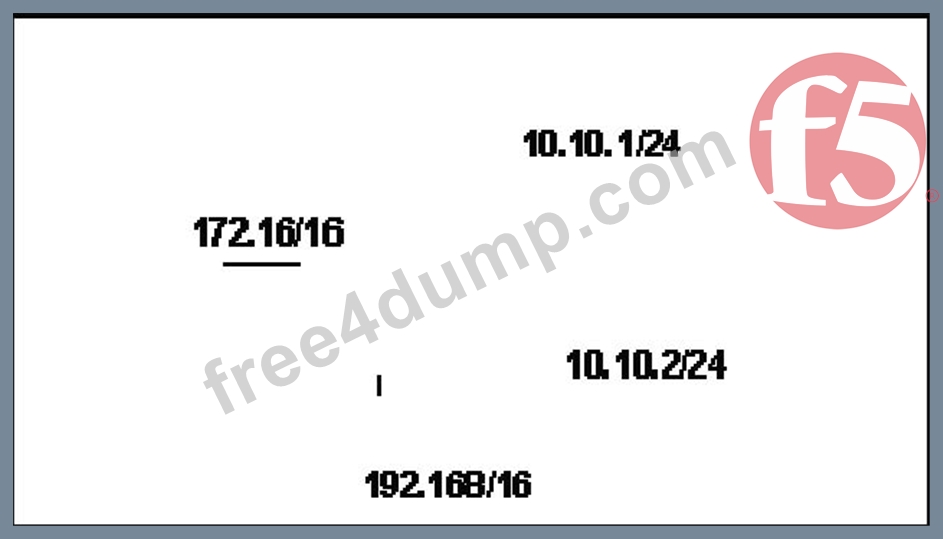
An LTM has the 3 virtual servers, 2 SNATs, four self IP addresses defined, and the networks shown in the exhibit. Selected options for each object are shown below. Settings not shown are at their defaults.
Assume port exhaustion has not been reached. Vi rtualServerl Destination: 10.10.2.102:80 netmask 255.255.255.255 Pool: Pool with 3 members in the 172.16/16 network SNAT Automap configured Vi rtualServer2 Destination: 10.10.2.102:* netmask 255.255.255.255 Pool: Pool with 3 members in the 192.168/16 network Vi rtualServer3 Destination: 10.10.2.0:80 netmask 255.255.255.0 Type: IP Forwarding SNAT1 Source IP: 10.10.0.0 netmask 255.255.0.0 SNAT Address: SNAT Pool with 2 members
172.16.20.50 and 192.168.10.50 SNAT2 Source IP: All Addresses SNATAddress:
10.10.2.102 Floating Self IPs 192.168.1.1; 172.16.1.1; 10.10.2.1; 10.10.1.1
- A. Source IP: 10.10.2.1; Destination IP: 10.10.2.10
- B. Source IP: Either 172.16.20.50 or 192.168.10.50; Destination IP: 10.10.2.10
- C. connection attempt is made with a source IP and port of 10.10.100.50:2222 and a destination IP and port of 10.10.2.10:80. When the request is processed, what will be the source and destination IP addresses?
- D. Source IP: 10.10.2.1; Destination IP: pool in the 172.16/16 network C
- E. The request will be droped.
- F. Source IP: 10.10.2.102; Destination IP 10.10.2.10
Answer: B
NEW QUESTION 36
Which statement describes advanced shell access correctly?
Which statement describes advanced shell access correctly?
- A. The context determines which events are available for iRule processing.
- B. The context has no impact on events.
- C. The context determines the values of commands that vary between client and server.
- D. The context determines which pools are available for load balancing.
Answer: C
NEW QUESTION 37
......
Topics in 301a - LTM Technology Specialist
The accompanying will be examined in F5 301 practice exam and F5 301 practice tests:
- F5 Architecture
Certification dumps - F5 Networks Certification Study Materials 301 guides - 100% valid: https://www.free4dump.com/301-braindumps-torrent.html