


Changing the Concept of IdentityIQ-Engineer Exam Preparation 2025
Getting IdentityIQ-Engineer Certification Made Easy! Get professional help from our IdentityIQ-Engineer Dumps PDF
SailPoint IdentityIQ-Engineer Exam Syllabus Topics:
| Topic | Details |
|---|---|
| Topic 1 |
|
| Topic 2 |
|
| Topic 3 |
|
| Topic 4 |
|
NEW QUESTION # 18
Is this a correct procedure for testing generated emails in a non-production system?
Solution: Change the Email Notification Type to POP3 under Global Settings > Configure IdentitylQ Settings > Mail Settings, run the test scenario. and verity if the emails were successfully delivered to mailboxes specified on Identity objects.
- A. No
- B. Yes
Answer: A
Explanation:
Changing the Email Notification Type to POP3 under Global Settings > Configure IdentityIQ Settings > Mail Settings is not a correct procedure for testing generated emails in a non-production system. POP3 is an email retrieval protocol, not a method for sending or redirecting email notifications from IdentityIQ. IdentityIQ requires an SMTP server to send emails, and POP3 is typically used by email clients to retrieve emails from a server, not by a server to send emails.
For testing purposes in a non-production environment, you would typically configure the SMTP server settings to either redirect emails to a specific testing mailbox or use a "Redirect to File" option, if available, to capture emails locally.
Thus, the correct answer is B. No.
NEW QUESTION # 19
Can this be achieved using Rapid Setup user interface configuration options?
Solution: Disable an account and remove all its entitlements on a particular application during Leaver events.
- A. Yes
- B. No
Answer: A
Explanation:
The Rapid Setup user interface configuration options in IdentityIQ can be used to disable an account and remove all its entitlements on a particular application during Leaver events. Rapid Setup is designed to simplify the configuration of common identity lifecycle processes, including handling leaver (termination) events. When configuring these events, you can specify actions such as disabling accounts and removing entitlements from specific applications as part of the termination process.
Reference:
SailPoint IdentityIQ Rapid Setup Guide
SailPoint IdentityIQ Lifecycle Manager Guide (Sections on Lifecycle Event Configuration)
NEW QUESTION # 20
is the following a valid role option that can be configured?
Solution: Configure a role to include a set of IdentitylQ capabilities.
- A. Yes
- B. No
Answer: A
Explanation:
The statement is true. In SailPoint IdentityIQ, it is possible to configure a role to include a set of IdentityIQ capabilities. Capabilities in IdentityIQ are permissions that grant users access to specific functionalities within the platform, such as managing identities, viewing reports, or administering roles. By associating a role with specific capabilities, you can control what actions users assigned to that role can perform within the IdentityIQ environment.
Reference:
SailPoint IdentityIQ Administration Guide (Role Configuration and Capabilities Section) SailPoint IdentityIQ Configuration Guide (Sections on Roles and Capabilities)
NEW QUESTION # 21
Is the following statement about IdentitylQ rule inputs and outputs correct?
Solution: The lypical input variables for a rule are listed in the BeanShell rule editor in IdentitylQ, based on the rule registry.
- A. Yes
- B. No
Answer: A
Explanation:
Yes, the typical input variables for a rule are listed in the BeanShell rule editor in IdentityIQ, based on the rule registry. When you create or edit a rule in IdentityIQ using the BeanShell editor, the available input variables that are relevant to the rule type are typically pre-defined and listed based on the rule registry. These input variables provide context and data that the rule can operate on, and their availability helps guide the rule development process.
Therefore, the correct answer is A. Yes.
Reference:
This information is confirmed by the SailPoint IdentityIQ Developer Guide, which discusses how the rule editor provides input variables based on the rule type and registry, ensuring that developers have the necessary context for writing rules.
NEW QUESTION # 22
Is this statement correct about writing and executing source mapping rules to populate identity attributes?
Solution: All Identity Mappings must use a rule to set the identity attribute.
- A. No
- B. Yes
Answer: A
Explanation:
The statement "All Identity Mappings must use a rule to set the identity attribute" is incorrect. While source mapping rules can be used to populate identity attributes dynamically, it is not mandatory for all identity mappings to rely on a rule. Identity mappings can also be configured using direct mappings, where attributes from a source are directly mapped to IdentityIQ attributes without any rule-based logic.
Therefore, the correct answer is B. No.
NEW QUESTION # 23
Is the following statement about workflow step types and their usage true?
Solution: The step actions available when editing a step in the Business Process Editor are: Script. Rule, Subprocess and Call Method.
- A. Yes
- B. No
Answer: A
Explanation:
Yes, the statement is true. When editing a step in the Business Process Editor in SailPoint IdentityIQ, the available step actions are Script, Rule, Subprocess, and Call Method. These actions allow for various types of logic and processing to be embedded within workflows. Each of these actions serves different purposes:
Script: Executes a Beanshell script.
Rule: Calls an existing IdentityIQ rule.
Subprocess: Invokes another workflow as a subprocess.
Call Method: Invokes a method on a specified object.
Reference:
SailPoint IdentityIQ Business Process Editor Guide
SailPoint IdentityIQ Administration Guide (Section on Workflow Management)
NEW QUESTION # 24
An engineer needs to trigger a workflow when a Division attribute changes from /7"to Senior IT, but only when the user is a manager.
Is this a valid process that the engineer could use to launch a workflow for a lifecycle event?
Solution: Create a trigger with an event type of rule and return True when the user's previous value of the division attribute is /7"andthe new value of the division attribute is Senior IT.
- A. No
- B. Yes
Answer: A
Explanation:
The scenario describes triggering a workflow when a "Division" attribute changes from a specific value to "Senior IT," but only when the user is a manager. The proposed solution suggests creating a trigger with an event type of "rule" that checks the previous and new values of the "Division" attribute.
However, this approach has a couple of issues:
Trigger Configuration: In SailPoint IdentityIQ, a lifecycle event trigger typically operates on changes in identity attributes, but it's not standard to define this trigger using a rule that directly inspects the previous and new values. Instead, the lifecycle event would usually be configured in the context of the application or identity to directly listen to specific changes without needing to define the logic in a custom rule.
Condition Validation: The condition of checking if the user is a manager should ideally be integrated within the workflow itself or the lifecycle event configuration, not just as part of a rule in the trigger.
While a rule can be used to define complex conditions, the correct way to implement this in IdentityIQ would involve setting up the lifecycle event trigger specifically for the attribute change and managing any additional conditions (like checking if the user is a manager) within the workflow or using an appropriate script/rule in that context.
Therefore, while partially correct in approach, the described solution is not the best practice or a valid process in IdentityIQ, so the correct answer is B. No.
Reference:
This answer is based on the SailPoint IdentityIQ Lifecycle Manager Guide, which provides best practices for configuring lifecycle events and triggers, as well as proper use of rules and workflow triggers in these scenarios.
NEW QUESTION # 25
Is the following statement true?
Solution: Every Link object must be associated to an Identity object
- A. Yes
- B. No
Answer: A
Explanation:
In SailPoint IdentityIQ, every Link object, which represents an account on an application for an identity, must be associated with an Identity object. The Link object is inherently tied to an identity, as it is a representation of that identity's account on a target system. Without this association, the Link would not have context within IdentityIQ. This is a fundamental aspect of IdentityIQ's data model. Refer to the SailPoint IdentityIQ Data Model documentation for detailed information on the relationships between Link objects and Identity objects.
NEW QUESTION # 26
Can this action be performed as part of configuring an application definition in IdentitylQ?
Solution: Define account correlation via a rule.
- A. Yes
- B. No
Answer: A
Explanation:
Yes, defining account correlation via a rule is an action that can be performed as part of configuring an application definition in SailPoint IdentityIQ. Account correlation rules are often used to determine how accounts from different sources are linked to identities within IdentityIQ. These rules allow for complex logic to be applied when matching accounts to identities, beyond simple attribute matching.
Reference:
SailPoint IdentityIQ Administration Guide (Section on Account Correlation) SailPoint IdentityIQ Application Configuration Guide (Using Rules for Account Correlation)
NEW QUESTION # 27
A client needs a custom quicklink, which only managers can launch, in order to launch a simple workflow. Is this a valid step to take during the development of this custom quicklink?
Solution: Enter the name of the workflow to launch in the quicklink object.
- A. Yes
- B. No
Answer: A
Explanation:
Yes, this is a valid step. When developing a custom quicklink in SailPoint IdentityIQ, it is important to specify the workflow that the quicklink should launch. This is done by entering the name of the workflow in the quicklink object configuration. This allows the quicklink to trigger the desired workflow when selected by a user, such as a manager, who has access to that quicklink.
Reference:
SailPoint IdentityIQ Quicklink Development Guide
SailPoint IdentityIQ Administration Guide (Custom Quicklinks and Workflow Integration)
NEW QUESTION # 28
Is this statement correct about writing and executing source mapping rules to populate identity attributes?
Solution: Once the value for the identity attribute has been calculated, the rule must persist the identity attribute to the database.
- A. No
- B. Yes
Answer: A
Explanation:
The statement is incorrect. When writing and executing source mapping rules to populate identity attributes, the rule itself does not need to persist the identity attribute to the database. In SailPoint IdentityIQ, once the value for an identity attribute has been calculated by a source mapping rule, IdentityIQ automatically handles the persistence of this attribute to the database as part of the aggregation or provisioning process. The developer does not need to explicitly persist the attribute; this is managed by the system.
Reference:
SailPoint IdentityIQ Source Mapping Guide
SailPoint IdentityIQ Administration Guide (Aggregation and Attribute Mapping Sections)
NEW QUESTION # 29
Can the following action be performed using Rapid Setup application onboarding?
Solution: Specify the account attribute and value filter that identifies a secondary account.
- A. No
- B. Yes
Answer: A
Explanation:
Rapid Setup application onboarding is designed to simplify the initial configuration and does not typically provide advanced configuration options like specifying an account attribute and value filter to identify secondary accounts. Such detailed configurations often require custom scripting or detailed adjustments within the standard application setup, outside of the Rapid Setup interface.
Reference:
SailPoint IdentityIQ Rapid Setup Guide
SailPoint IdentityIQ Administration Guide (Sections on Application Onboarding and Advanced Account Mapping)
NEW QUESTION # 30
An engineer needs to first create a custom audit event and then set up an associated report. What are four steps to accomplish this goal?
Solution:
- A. No
- B. Yes
Answer: A
Explanation:
The solution provided is incomplete. To create a custom audit event and set up an associated report, the process involves several steps, including defining the custom audit event in the Audit Configuration object, updating or creating relevant audit triggers in the system, and defining the custom report using XML or the IdentityIQ report editor. The steps mentioned in the solution do not cover the necessary configuration and implementation details required for this task. For a complete process, consult the SailPoint IdentityIQ Reporting Guide and the Audit Framework documentation.
NEW QUESTION # 31
Is this a valid statement about connector rules?
Solution: A Post-Iterate Rule, if configured, is run after reading accounts from a SQL Loader application.
- A. Yes
- B. No
Answer: A
Explanation:
A Post-Iterate Rule in SailPoint IdentityIQ is a type of connector rule that is executed after each account from the source system (e.g., SQL Loader application) has been read during the aggregation process. This rule allows for additional processing or customization of the data after the account has been iterated over. According to SailPoint IdentityIQ documentation, configuring a Post-Iterate Rule enables the execution of logic after each account's data has been processed, confirming that the given statement is valid. Refer to the SailPoint IdentityIQ Connector Development Guide for detailed information on rule execution during aggregation.
NEW QUESTION # 32
Is this statement true about identitylQ's syslog event storage?
Solution: IdentitylQ logging and auditing both require extra function calls within the application and will generate data that can be compressed to avoid any storage and Improve overall performance.
- A. No
- B. Yes
Answer: A
Explanation:
The statement is false. While it is true that logging and auditing require extra function calls and generate data, the suggestion that this data can be compressed to avoid storage issues and improve performance is misleading. In practice, while compression might save storage space, it does not inherently improve performance, particularly because the overhead of compression and decompression could negate the performance benefits. Effective performance management in IdentityIQ involves more nuanced approaches, such as optimizing the level of detail in logs, managing log rotation, and tuning the system for efficient I/O operations.
Reference:
SailPoint IdentityIQ Logging and Auditing Guide
SailPoint IdentityIQ Performance Tuning Guide
NEW QUESTION # 33
Is this a correct procedure for testing generated emails in a non-production system?
Solution: Change the Email Notification Type to POP3 under Global Settings > Configure IdentitylQ Settings > Mail Settings, run the test scenario. and verity if the emails were successfully delivered to mailboxes specified on Identity objects.
- A. No
- B. Yes
Answer: A
NEW QUESTION # 34
A client wants users who belong to an IdentitylQ workgroup named Management to be able to request entitlements and roles, but only for other users whose location attribute is the same as theirs.
Is this a population that will achieve the goal?
Solution: Create a quicklink population, set the membership match list to the IdentitylQ workgroup "Management," and set "Who can members request for?" as report to the requester.
- A. No
- B. Yes
Answer: A
Explanation:
The provided solution does not fulfill the client's requirement. Setting "Who can members request for?" to "report to the requester" only limits the request scope to users who directly report to the requester, which does not account for the location attribute. The goal is to restrict requests based on the location attribute, and this specific configuration does not consider that attribute. To achieve the desired behavior, the configuration should include logic that filters users based on the same location as the requester.
Reference:
SailPoint IdentityIQ Quicklink Population Configuration Guide
SailPoint IdentityIQ Advanced Population Management Guide
NEW QUESTION # 35
An engineer is developing an instance of IdentitylQ using the Services Standard Build (SSB) for a client. Is this a valid action the engineer can perform when setting up or using the SSB?
Solution: Place the patch jar file in the build's base/patch folder that matches the patch version the client is using
- A. Yes
- B. No
Answer: A
Explanation:
Yes, this is a valid action. When using the Services Standard Build (SSB) in SailPoint IdentityIQ, placing the patch jar file in the build's base/patch folder is a correct procedure, provided the patch version matches what the client is using. This allows the build process to incorporate the patch into the deployment, ensuring that the correct versions and fixes are applied to the IdentityIQ instance.
Reference:
SailPoint IdentityIQ Services Standard Build Guide
SailPoint IdentityIQ Patching and Version Management Guide
NEW QUESTION # 36
A client wants users who belong to an IdentitylQ workgroup named Management to be able to request entitlements and roles, but only for other users whose location attribute is the same as theirs.
Is this a population that will achieve the goal?
Solution: Create a quicklink population, set the membership match list to "All," and set "Who can members request for?'' as share attributes with the requester, with the attribute set to location.'
- A. Yes
- B. No
Answer: A
Explanation:
This solution correctly addresses the client's requirement. By setting the membership match list to "All" and configuring "Who can members request for?" as "share attributes with the requester," with the attribute set to location, the system ensures that users in the "Management" workgroup can only request roles and entitlements for other users who share the same location. This setup effectively filters based on the location attribute, aligning with the client's needs.
Reference:
SailPoint IdentityIQ Quicklink Population Configuration Guide
SailPoint IdentityIQ Attribute-Based Access Control Guide
NEW QUESTION # 37
Can the rule library named Common Rules Library" be included in a Rule by adding this code?
Solution:
- A. Yes
- B. No
Answer: A
Explanation:
Yes, the code provided in the second image is correct for including a rule library named "Common Rules Library" in a Rule. The correct syntax is to use class="sailpoint.object.RuleLibrary" and specify the name of the rule library. This allows the Rule to reference the functions and logic defined in the "Common Rules Library." Correct Syntax (from the second image):
<ReferenceRules>
<Reference class="sailpoint.object.RuleLibrary" name="Common Rules Library"/>
</ReferenceRules>
Reference:
SailPoint IdentityIQ Rule Library Documentation
SailPoint IdentityIQ Configuration Guide (Rule and Rule Library Management)
NEW QUESTION # 38
An implementation engineer needs to perform an initial installation of identitylQ.
Drag the options from the left into the answer area on the right, and place them in the correct order.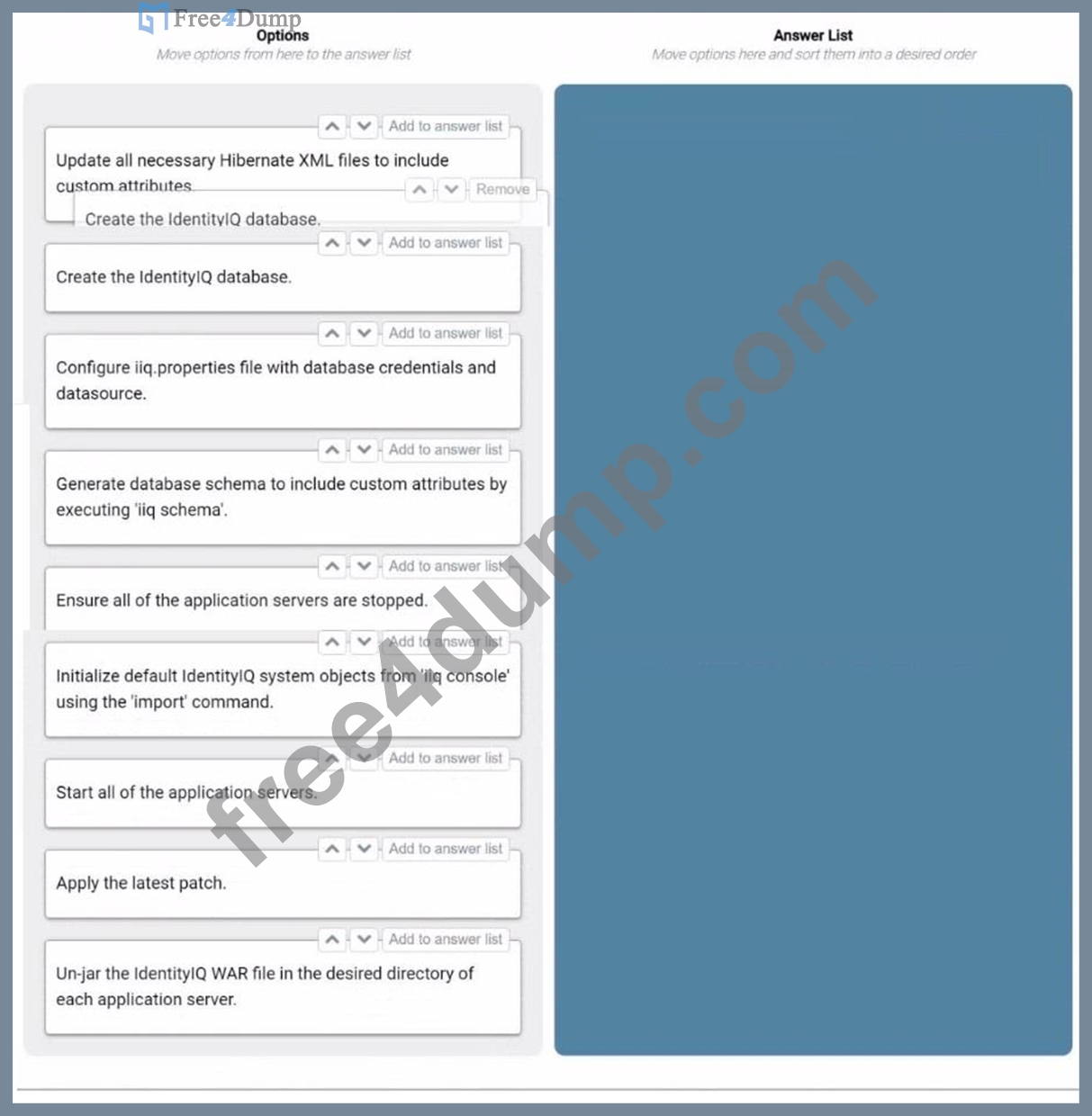
Answer:
Explanation:
NEW QUESTION # 39
Is this statement true about identitylQ's syslog event storage?
Solution: Both logging and auditing can have a negative influence on performance. Logging and auditing both require extra function calls within The application and will generate data that will need to be stored.
- A. Yes
- B. No
Answer: A
Explanation:
Yes, the statement is true. Both logging and auditing in SailPoint IdentityIQ can have a negative influence on performance because they involve additional function calls within the application. These processes generate data that needs to be stored, which can impact performance if not managed properly. Extensive logging and auditing, particularly at high levels of detail, can lead to increased I/O and storage usage, potentially slowing down system operations.
Reference:
SailPoint IdentityIQ Performance Tuning Guide
SailPoint IdentityIQ Logging and Auditing Guide (Impact on Performance)
NEW QUESTION # 40
Is this a valid step to take when importing SailPoint XML file objects into IdentitylQ?
Solution: Move the XML file into the IIQ_HOME/WEB-INF/database.
- A. No
- B. Yes
Answer: A
Explanation:
The statement suggests moving the XML file into IIQ_HOME/WEB-INF/database as part of the process to import SailPoint XML file objects into IdentityIQ. However, this is not a valid step for importing XML objects.
The correct procedure to import SailPoint XML objects typically involves the following steps:
Use the iiq console command-line tool provided by SailPoint to import the XML file.
The command typically looks like: iiq console import <filename>.xml.
The XML file does not need to be moved to any specific directory like WEB-INF/database for the import process.
Moving the XML file into the WEB-INF/database directory does not align with the documented process and does not facilitate the import. The correct answer is B. No.
Reference:
This answer is based on the official SailPoint IdentityIQ documentation regarding object import procedures, which clearly states that imports should be performed using the IdentityIQ console or through the user interface (for smaller imports).
NEW QUESTION # 41
Is this statement correct about writing and executing source mapping rules to populate identity attributes?
Solution: The rule type must be IdentityAttribute.
- A. Yes
- B. No
Answer: A
Explanation:
The statement "The rule type must be IdentityAttribute" is correct. In SailPoint IdentityIQ, when writing a rule that is intended to map or manipulate identity attributes during the aggregation process, the rule type should be set to "IdentityAttribute". This ensures that the rule is recognized and executed in the appropriate context for managing identity attributes.
Therefore, the correct answer is A. Yes.
NEW QUESTION # 42
......
IdentityIQ-Engineer Exam Crack Test Engine Dumps Training With 124 Questions: https://www.free4dump.com/IdentityIQ-Engineer-braindumps-torrent.html
Obtain the IdentityIQ-Engineer PDF Dumps Get 100% Outcomes Exam Questions For You To Pass: https://drive.google.com/open?id=1mEssv9KnWrbiiMyOcmXMm7eYoVe8yHE3