


Guide (New 2025) Actual SailPoint IdentityIQ-Engineer Exam Questions
IdentityIQ-Engineer Exam Dumps Pass with Updated 2025 Certified Exam Questions
NEW QUESTION # 43
Can the following IdentitylQ object be extended to store client-specific data by updating the corresponding .HBM file?
Solution: WorkItem
- A. No
- B. Yes
Answer: A
Explanation:
In SailPoint IdentityIQ, certain objects are designed to be extended by updating their corresponding Hibernate Mapping (.HBM) files. However, the WorkItem object is not one of these extendable objects. The WorkItem is a system object that primarily represents tasks or actions that need to be processed within the workflow. It is not intended to store client-specific data through direct modification of its .HBM file. Instead, client-specific data should be handled using other mechanisms, such as custom attributes or the extension of Identity or Account objects. Attempting to modify the WorkItem object's HBM file could lead to unexpected behavior and is not supported by SailPoint's best practices.
Reference:
SailPoint IdentityIQ Customization Guide
SailPoint IdentityIQ Object Model Documentation
NEW QUESTION # 44
Is this statement correct about writing and executing source mapping rules to populate identity attributes?
Solution: The Identity object is passed to the rule.
- A. Yes
- B. No
Answer: A
Explanation:
The statement "The Identity object is passed to the rule" is correct. When writing source mapping rules to populate identity attributes, the Identity object is indeed passed to the rule. This allows the rule to access and modify attributes on the Identity object based on the logic defined within the rule.
Therefore, the correct answer is A. Yes.
NEW QUESTION # 45
Is the following statement about workflow step types and their usage true?
Solution: When a wait step is encountered in a foreground workflow, the user will notice this, because the screen will freeze for the specified number of seconds.
- A. No
- B. Yes
Answer: A
Explanation:
No, this statement is incorrect. When a wait step is encountered in a foreground workflow, it does not cause the user's screen to freeze for the specified number of seconds. Instead, the wait step simply pauses the workflow execution for the specified duration, but this is managed in the background. The user interface remains responsive, and the end-user typically won't notice any freezing or delays caused by the wait step itself.
Reference:
SailPoint IdentityIQ Workflow Guide (Section on Workflow Step Types)
SailPoint IdentityIQ Scripting and Workflow Best Practices
NEW QUESTION # 46
Is this statement valid regarding the control and usability of the Debug pages in IdentitylQ?
Solution: The Debug-Logging page does not have to be reloaded when the log4j file is altered while the application server is running.
- A. No
- B. Yes
Answer: A
Explanation:
The statement that the Debug-Logging page does not have to be reloaded when the log4j file is altered while the application server is running is incorrect. In SailPoint IdentityIQ, if you modify the log4j configuration file while the application is running, you generally need to reload the Debug-Logging page to reflect those changes. Without reloading, the page will not display the updated logging configurations, and the changes will not take effect until the application server or the logging system within the server acknowledges those changes.
Therefore, the correct answer is B. No.
Reference:
This information is based on the SailPoint IdentityIQ Debugging Guide, which explains the procedures for making and reflecting changes to logging configurations, particularly using the Debug-Logging page.
NEW QUESTION # 47
Can the Provisioning tab under "Administrator Console' be used to do the following task?
Solution: Map the associated WorkflowCase to a particular Provisioning Transaction.
- A. No
- B. Yes
Answer: A
Explanation:
No, the Provisioning tab under the "Administrator Console" is not used to map the associated WorkflowCase to a particular Provisioning Transaction. The Provisioning tab is primarily for monitoring and managing provisioning operations, not for mapping workflow cases to transactions. Such mappings are typically handled within the workflow configuration itself, not through the Provisioning tab.
Reference:
SailPoint IdentityIQ Workflow Guide (Handling Workflow and Provisioning Transactions) SailPoint IdentityIQ Administration Guide (Provisioning Tab Limitations)
NEW QUESTION # 48
Is this what should be performed in order to generate the database script to extend Application attributes in the IdentitylQ database on the initial installation?
Solution: Run a build with the updated schema placed inside it.
- A. No
- B. Yes
Answer: A
Explanation:
Running a build with the updated schema placed inside it is not the correct procedure to generate the database script to extend Application attributes in the IdentityIQ database during the initial installation. To extend the schema, you typically need to define the changes in a specific XML schema file and then generate the corresponding database scripts using IdentityIQ tools designed for schema extension. A build process does not inherently generate the required database scripts for extending attributes.
Reference:
SailPoint IdentityIQ Schema Configuration Guide
SailPoint IdentityIQ Installation and Setup Guide
NEW QUESTION # 49
Can the search type in Syslog be used to accomplish this result?
Solution: Launching a certification using the search results
- A. Yes
- B. No
Answer: A
Explanation:
Syslog cannot be used to launch a certification using the search results. Launching a certification in IdentityIQ is a process that involves interacting with the application's certification module, where you define parameters, select users or roles, and initiate the certification campaign. This process requires using the IdentityIQ user interface or APIs, not the Syslog, which is purely for logging purposes.
Reference:
SailPoint IdentityIQ Certification Guide
SailPoint IdentityIQ API and UI Guide
NEW QUESTION # 50
Is this configuration option required when an engineer sets up a SCIM 2.0 application?
Solution: Name
- A. Yes
- B. No
Answer: A
Explanation:
The "Name" configuration option is required when setting up a SCIM 2.0 application in SailPoint IdentityIQ. The "Name" field is a mandatory identifier for the application within IdentityIQ. This name is used throughout the system to reference the application and is critical for configuration, management, and integration processes. Without specifying a name, IdentityIQ cannot properly identify and interact with the SCIM 2.0 application.
Reference:
SailPoint IdentityIQ SCIM 2.0 Application Configuration Guide
SailPoint IdentityIQ Administration Guide (Application Setup and Naming Conventions)
NEW QUESTION # 51
Is this an example of a mover lifecycle event?
Solution: A contractor whose contract expired and accounts were disabled has a new contract with the company; the contractor needs all of their previous accounts enabled.
- A. Yes
- B. No
Answer: A
Explanation:
Yes, this is an example of a mover lifecycle event. A mover lifecycle event typically occurs when an individual's role or employment status within the organization changes, requiring updates to their accounts and access rights. In this scenario, a contractor whose accounts were previously disabled due to contract expiration needs those accounts re-enabled upon securing a new contract. This reactivation and adjustment of access rights based on a change in employment status fits the definition of a mover event.
Therefore, the correct answer is A. Yes.
NEW QUESTION # 52
Is the following true of Identity Provisioning Policies?
Solution: The Create Identity Provisioning Policy will be applied to identity creation during aggregation from an authoritative source so that identities will be created with valid/authorized attribute values.
- A. Yes
- B. No
Answer: A
Explanation:
The Create Identity Provisioning Policy in SailPoint IdentityIQ is designed to apply specific provisioning rules and actions during the creation of identities, especially when aggregating data from authoritative sources. These policies ensure that newly created identities have valid and authorized attribute values based on organizational rules and compliance requirements.
During identity aggregation from an authoritative source, the provisioning policy can enforce rules such as role assignments, attribute validation, and other actions necessary to ensure that the identity is created correctly and securely.
Therefore, the correct answer is A. Yes.
NEW QUESTION # 53
Which four steps are necessary for turning on Certifications logging at the severity log level of trace? Drag four options from the left into the answer area on the right, and place them in the correct order.
Answer:
Explanation: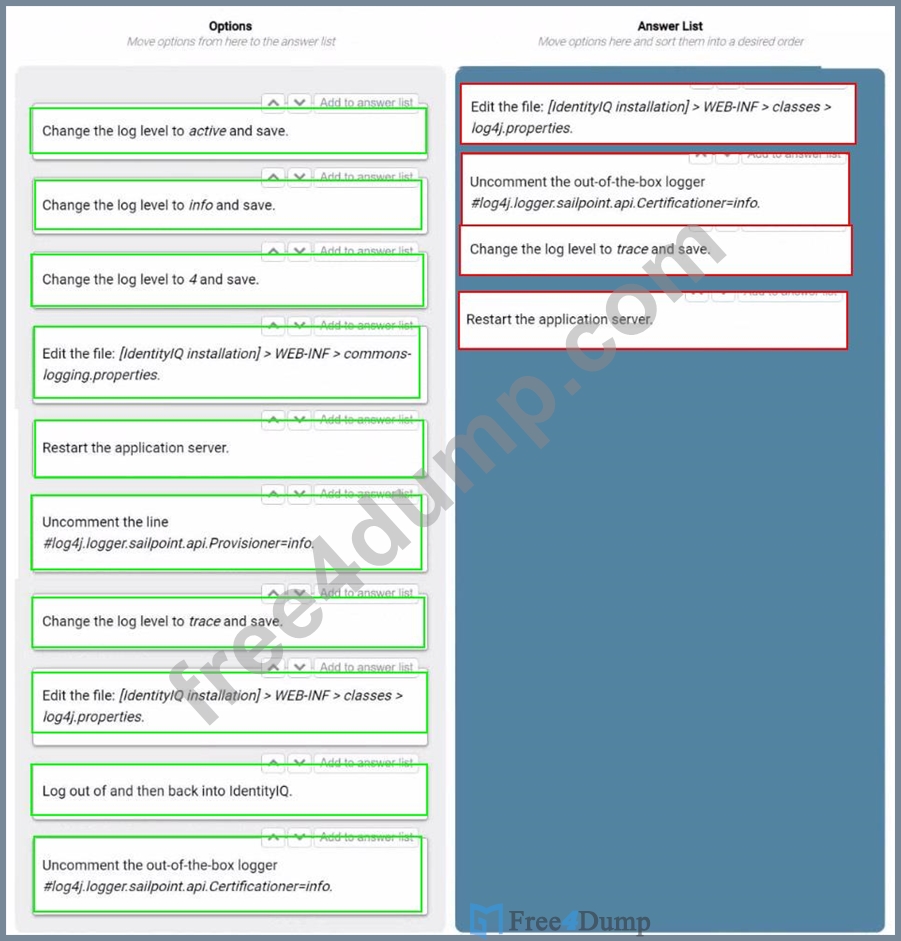
NEW QUESTION # 54
Can this be achieved using Rapid Setup user interface configuration options?
Solution: Disable an account on a particular application for one set of users and delete the account for another set of users during administrative Terminations.
- A. No
- B. Yes
Answer: A
Explanation:
The Rapid Setup user interface in SailPoint IdentityIQ is designed to simplify and streamline common configuration tasks, particularly during the initial setup of IdentityIQ environments. However, it has certain limitations in terms of granularity and customization.
In this case, the requirement is to disable an account on a particular application for one set of users and delete the account for another set of users during administrative terminations. The Rapid Setup interface does not provide options to differentiate between user groups for different actions (disable vs. delete) within the same termination event.
This level of specificity-applying different actions based on user group membership-would require a more advanced setup, possibly involving custom rules or workflows rather than using the Rapid Setup options. Therefore, the correct answer is B. No.
Reference:
This answer is based on the SailPoint IdentityIQ Rapid Setup Guide, which describes the capabilities and limitations of the Rapid Setup interface. The guide indicates that more complex scenarios require customization beyond what Rapid Setup can offer.
NEW QUESTION # 55
A client needs a custom quicklink, which only managers can launch, in order to launch a simple workflow. Is this a valid step to take during the development of this custom quicklink?
Solution: Set the quicklink options to Tor Others" in order to launch the workflow immediately when the quicklink is clicked.
- A. No
- B. Yes
Answer: A
Explanation:
The statement is incorrect. The "For Others" option in the quicklink configuration is used to allow users to perform actions on behalf of other identities (e.g., a manager performing an action for a subordinate). However, setting the quicklink to "For Others" does not make it launch a workflow immediately. To have a quicklink launch a workflow immediately when clicked, you would typically need to configure the quicklink to call the workflow directly, without requiring additional user input. "For Others" is more about the context of the action rather than triggering workflows automatically.
Reference:
SailPoint IdentityIQ Quicklink Development Guide
SailPoint IdentityIQ Administration Guide (Quicklink and Workflow Configuration)
NEW QUESTION # 56
A bank is two years into an ongoing project to provide all access through roles. The bank is actively using roles and actively adding to their role model. They need to ensure that all roles include the correct entitlements.
Will this certification type achieve the goal?
Solution: Account Group Membership Certification
- A. No
- B. Yes
Answer: A
Explanation:
An Account Group Membership Certification is designed to certify group memberships within accounts, typically focusing on the validation of access within specific account groups (e.g., Active Directory groups).
This type of certification does not directly address the accuracy of role composition or the correctness of entitlements assigned within roles. Since the bank's goal is to ensure that all roles include the correct entitlements, an Account Group Membership Certification is not suitable for this purpose.
Thus, the correct answer is B. No.
NEW QUESTION # 57
Can this action be performed as part of configuring an application definition in IdentitylQ?
Solution: Specify which users should be provisioned with a basic account as part of a joiner event.
- A. Yes
- B. No
Answer: A
Explanation:
Yes, this action can be performed as part of configuring an application definition in IdentityIQ. When defining an application, you can specify provisioning policies, including which users should be provisioned with a basic account as part of a joiner event. This is typically done by setting up account creation rules or provisioning policies that trigger when a new user (joiner) is detected, ensuring they receive the necessary basic accounts and entitlements.
Therefore, the correct answer is A. Yes.
NEW QUESTION # 58
An implementation engineer needs to perform an upgrade of IdentitylQ between releases. Is the following statement true?
Solution: Every version release (excluding patch releases) between the current version of IdentitylQ and the target version of IdentitylQ must be installed in sequential order for an upgrade.
- A. No
- B. Yes
Answer: A
Explanation:
When upgrading SailPoint IdentityIQ between releases, it is not necessary to install every version in sequential order between the current version and the target version. SailPoint provides upgrade paths that often allow skipping several major versions by directly upgrading to the desired target version from a supported previous version. However, it is crucial to follow the specific upgrade paths and procedures documented by SailPoint, which may involve intermediate steps or specific considerations depending on the versions involved.
Therefore, the correct answer is B. No.
Reference:
This answer is supported by SailPoint IdentityIQ Upgrade Guides, which detail the approved upgrade paths and instructions for moving between specific versions, indicating that sequential upgrades through every version are not always required.
NEW QUESTION # 59
An engineer is developing an instance of IdentitylQ using the Services Standard Build (SSB) for a client. Is this a valid action the engineer can perform when setting up or using the SSB?
Solution: Place the patch jar file in the build's base/patch folder that matches the patch version the client is using
- A. Yes
- B. No
Answer: A
Explanation:
Yes, this is a valid action. When using the Services Standard Build (SSB) in SailPoint IdentityIQ, placing the patch jar file in the build's base/patch folder is a correct procedure, provided the patch version matches what the client is using. This allows the build process to incorporate the patch into the deployment, ensuring that the correct versions and fixes are applied to the IdentityIQ instance.
Reference:
SailPoint IdentityIQ Services Standard Build Guide
SailPoint IdentityIQ Patching and Version Management Guide
NEW QUESTION # 60
Is the following statement true?
Solution: Every Link object must be associated to an Identity object
- A. Yes
- B. No
Answer: A
Explanation:
In SailPoint IdentityIQ, every Link object, which represents an account on an application for an identity, must be associated with an Identity object. The Link object is inherently tied to an identity, as it is a representation of that identity's account on a target system. Without this association, the Link would not have context within IdentityIQ. This is a fundamental aspect of IdentityIQ's data model. Refer to the SailPoint IdentityIQ Data Model documentation for detailed information on the relationships between Link objects and Identity objects.
NEW QUESTION # 61
Is this what should be performed in order to generate the database script to extend Application attributes in the IdentitylQ database on the initial installation?
Solution: Run the command iiq extendedSchema in the IIQ_Home/WEB-INF/bin directory.
- A. Yes
- B. No
Answer: A
Explanation:
Running the command iiq extendedSchema in the IIQ_Home/WEB-INF/bin directory is correct and one of the standard procedures for generating database scripts to extend Application attributes in the IdentityIQ database. This command processes the schema definitions (including any new attributes) and generates the appropriate SQL scripts to update the database schema. These scripts can then be executed against the database to apply the changes.
Reference:
SailPoint IdentityIQ Administration Guide (Schema Extension and Database Management Sections) SailPoint IdentityIQ Configuration Guide (Extended Schema Management)
NEW QUESTION # 62
Can the following IdentitylQ object be extended to store client-specific data by updating the corresponding .HBM file?
Solution: Link
- A. No
- B. Yes
Answer: A
Explanation:
In SailPoint IdentityIQ, certain objects, such as the Link object, cannot be directly extended by updating the corresponding .HBM (Hibernate Mapping) file. Modifying or extending core IdentityIQ objects typically requires a deeper level of customization involving the extension of the application schema and possibly custom Java code. The .HBM files are part of IdentityIQ's internal persistence framework, and altering them is not a supported or recommended method for extending objects in a production environment. Customization should instead be done using SailPoint's supported extension points, such as using ManagedAttributes or CustomAttributes within the IdentityIQ application framework. For guidelines on extending IdentityIQ objects, refer to the SailPoint IdentityIQ Customization Guide and best practices documentation.
Top of Form
Bottom of Form
NEW QUESTION # 63
IdentitylQ is using emails to notify users about completion of steps within a process, or actions that need to be addressed.
To ensure this notification is working, a main configuration must be set up in IdentitylQ to provide mail server and mail server authentication details.
Is this a required setting that an engineer must set up in IdentitylQ in order to ensure successful communication with the SMTP server?
Solution: Email Protocol
- A. No
- B. Yes
Answer: A
Explanation:
No, the "Email Protocol" is not a setting that an engineer must set up to ensure successful communication with the SMTP server. Instead, the essential settings include the mail server address, port, authentication details (like username and password if required), and possibly the security settings (such as SSL/TLS). While the email protocol (e.g., SMTP) is implicitly involved, it is not a specific setting that needs to be configured separately within IdentityIQ. The critical setup revolves around configuring the mail server connection parameters.
Reference:
SailPoint IdentityIQ Configuration Guide (Email and Notification Settings) SailPoint IdentityIQ Administration Guide (SMTP Configuration for Email Notifications)
NEW QUESTION # 64
A client wants users who belong to an IdentitylQ workgroup named Management to be able to request entitlements and roles, but only for other users whose location attribute is the same as theirs.
Is this a population that will achieve the goal?
Solution: Create a quicklink population, set the membership match list to the IdentitylQ workgroup "Management," and set "Who can members request for?" as report to the requester.
- A. No
- B. Yes
Answer: A
Explanation:
The provided solution does not fulfill the client's requirement. Setting "Who can members request for?" to "report to the requester" only limits the request scope to users who directly report to the requester, which does not account for the location attribute. The goal is to restrict requests based on the location attribute, and this specific configuration does not consider that attribute. To achieve the desired behavior, the configuration should include logic that filters users based on the same location as the requester.
Reference:
SailPoint IdentityIQ Quicklink Population Configuration Guide
SailPoint IdentityIQ Advanced Population Management Guide
NEW QUESTION # 65
For a user who wants to be able to enable an account for a subordinate or themselves through Manage Accounts, does this configuration need to be performed in Lifecycle Manager (LCM)?
Select the Rehire action under Manage Accounts Options in the LCM Configuration.
Solution: Select the Rehire action under Manage Accounts Options in the LCM Configuration.
- A. No
- B. Yes
Answer: A
Explanation:
In SailPoint IdentityIQ, the specific configuration that allows a user to enable an account for themselves or a subordinate through the "Manage Accounts" option does not necessarily need to be configured in Lifecycle Manager (LCM) alone. While LCM does provide extensive capabilities for account management actions like provisioning, rehire, and more, enabling an account is primarily tied to the permissions and entitlements granted to the user through their role, capabilities, and access profiles.
To address the specific functionality described:
Manage Accounts is typically a part of IdentityIQ's broader account management capabilities, which are not exclusively tied to LCM. The ability to enable or disable accounts can be governed by rules and workflows within IdentityIQ, and these may or may not be linked directly to LCM configurations.
Rehire Action in LCM: The "Rehire" action within LCM Configuration is specific to processes related to reactivating an employee's identity when they are rehired. This does not directly relate to enabling an account from the "Manage Accounts" screen. Rehire workflows typically involve reinstating the user's previous access, which could include enabling accounts, but this is a broader process.
Permissions and Roles: The ability to enable accounts is often governed by the permissions assigned to a user's role within IdentityIQ. These permissions may be granted outside of LCM configurations and handled by IdentityIQ's access governance framework.
Workflow Configurations: Enabling or disabling an account could also be tied to specific workflows, which can be configured separately from LCM, using IdentityIQ's workflow engine. These workflows determine the steps and approvals required to perform such actions.
Reference:
SailPoint IdentityIQ Configuration Guide: Account Management
SailPoint IdentityIQ Lifecycle Manager Configuration Guide
SailPoint IdentityIQ Administration Guide (Sections on Roles and Permissions, Workflow Configurations)
NEW QUESTION # 66
Is this a default role type that is available in identitylQ?
Solution: Entitlement Role
- A. No
- B. Yes
Answer: A
Explanation:
In SailPoint IdentityIQ, the concept of a "role" is fundamental to the identity governance framework. The platform supports several default role types that are pre-configured to help organizations manage access effectively. The default role types include:
Business Role: Represents a collection of entitlements necessary for a specific job function within the organization.
IT Role: Aggregates technical entitlements that are typically assigned together, often linked to specific applications or systems.
Application Role: Tied to a specific application, representing roles within that application's context.
Composite Role: A combination of other roles, either business or IT, to form a higher-level role.
The term "Entitlement Role" is not recognized as a default role type in SailPoint IdentityIQ. While entitlements can be components of roles, "Entitlement Role" itself is not a predefined role type in the platform. Therefore, the correct answer is B. No.
Reference:
This answer is based on the SailPoint IdentityIQ Role Management Guide, which details the standard role types and their usage within the platform. The guide explicitly lists the supported default role types, and "Entitlement Role" is not among them.
NEW QUESTION # 67
......
Pass Guaranteed Quiz 2025 Realistic Verified Free SailPoint: https://www.free4dump.com/IdentityIQ-Engineer-braindumps-torrent.html
IdentityIQ-Engineer Exam Questions - Real & Updated Questions PDF: https://drive.google.com/open?id=1mEssv9KnWrbiiMyOcmXMm7eYoVe8yHE3